Talking Science Podcast
Artificial Intelligence – How Machines Learn
A computer that can recognise a friend’s face in a photo, translate a menu in a foreign country, or hold a surprisingly natural conversation would have seemed like magic not long ago. Today these abilities are ordinary, tucked into phones and websites we use every day. The engine behind them is artificial intelligence, and the most powerful version of it works in a way that is genuinely different from traditional computing. Rather than being told exactly what to do, these systems learn.
Two Ways to Teach a Computer
For most of computing history, we programmed machines by writing explicit rules. If you wanted a program to sort emails, you might tell it to flag any message containing certain words. This approach works well for tasks we can fully describe, but it falls apart for messier problems. How would you write down rules to recognise a cat in a photograph? Cats come in countless colours, poses, and lightings. Spelling out every possibility is hopeless.
Machine learning takes a completely different approach. Instead of handing the computer rules, we hand it examples and let it work out the rules for itself. Show a system thousands of pictures labelled cat and thousands labelled not a cat, and it gradually learns the patterns that distinguish them. This shift, from writing instructions to providing examples, is the heart of the modern AI revolution.
Learning From Examples
The most common form of this is called supervised learning, and the name gives a clue to how it works. The system is trained on data where the correct answers are already known, a bit like a student working through practice problems with an answer key. Each time the system makes a guess, it can check how far off it was and adjust.
Crucially, the machine is not memorising the specific examples. The goal is for it to generalise, to extract patterns that also apply to new cases it has never seen. A well-trained image system should recognise a cat it was never shown during training. That ability to handle the unfamiliar is what makes the learning genuinely useful.
This is also where things can go wrong. If a system leans too hard on its training examples, it can end up memorising quirks rather than learning the real pattern, a problem researchers call overfitting. Such a system performs beautifully on the data it studied and poorly on anything new, a bit like a student who memorised the answers to last year’s exam without understanding the subject. Guarding against this, by testing the system on fresh examples it has never seen, is a central part of building AI that actually works in the real world.
Inside a Neural Network
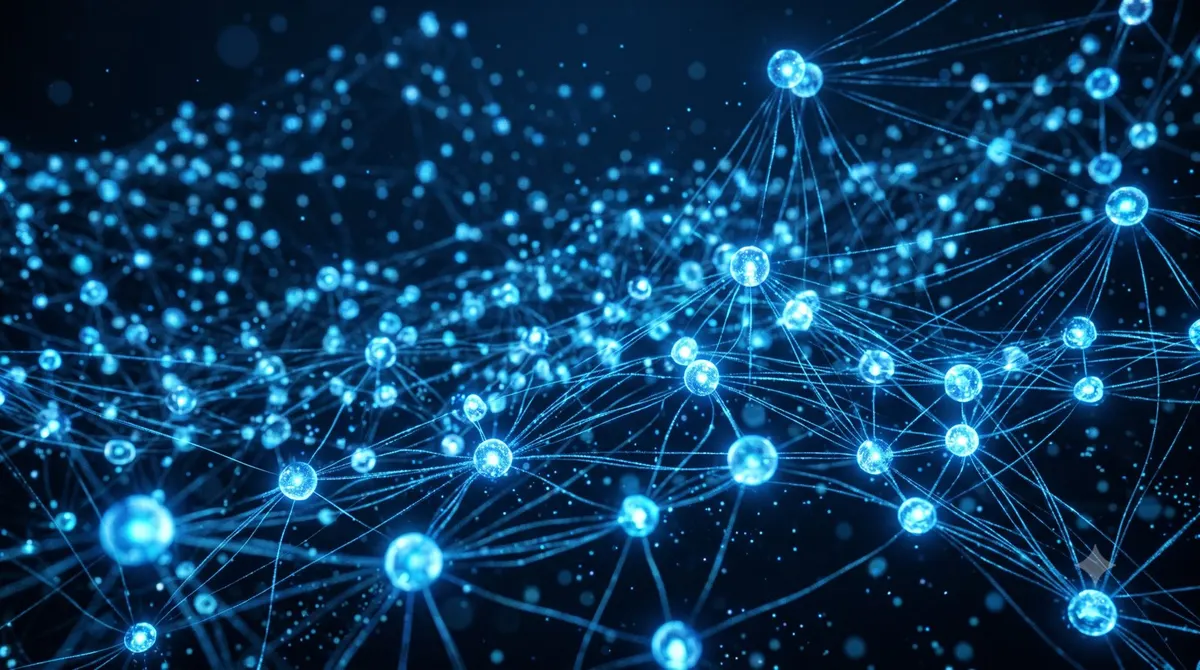
Many of today’s most impressive systems are built on structures loosely inspired by the brain, called artificial neural networks. It is important not to take the brain comparison too literally; these networks are far simpler than real biology. But the basic idea is that they are made of many small units, sometimes called neurons, arranged in connected layers.
Information enters at one end, flows through the layers, and produces an answer at the other. Each connection between units has a number attached to it, called a weight, which controls how much influence one unit has on the next. A large network can have billions of these weights. Together they act like billions of tiny dials, and the exact setting of every dial determines how the network behaves.
Learning as Adjustment
So how does a network actually learn? At the start, all those dials are set randomly, so the system’s answers are useless. Training is the process of tuning them. The network is shown an example and makes a prediction. That prediction is compared to the correct answer, and the size of the mistake is measured.
The system then works backwards through the network, nudging each weight slightly in the direction that would have made the answer a little better. On its own, a single nudge changes almost nothing. But repeat this millions or billions of times, across enormous amounts of data, and the countless small adjustments add up. Slowly the dials settle into a configuration that produces good answers. There is no moment of understanding; there is only relentless, gradual improvement driven by feedback.
Why Now?
The core ideas behind neural networks are decades old, so why has AI advanced so dramatically in recent years? Three ingredients came together. First, we accumulated vast amounts of digital data, the raw material these systems learn from. Second, computer hardware, especially the kind of chips originally built for video game graphics, became powerful enough to perform the immense number of calculations training requires. Third, researchers developed better designs and techniques for building and training larger networks.
The result has been a leap in what these systems can do, particularly in understanding language. Modern language systems are trained on staggering quantities of text, learning the statistical patterns of how words follow one another. From that, they become able to answer questions, summarise documents, and write in a fluent, human-like way, which is why AI has suddenly become part of everyday conversation.
Powerful, But Not Magic
For all their impressive output, it is worth being clear-eyed about what these systems are and are not. They do not understand the world the way a person does. They are, at their core, extraordinarily sophisticated pattern-matchers, predicting what is most likely based on what they were trained on. This is why they can sometimes produce answers that sound confident but are simply wrong, a tendency worth keeping in mind whenever you rely on them.
They also inherit the flaws of their training data. If the examples a system learns from contain human biases or errors, the system can absorb and even amplify them. This makes questions of fairness, accuracy, and responsible use just as important as raw technical capability.
Artificial intelligence is not the thinking machine of science fiction, at least not yet. It is something subtler and, in its own way, more remarkable: a method for letting computers discover patterns too complex for us to describe by hand. By learning from mountains of examples and adjusting billions of internal settings, machines have gained abilities their programmers could never have written out line by line. Understanding that this is learning, not magic, is the first step to using these powerful tools wisely.