Talking Science Podcast
Semiconductors – The Brains of Modern Technology
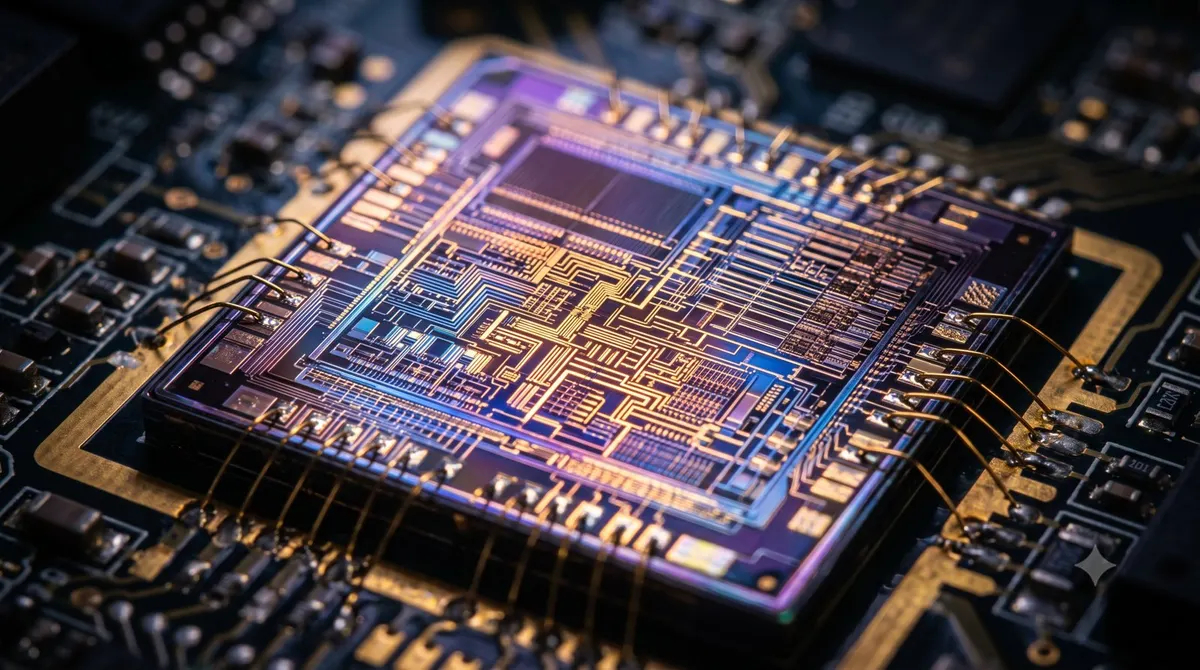
Somewhere inside the device you are reading this on sits a sliver of silicon smaller than a fingernail, and etched onto it are billions of switches too small to see. This tiny chip can perform astonishing feats of calculation, and it is made possible by a class of materials with an odd and wonderful property. They are called semiconductors, and understanding them is the key to understanding nearly all of modern technology.
The Material in the Middle
To appreciate semiconductors, it helps to think about how materials handle electricity. Some, like copper and other metals, are conductors: electric current flows through them easily. Others, like rubber or glass, are insulators: they block current almost completely. For a long time these seemed to be the only two options.
Semiconductors sit squarely between the two. On their own they conduct electricity only weakly, better than an insulator but far worse than a metal. That might sound like the worst of both worlds, but this in-between behaviour turns out to be extraordinarily useful. The reason is that we can control it. By carefully tweaking a semiconductor, we can decide when it conducts and when it does not, effectively turning it into a switch.
The Magic of Doping
The most common semiconductor is silicon, one of the most abundant elements on Earth, found in ordinary sand. Pure silicon is not much use by itself. Its power is unlocked through a process called doping, which means deliberately adding tiny amounts of other elements to change its electrical behaviour.
Depending on what is added, engineers can create silicon with a slight surplus of electrons, which carry negative charge, or silicon with a shortage of electrons, leaving behind positively charged gaps that behave almost like particles in their own right. These two types are called n-type and p-type silicon. Neither is remarkable alone, but bring them together and something special happens.
The Transistor: A Switch With No Moving Parts
When you join n-type and p-type material, you create a junction with a very handy quality: it lets current flow easily in one direction but resists it in the other. Build on this idea, and you can make a transistor, arguably the most important invention of the twentieth century.
A transistor is a switch controlled by electricity rather than by a finger or a lever. A small voltage applied to one part of the device decides whether current can flow through another part. In other words, one electrical signal can turn another on or off. Because there are no moving parts, transistors can switch billions of times per second and can be made almost unimaginably small.
That ability to switch is everything. Deep down, a computer is just an enormous collection of switches turning on and off, representing information as patterns of ones and zeros. Combine transistors cleverly and you can build circuits that add numbers, store data, and follow instructions, which is to say you can build a computer.
Before the transistor, this switching job was done by bulky glass vacuum tubes that ran hot, burned out often, and drew a great deal of power. Early computers filled entire rooms with thousands of them. The transistor replaced all that with a solid, reliable component that could be shrunk almost without limit. This is why the invention of the transistor is often described as the moment the modern electronic age truly began.
From One Switch to Billions
A single transistor is impressive, but its real power emerges in vast numbers. The breakthrough that launched the digital age was the integrated circuit, or microchip, which packs many transistors, along with the connections between them, onto a single small piece of silicon.
Manufacturers make these chips through an intricate process that resembles printing at an incredibly fine scale. Patterns are projected onto silicon wafers using light, and layer by layer the circuitry is etched and built up. The features have become so small that they are now measured in billionths of a metre, allowing billions of transistors to fit on a chip the size of a postage stamp.
For decades, the number of transistors that could be squeezed onto a chip roughly doubled every couple of years, an observation famously noted by an industry pioneer. This relentless miniaturisation is why the computer that once filled a room now fits in your pocket and runs far faster.
Not Just Computers
It is easy to associate semiconductors only with computers and phones, but their reach is far wider. The same family of materials powers many devices you might not immediately connect them to:
- The light-emitting diodes, or LEDs, that light our homes and screens.
- The image sensors inside every digital camera.
- The solar panels that turn sunlight into electricity.
In each case, the ability of semiconductors to convert between electricity and light, or to control current with precision, is doing the heavy lifting. They are the quiet enablers behind an enormous share of the technology around us.
A Fragile Global Web
Because chips are so central to modern life, making them has become one of the most important and complex industries on the planet. The factories that produce advanced chips cost enormous sums to build and rely on some of the most precise machines ever created. Only a handful of companies in the world can manufacture the very smallest, most advanced designs.
This concentration has made semiconductors a matter of global strategy. When chip supplies were disrupted a few years ago, factories making everything from cars to appliances were forced to slow down, a vivid reminder of how much our world now depends on these tiny components. Nations increasingly view the ability to design and build chips as a cornerstone of both economic strength and security.
The next time you unlock your phone or ask a computer a question, spare a thought for the semiconductor at its heart. From a material that could not decide whether to conduct electricity, we have built the entire digital world. It is a striking example of how a deep understanding of nature, patiently pursued, can turn an unremarkable property of sand into the brains behind almost everything we do.