Talking Science Podcast
Where the Elements Come From – Cosmic Nucleosynthesis
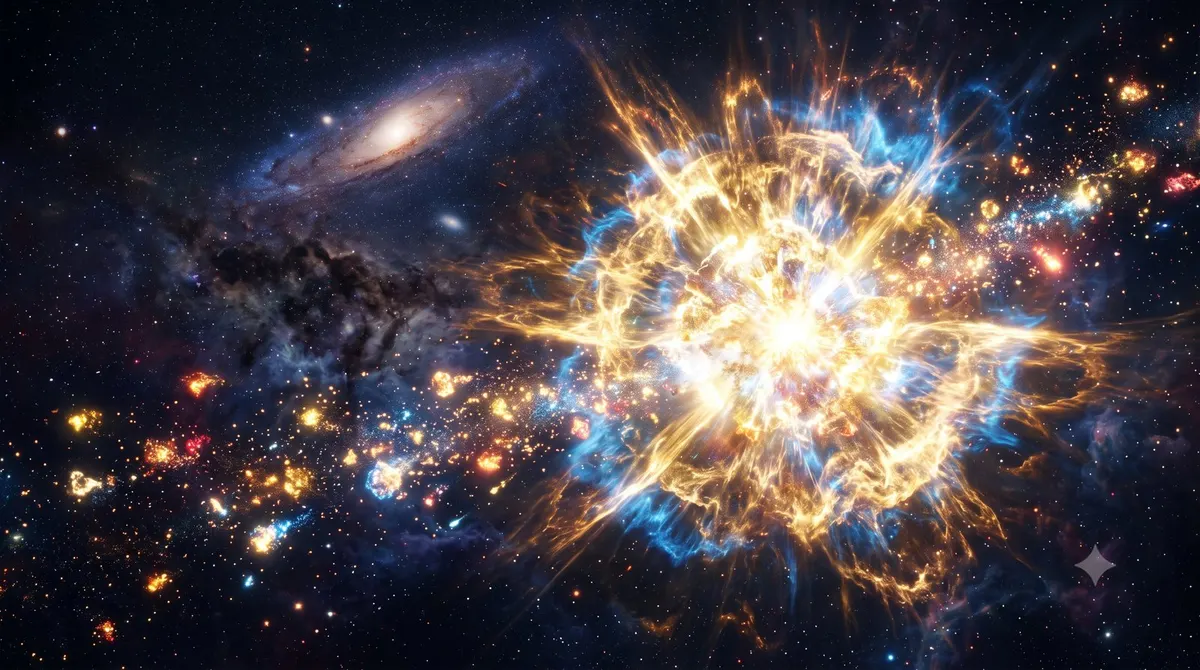
There is a phrase that sounds like poetry but is in fact plain scientific truth: we are made of stardust. The iron in your blood, the calcium in your bones, the oxygen you are breathing right now, all of it was created in space, in the hearts of stars and the violence of their deaths, long before the Earth or the Sun existed. The story of how the universe built the atoms we are made from is one of the grandest tales science has to tell.
A Universe of Just Two Ingredients
Let us start at the very beginning. In the early moments after the birth of the universe, in the event we call the Big Bang, there were no complex elements at all. The young cosmos was too hot and chaotic for atoms to exist. As it expanded and cooled over its first few minutes, the simplest nuclei could finally form.
The result was a universe made almost entirely of the two lightest elements: hydrogen, the simplest of all, and helium, along with a tiny trace of a couple of others. That was essentially the entire starting inventory. There was no carbon, no oxygen, no iron, none of the rich variety of elements that make up our world. Everything else had to be built later, and the factories that built them were the stars.
Stars as Element Factories
A star is born when a vast cloud of hydrogen gas collapses under its own gravity, growing so hot and dense at its core that a remarkable process ignites: nuclear fusion. Fusion is the joining together of light nuclei to form heavier ones, and it releases enormous amounts of energy. This is what makes a star shine, and it is the same process that powers our own Sun.
Deep in a star’s core, hydrogen nuclei fuse together to make helium. This is the main business of a star for most of its life. But when a star begins to run low on hydrogen fuel, the story gets more interesting. In larger stars, the core heats up further and fusion moves on to heavier elements, forging helium into carbon, then oxygen, and onward through a series of stages, building progressively heavier atoms layer by layer.
A massive star near the end of its life takes on a structure a little like an onion, with layers of different elements arranged around the core. The heaviest elements the star can make sit deepest, where it is hottest, while lighter layers surround them. Each stage of fusion burns faster than the last, so a process that began with millions of years of quiet hydrogen burning races through its final chapters in a matter of days.
The Iron Barrier
This element-building cannot continue forever. As fusion works its way up to iron, it hits a fundamental wall. Iron is special: it is among the most stable of all nuclei, and fusing iron into anything heavier no longer releases energy but instead absorbs it. A star cannot make a profit by fusing iron, so it cannot use iron as fuel.
For a massive star, building an iron core is the beginning of the end. With no more energy pouring out from fusion to hold it up against the crushing pull of its own gravity, the core can no longer support the star’s enormous weight. What happens next is one of the most spectacular events in the universe.
Death and Creation in a Supernova
When the core of a massive star finally gives way, it collapses in a fraction of a second and then rebounds in a titanic explosion called a supernova. For a brief time, a single dying star can outshine an entire galaxy of ordinary stars. This cataclysm does two vital things for the story of the elements.
First, the explosion is so extraordinarily energetic that it can forge elements heavier than iron, the ones fusion inside a normal star could never make. Second, and just as important, the explosion blasts all the elements the star had built, from the carbon and oxygen deep inside to the freshly minted heavy elements, out into space. A supernova is at once a graveyard and a nursery, scattering the raw material for new worlds across the cosmos.
The Cosmic Recycling of Matter
Astronomers now recognise several other places where elements are made, including the collisions of ultra-dense stellar remnants, which are thought to be an important source of some of the heaviest elements, such as gold. But the underlying theme is the same everywhere: the heavier elements are forged and then flung out into space, enriching the great clouds of gas and dust that drift between the stars.
Over billions of years, these enriched clouds become the material for a new generation of stars and planets. Each generation seeds the next with the elements it created, so the universe slowly grows richer in variety. Our own Sun and its planets condensed from a cloud that had already been salted with the debris of earlier stars, which is why the Earth contains such a wonderful abundance of elements.
The Atoms Within You
This is where the story comes home. The atoms that make up your body did not originate on Earth. The carbon that forms the backbone of every molecule of life was cooked inside an ancient star. The oxygen in the water you drink was forged the same way. The iron carrying oxygen through your bloodstream may have been created in a supernova explosion. And some of the heavier atoms scattered through your body trace back to the most violent events the cosmos can produce.
Every one of those atoms was made in space, drifted for eons, gathered into the cloud that became our Solar System, and eventually found its way into a living thing that could look up at the sky and wonder where it all came from. When we say we are made of stardust, we are stating a literal fact about our origins.
The history of the elements ties us to the universe in the most intimate way imaginable. The same processes that light the night sky also assembled the ingredients of life. Every breath you take and every heartbeat is powered by atoms forged in the furnaces of long-dead stars. In learning where the elements come from, we discover that the story of the cosmos and the story of ourselves are, in the deepest sense, one and the same.