 Talking Science Podcast
Atoms – What Everything Is Made Of
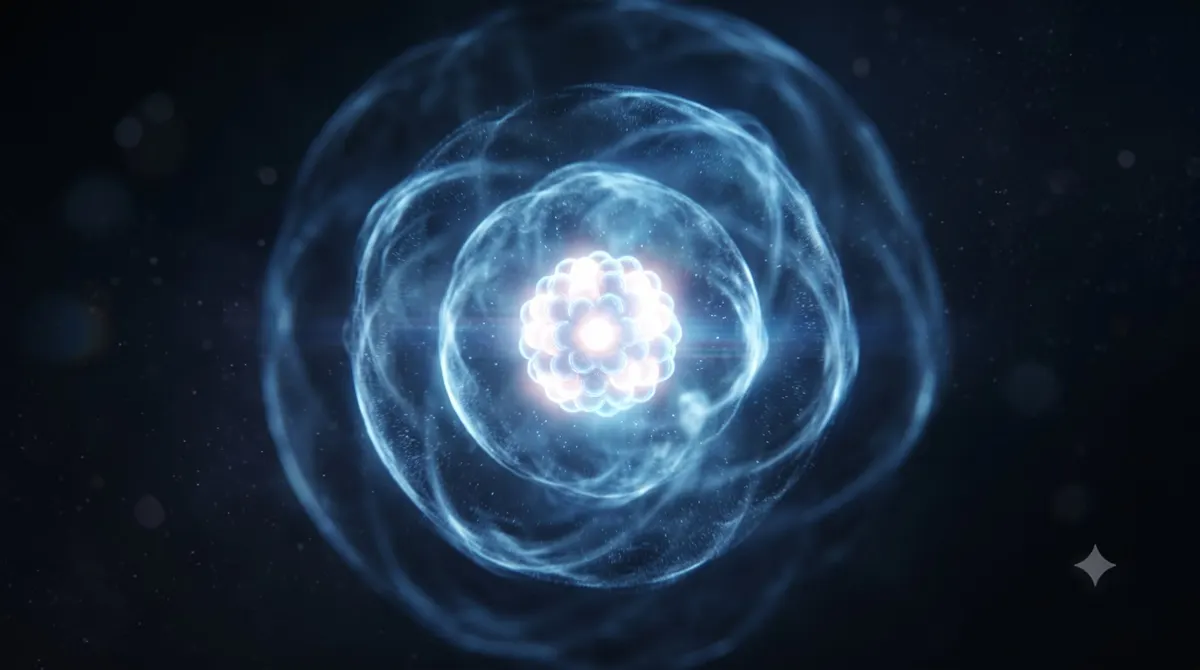
Pick up anything at all, this page, a cup of coffee, your own hand, and ask a simple question: if you kept cutting it into smaller and smaller pieces, would you ever reach a piece that could not be divided any further? Thinkers have wondered about this for thousands of years, and the answer they eventually found is one of the grandest ideas in all of science. Everything, absolutely everything you have ever seen or touched, is built from unimaginably tiny building blocks called atoms. And when scientists finally worked out what atoms are like inside, the picture was far stranger than anyone expected.
An Ancient Guess
The idea is remarkably old. More than two thousand years ago, some Greek philosophers reasoned that matter could not be endlessly divisible. There must, they argued, be some smallest possible grain, and they called it the atom, meaning uncuttable. It was a brilliant intuition, but it was pure philosophy, with no way to test it. For most of history it remained just one idea among many about the nature of stuff.
Real evidence arrived only a couple of centuries ago, when chemists noticed that substances always combine in fixed, tidy proportions. Elements joined together as if they came in discrete units, never in arbitrary amounts. The neatest explanation was that each element is made of its own kind of atom, and that these atoms link up in simple whole-number combinations to form everything else. The ancient guess was turning into science.
Mostly Empty Space
The next great surprise was what atoms look like inside. A famous experiment fired tiny particles at a whisper-thin sheet of gold foil, expecting them to sail straight through. Most did. But every so often one bounced sharply back, as if it had struck something small, hard, and dense hidden within the atom. The scientist leading the work said it was as astonishing as firing a shell at tissue paper and having it rebound.
The conclusion reshaped our picture of matter. An atom is almost entirely empty space. At its center sits a tiny, dense core called the nucleus, holding nearly all the atom’s mass in a speck far smaller than the atom itself. Around this nucleus, at a relatively vast distance, drift even tinier particles called electrons. If an atom were blown up to the size of a stadium, the nucleus would be a marble at the center and the electrons would flit around the distant stands. The solid-feeling world around you is, at heart, overwhelmingly nothing.
The Three Ingredients
Zoom in and an atom turns out to be built from just three kinds of particle, arranged in a simple architecture.
- Protons, which carry a positive electric charge and sit in the nucleus.
- Neutrons, which carry no charge and sit in the nucleus alongside the protons, adding weight.
- Electrons, which carry a negative charge and swarm in the space around the nucleus.
What makes one element different from another is astonishingly simple: it is just the number of protons in the nucleus. An atom with one proton is hydrogen. Add a proton and it becomes helium, then lithium, and so on up the ladder. Change that single number and you change the substance entirely, from the oxygen you breathe to the gold in a ring to the carbon in every living thing. The whole periodic table, the entire alphabet of matter, is written by counting protons.
Why Atoms Stick Together
Atoms rarely stay solitary. They join up to form the endless variety of materials around us, and the electrons are the matchmakers. The outermost electrons of one atom can be shared with, or handed to, another atom, and these shared arrangements are the chemical bonds that hold molecules together. Two hydrogen atoms clasping one oxygen atom make a molecule of water; string carbon atoms into long chains and you get the backbone of life.
This is the essence of chemistry: not about the nuclei, which stay aloof, but about the restless outer electrons and the partnerships they form. Every reaction, from rust creeping across iron to the digestion of your breakfast, is ultimately atoms rearranging their electron partnerships into new combinations. Nothing is truly created or destroyed; the same atoms simply link up in new ways.
A Quantum Twist
The tidy image of electrons orbiting a nucleus like planets around a sun is a useful cartoon, but the reality is stranger. Electrons do not follow neat paths. Governed by the odd rules of quantum physics, they behave more like fuzzy clouds of probability, existing in a haze of where-they-might-be around the nucleus rather than tracing definite circles. They are also restricted to specific energy levels, allowed to occupy certain rungs of a ladder but nothing in between.
Strange as it sounds, this quantum behavior is not a minor footnote. It explains why each element has its own character, why materials have the colors they do, and why some substances conduct electricity while others do not. Mastering these rules is exactly what let engineers design the transistors inside every computer chip, making the entire digital world a direct descendant of understanding the atom.
Splitting the Unsplittable
The Greeks named the atom uncuttable, and for a long time that seemed apt. But the twentieth century revealed that the nucleus itself can be broken apart or built up, and doing so unleashes energy far greater than any ordinary chemical reaction. Split a heavy nucleus like uranium and it releases a burst of energy; this is the fission that powers today’s nuclear reactors and, less happily, nuclear weapons. Join light nuclei together and you get fusion, the process that lights the stars.
This deeper layer taught us that the atom is not the final word after all. The protons and neutrons in the nucleus are themselves built from still smaller particles called quarks, held together by forces we are only beginning to fully map. The uncuttable grain turned out to have a rich inner life, a whole hierarchy of structure nested inside what once seemed the smallest thing there could be. Each time we looked closer, nature had another surprise waiting.
It is worth pausing on the wonder of it. You are made of roughly the same atoms that were forged in ancient stars and scattered across space long before the Earth existed. Those atoms have been recycled through countless forms and now, for a while, they are arranged into you, reading these words and pondering their own structure. The uncuttable grains the Greeks imagined turned out to be real, mostly empty, quietly governed by quantum rules, and generous enough to build a universe, and everyone in it, out of just a few simple parts.


