Talking Science Podcast
Friction – The Force That Wears the World Down
Try walking across a freshly mopped floor in socks and you get a sudden lesson in something you rely on every second of the day. Friction is why your shoes grip the footpath, why a knot holds, why a pencil leaves a mark and why a car can pull up at a red light instead of gliding gently into the intersection.
Yet friction is also a thief. It turns useful motion into waste heat, grinds machines down and quietly eats a remarkable share of the world's energy. Up close, it is also far stranger than the simple "rubbing" we learn about at school.
What Friction Actually Is
Friction is the force that resists one surface sliding over another. Even a surface that feels perfectly smooth, like polished steel or glass, is a landscape of microscopic hills and valleys. Pressed together, two such surfaces touch only at the tips of the highest bumps, called asperities, and the true area of contact is often a tiny fraction of what it appears to be.
At those contact points, the atoms of the two surfaces get close enough to stick, and the bumps also snag on and deform one another. Sliding means constantly breaking those little junctions and forming new ones, and that takes force. Press harder and the bumps squash flatter, creating more real contact, which is why heavier objects are harder to drag.
This explains an old observation. Around 1700, the French physicist Guillaume Amontons reported that friction depends on how hard surfaces are pressed together but, for most everyday materials, not on how big the apparent contact area is. Leonardo da Vinci had noted the same thing in his notebooks two centuries earlier. A brick slides just as reluctantly on its narrow side as on its broad face. Spread the load more widely and each contact carries less weight, so the real contact area barely changes.
Static Versus Kinetic Friction
Anyone who has shoved a heavy fridge knows that getting it moving is the hardest part, because there are really two kinds of friction. Static friction holds things still, growing to match whatever push you apply until it reaches a limit. Once something is sliding, kinetic friction takes over, and it is usually weaker.
Part of the reason is time: surfaces at rest settle into each other, and their contact points bond a little more strongly. The gap between the two kinds of friction produces a jerky effect called stick-slip: surfaces lock, build up force, lurch free, then lock again. It's the squeal of a door hinge, the screech of chalk on a blackboard and the singing note of a violin bow drawn across a string. On a far grander scale, stick-slip along geological faults is how many earthquakes happen, with rock locked in place for centuries before slipping in seconds.
Why Smoother Isn't Always Slipperier
Polishing a surface does reduce friction up to a point, because there are fewer large bumps to catch on. But push smoothness far enough and the trend can reverse. When two surfaces are extremely flat and clean, far more of their atoms come into close contact, and the attraction between them starts to dominate.
Engineers see this with precision steel gauge blocks, which are so flat that they can be "wrung" together and cling with surprising strength. Very clean metals in a vacuum, stripped of the oxide and grime that normally coat them, can even bond on contact, a phenomenon called cold welding that spacecraft designers must guard against.
How Lubrication Works
The simplest way to beat friction is to stop the surfaces touching at all, and that is what a lubricant does. In a well-designed engine bearing, the spinning shaft drags oil into a narrowing, wedge-shaped gap, building up enough pressure to lift the shaft clear of its housing. The metal surfaces float on a thin film of fluid, and the only resistance left is the fluid's own internal friction, its viscosity. When this hydrodynamic lubrication works, wear is almost zero.
The film needs motion to form, though. At start-up, or under heavy loads at low speed, the surfaces can touch, so engine oils carry additives that cling to metal and form protective chemical layers. Ice is the famous puzzle. Its slipperiness is usually put down to a thin, watery surface layer acting as a lubricant, but exactly how that layer forms is still actively researched.
The Enormous Cost of Rubbing
The study of friction, wear and lubrication even has its own name, tribology, coined in a 1966 British government report that argued industry was losing fortunes to worn-out machinery. Every moving part in an engine, gearbox or wind turbine loses some energy to friction, and that energy ends up as heat, a one-way conversion governed by entropy. Parts that wear out must then be manufactured all over again.
A widely cited 2017 analysis by tribology researchers estimated that roughly a fifth of the world's total energy use goes into overcoming friction, with more consumed in replacing worn parts. In a typical petrol car, a substantial share of the fuel's energy is lost to friction in the engine, transmission and tyres. Better lubricants and low-friction coatings are quiet but important tools for saving energy.
Putting Friction to Work
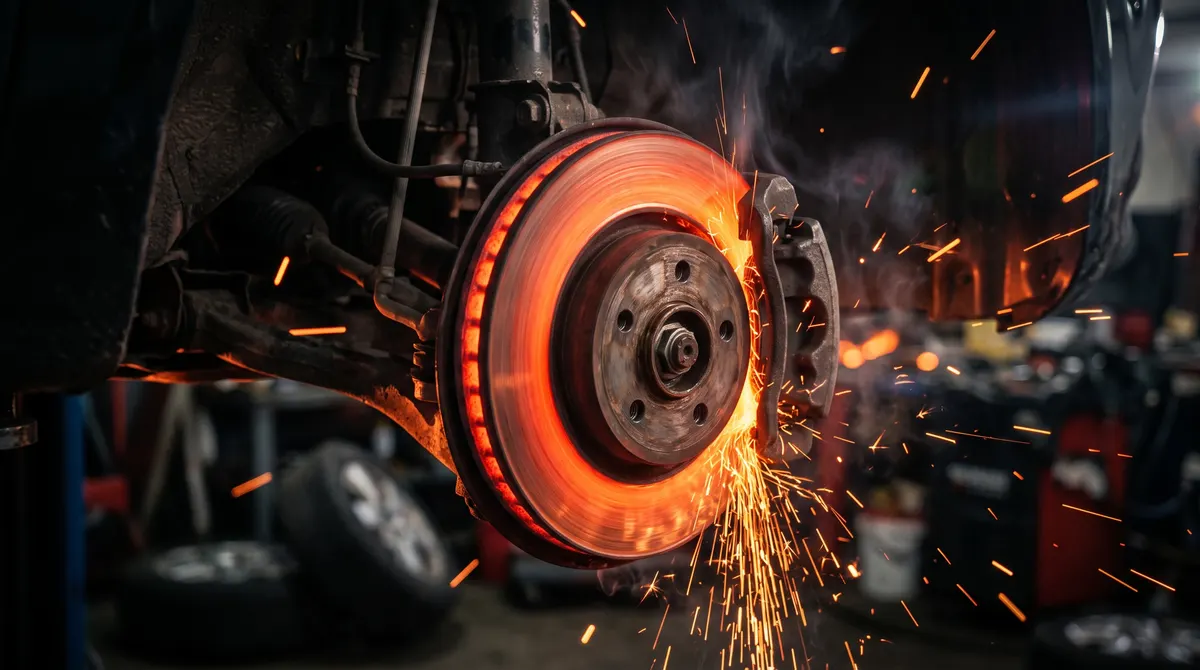
For all the energy it wastes, we depend on friction and deliberately harness it. Brakes are friction machines: pads clamp onto a spinning disc and convert the car's energy of motion into heat, which is why brake discs can glow after hard laps of a racetrack.
Tyres rely on static friction rather than kinetic. When a wheel rolls without skidding, the rubber touching the road is momentarily at rest relative to it. Anti-lock brakes stop the wheels locking and sliding, keeping the tyres in the grippier static regime so the driver can still steer.
Ball and roller bearings take the opposite approach, replacing sliding with rolling. A rolling ball loses far less energy than a sliding surface, which is why bearings sit inside everything from skateboard wheels and bicycle hubs to washing machines and jet engines.
The Joints That Outperform Engineering
Some of the best friction engineering on the planet is inside your knees. The bone ends are capped with articular cartilage, a smooth, rubbery tissue soaked with fluid, and the joint is bathed in synovial fluid. The result is a bearing with friction lower than ice sliding on ice, carrying loads of several times your body weight with each step, for decades.
Several tricks work together. Cartilage is spongy, and when it is loaded, the fluid trapped inside becomes pressurised and carries much of the weight, so the solid parts barely press on each other. Molecules such as lubricin and hyaluronic acid coat the surfaces and keep them slick. When cartilage wears away, as happens in osteoarthritis, that remarkable low-friction surface is lost, which helps explain why the condition can be so painful and limiting.
A Force Worth Understanding
Friction is neither simply good nor simply bad. It is the grip that lets us walk and drive, and the drag that wears out engines and wastes energy on a global scale. Underneath it lies an intricate world of microscopic bumps, thin films and trapped fluids. Engineers have learned to add friction where we need grip and remove it where we need efficiency, yet a healthy knee still does the job better than almost anything we have built.