Talking Science Podcast
Gravity – The Weakest Force in Charge of Everything
Stick a small magnet on the fridge and use it to pick up a paperclip. In that tiny moment, a scrap of magnetised metal has beaten the pull of the entire planet. Six thousand billion billion tonnes of rock and iron are tugging the paperclip down, and a fridge magnet wins without trying.
That should be puzzling, because gravity is the force we feel most constantly. It keeps our feet on the ground, holds the Moon in orbit, keeps the Earth circling the Sun and gathers stars into galaxies. Gravity is easily the weakest of nature's fundamental forces, and yet it shapes the universe on every scale larger than a mountain.
Just How Weak Is Gravity?
Physicists recognise four fundamental forces: gravity, electromagnetism, and the strong and weak nuclear forces that operate inside atoms. You can meet all four in our guide to the four fundamental forces.
One way to compare them is to take two protons and ask how hard they push and pull on each other. Their electrical repulsion is stronger than their gravitational attraction by a factor of roughly ten to the power of thirty-six, which is a trillion trillion trillion. You need the combined mass of a whole planet before gravity becomes something you notice in daily life.
Why the Weakest Force Still Wins
So why does it run the cosmos? Two simple properties explain it.
- Gravity only attracts. Electric charges come in positive and negative, and in ordinary matter they almost perfectly cancel out. A planet is electrically neutral overall, so its huge electrical forces largely vanish at a distance. Mass has no negative version, so every extra kilogram adds to the pull.
- Gravity reaches a long way. The nuclear forces only act across distances smaller than an atomic nucleus. Gravity, like electromagnetism, fades with distance but never switches off entirely.
One atom's pull is negligible, but the pull of a planet, a star or a galaxy is the sum of countless atoms all pulling the same way.
Newton's Universal Law
In 1687, Isaac Newton published his law of universal gravitation. It says that every mass attracts every other mass with a force that grows with their masses and weakens with the square of the distance between them. Double the distance and the pull drops to a quarter. The same rule that makes an apple fall keeps the Moon in orbit: the heavens and the Earth obey the same physics.
Newton's law worked astonishingly well. In the 1840s, astronomers noticed that Uranus was drifting slightly from the path the law predicted. Rather than give up on Newton, the French mathematician Urbain Le Verrier assumed an unseen planet was tugging on it and calculated where it should be. In 1846, the astronomer Johann Galle pointed his telescope at that spot and found Neptune very close to the predicted position. A planet had been discovered with a pencil before it was seen through a lens.
The Crack in Newton's Picture
Le Verrier also studied Mercury, and here the trick did not work. Mercury's orbit is a slightly stretched ellipse, and the point where it comes closest to the Sun slowly shifts around over time. Most of that shift is explained by the pull of other planets, but a tiny leftover amount, about 43 arcseconds per century, refused to fit. Astronomers searched for another hidden planet near the Sun, but never found one.
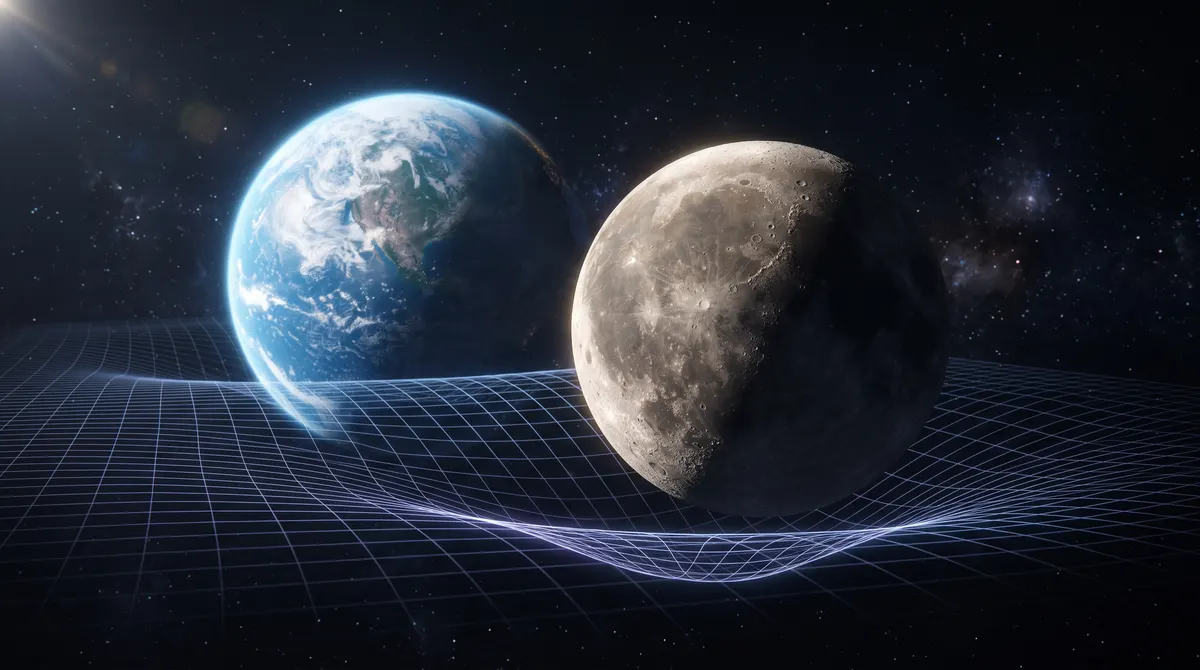
In 1915, Albert Einstein published his general theory of relativity, which described gravity in a completely new way. In Einstein's picture, mass and energy curve space and time, and objects moving freely simply follow the straightest possible paths through that curved spacetime. The Earth is not pulled by an invisible rope; it follows the shape the Sun gives to the space around it.
When Einstein applied his equations to Mercury, the missing 43 arcseconds fell out naturally. Four years later, observations during a total solar eclipse showed starlight bending around the Sun by roughly the amount his theory predicted. Since then general relativity has passed every test thrown at it, from the precise timing of GPS satellites to the detection of gravitational waves from colliding black holes in 2015. Our piece on Einstein's relativity explains how gravity even slows down time.
Newton was not thrown away. For most engineering and space missions his law is still accurate enough and far easier to use.
Floating, Falling and Weightlessness
Astronauts on the International Space Station look as though they have escaped gravity, but they have not. At the station's altitude, about 400 kilometres up, gravity is still roughly ninety per cent as strong as on the ground. Astronauts float because the station and everything inside it are falling together.
The station is also moving sideways at about 28,000 kilometres per hour. It falls towards the Earth constantly, but the curved surface keeps falling away beneath it. That endless fall is what an orbit is. Inside, nothing presses against the floor, so everything feels weightless.
How the Moon Moves the Oceans
Tides are gravity at work on a planetary scale. The Moon pulls on the whole Earth, but it pulls slightly harder on the side facing it and slightly less on the far side. That difference stretches the oceans into two bulges, one towards the Moon and one away from it. As the Earth turns, most coastlines pass through both bulges, which is why many places see two high tides a day.
The Sun has a tidal effect too, a bit less than half as strong as the Moon's because it is so much farther away. When the Sun and Moon line up at new and full moon, their effects combine into bigger spring tides. When they pull at right angles, we get smaller neap tides. Local geography then amplifies or dampens the effect, which is why parts of the Kimberley coast in Western Australia see some of the largest tidal ranges anywhere, at more than ten metres, while other coasts barely notice the tide at all.
The Problem Nobody Has Solved
For all its success, general relativity does not sit comfortably with quantum mechanics, the theory that describes atoms and particles. The other three forces have all been described in quantum terms, as interactions carried by particles. Gravity has not. Many physicists suspect it is carried by a particle called the graviton, but because gravity is so weak, detecting one appears far beyond any experiment we could build.
The clash matters most in extreme places, such as the centre of a black hole or the first instant of the Big Bang, where enormous mass is crammed into tiny spaces and both theories should apply at once. There, their predictions break down. Ideas such as string theory and loop quantum gravity try to bridge the gap, but none has yet been confirmed by experiment.
The Force That Adds Up
Gravity's weakness and its power are two sides of the same coin. It loses easily to a fridge magnet, but it never cancels, never switches off, and quietly accumulates across planets, stars and galaxies until it dominates everything. Newton gave us a law that predicted a planet, Einstein showed that gravity is the shape of spacetime itself, and the next step, a quantum theory of gravity, remains one of the great unfinished jobs in science.