Talking Science Podcast
Carbon – The Element That Makes Life Possible
Somewhere in your body right now, carbon atoms are doing the work of keeping you alive. They form the spine of your DNA, the walls of your cells, the sugars fuelling your muscles, the proteins building your tissues. Look around and carbon is everywhere else too: in the wood of the table, the plastic of your phone, the graphite in a pencil, the sparkle of a diamond. One modest element, sitting quietly in the periodic table, turns out to be the master builder of both the living world and much of the made one. Why carbon? What makes this particular atom so extraordinarily versatile?
The Atom With Four Hands
The secret lies in carbon’s structure. Every carbon atom has four electrons available in its outer layer for making bonds – four spots where it can link to other atoms. Picture an atom with four hands, each ready to grab a partner. Many elements have only one or two such connection points, which sharply limits what they can build. Carbon’s four give it remarkable reach.
Those four bonds let carbon connect in every direction at once, forming not just chains but branches, rings, and sprawling three-dimensional networks. A carbon atom can join to hydrogen, oxygen, nitrogen, and a whole cast of other elements, and crucially it bonds happily to other carbon atoms too. This means carbon can build enormous, elaborate structures using itself as scaffolding. No other element does this quite so readily or so well.
Chains, Rings, and Endless Variety
Because carbon links to itself so easily, it can form chains of astonishing length – dozens, hundreds, even thousands of atoms strung together like beads. It can loop those chains into rings. It can hang other atoms off the sides like ornaments on a garland. Each different arrangement is a different molecule with different properties, and the number of possible arrangements is effectively limitless.
This is why the branch of chemistry devoted to carbon compounds, called organic chemistry, is so vast. Millions of distinct carbon-based molecules are known, and more are made in laboratories every year. From the same handful of ingredients – carbon, hydrogen, oxygen, a few others – nature and chemists alike assemble an unending catalogue of substances. The simple sugar that sweetens your tea and the complex protein that carries oxygen in your blood are both, at root, carbon architecture.
The Same Atom, Wildly Different Forms
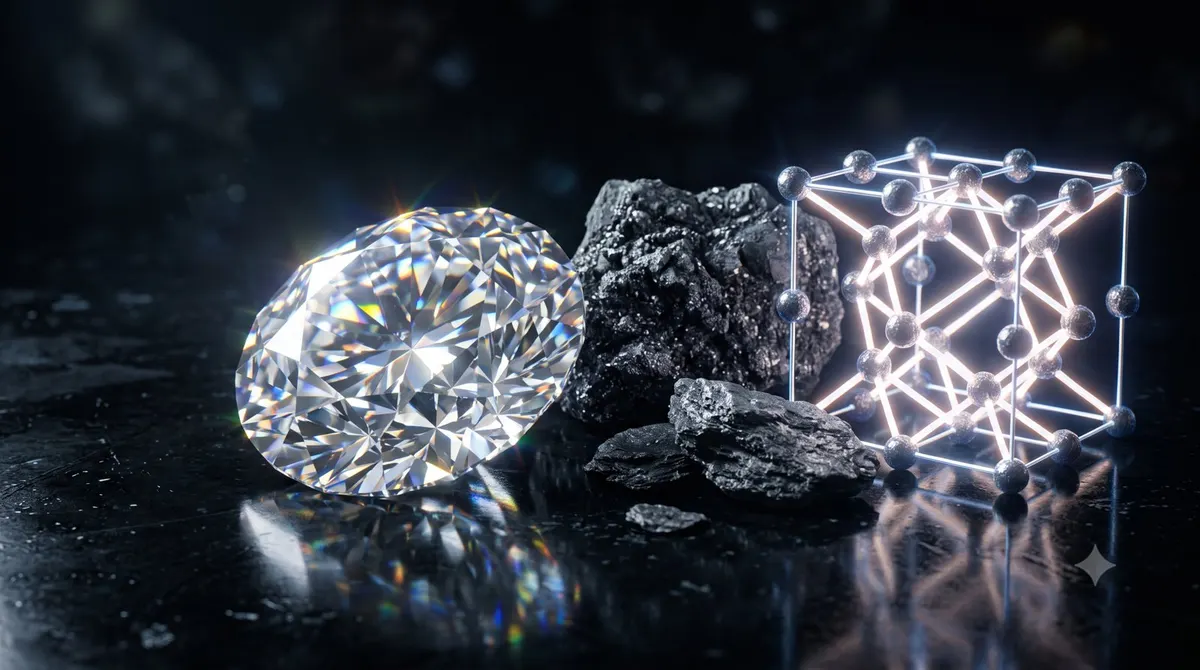
Carbon’s versatility shows up even when it bonds only to itself. Take pure carbon and arrange its atoms one way and you get graphite, the soft grey material in pencil leads. In graphite the atoms lie in flat sheets that slide over one another easily, which is why it leaves a mark on paper and feels slippery.
Arrange those very same atoms differently, into a rigid three-dimensional lattice, and you get diamond, the hardest natural substance known. Same element, utterly different material – one you can smear with your finger, the other capable of cutting steel. The only difference is how the atoms are connected. It is a vivid reminder that in chemistry, structure is destiny. Scientists have since found still other forms of pure carbon, including hollow spheres and tubes so thin and strong they have opened whole fields of research.
The Chemistry of Life
Life did not choose carbon by accident. Living things need molecules that are stable enough to hold their shape and store information, yet flexible enough to be built up, broken down, and rearranged as an organism grows and functions. Carbon strikes this balance perfectly. Its bonds are strong enough to be reliable but not so strong that they can never be undone, which lets living cells assemble and dismantle molecules as needed.
The great families of molecules that make up living things are all carbon-based. Proteins, which do most of the work in cells, are long carbon chains folded into precise shapes. Carbohydrates, our fuel, are built on carbon rings. Fats, DNA, the pigments that make leaves green and blood red – all of them are carbon frameworks decorated with other atoms. When biologists search for the possibility of life elsewhere in the universe, they look first for carbon chemistry, because it is hard to imagine the same richness arising any other way.
Carbon on the Move
Carbon does not sit still. It cycles endlessly through the living world, the air, the oceans, and the ground in a grand loop that keeps the planet running. Plants pull carbon from the air in the form of carbon dioxide gas and, using sunlight, lock it into sugars. Animals eat the plants and release the carbon again by breathing out. When living things die and decay, their carbon returns to the soil and air. Over vast stretches of time, some of it becomes coal, oil, and gas buried underground.
This natural cycle kept a rough balance for millions of years. Human activity has tipped it by digging up that buried carbon and burning it, releasing long-stored carbon dioxide back into the air far faster than the cycle can absorb it. The same element that makes life possible is, in this altered balance, at the centre of our climate challenge – not because carbon has changed, but because we have moved so much of it so quickly.
It is worth pausing on how personal this cycle is. The carbon atoms in your body did not begin there and will not end there. Each was forged long ago inside a dying star, drifted through space, became part of the Earth, and has since passed through countless plants and animals before arriving in you. When you eventually return it to the world, it will move on again. You are not so much a fixed object as a temporary pattern that carbon flows through, borrowing atoms for a while before passing them along.
It is a strange thought that so much can rest on so ordinary an atom. Carbon is not rare or glamorous; it is the black soot in a candle flame and the lead in a schoolchild’s pencil. Yet its four patient bonds, its willingness to chain and ring and branch without limit, make it the one element capable of building the machinery of life. We are, quite literally, creatures of carbon – clever arrangements of an atom that just happens to be the universe’s most gifted builder.