 Talking Science Podcast
Einstein’s Relativity – Time Is Not What You Think
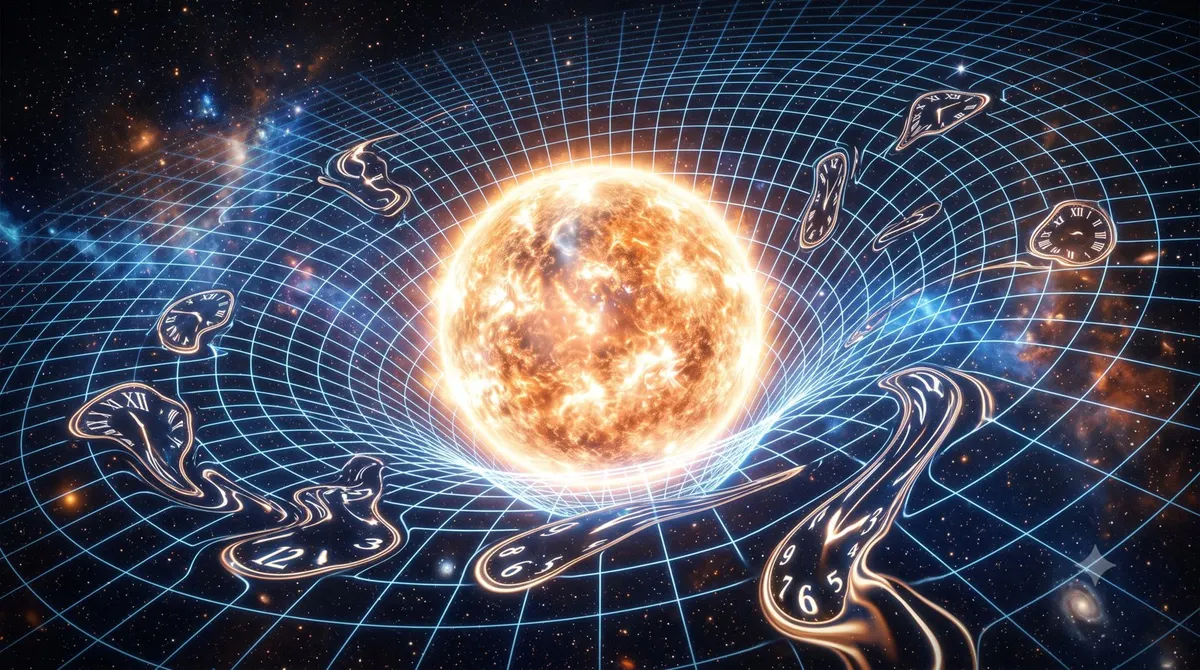
We treat time as the one thing we can count on. A second is a second, whether you are racing down a motorway or dozing in a chair, and a clock in Tokyo ticks at the same pace as one in New York. It feels obvious. It also happens to be wrong. A little over a century ago, a young patent clerk named Albert Einstein showed that time itself bends and stretches depending on how you move and where you stand. His theory of relativity remains one of the most mind-bending and thoroughly tested ideas in all of science.
The Puzzle of Light
Einstein’s revolution began with a stubborn puzzle about light. In the late nineteenth century, experiments kept revealing something impossible: no matter how fast you chase a beam of light, it always races away from you at the same speed. Run toward it or away from it, the answer never changes. Compare that with everyday life. If you drive at fifty miles per hour alongside a car going sixty, the other car creeps past at just ten. Light refuses to play this game.
Most scientists tried to explain the puzzle away. Einstein did the braver thing: he took it at face value. In 1905, he proposed that the speed of light is an absolute, unbreakable constant of nature, the same for every observer. This sounds harmless enough. But if the speed of light never changes, then something else must give. And the thing that gives, astonishingly, is time itself.
To see why, imagine measuring the speed of anything. You divide the distance travelled by the time it took. If the answer for light must come out the same for everyone, no matter how they are moving, then distances and durations themselves cannot be fixed and universal. They must stretch and shrink from one observer to another, just enough to keep the speed of light constant. Einstein followed this thread with relentless logic, and it led him to conclusions that overturned two centuries of settled physics.
Time Slows Down
Here is the heart of what Einstein called special relativity. If the speed of light is fixed for everyone, then a clock moving quickly past you must tick more slowly than your own. This is not an illusion or a trick of measurement. Time genuinely runs at different rates for people moving differently. Physicists call this time dilation, and it is one of the strangest truths we know.
The effect is tiny at ordinary speeds, which is why we never notice it. But it grows dramatically as you approach the speed of light. Picture two twins. One boards a spacecraft and travels near light speed to a distant star and back; the other stays home. When the traveller returns, they find their earthbound twin has aged far more. The astronaut has, in a very real sense, journeyed into the future. This is not a thought experiment gone wild. We have measured slower ticking in precise atomic clocks flown aboard aircraft, and it matches Einstein’s numbers.
Space Bends Too
Time is not the only casualty. Space gets stretched and squeezed as well. Objects moving at high speed become shortened along their direction of travel, an effect known as length contraction. Even the idea of two events happening at the same time falls apart. What looks simultaneous to you might look staggered to someone rushing past. There is no universal now that everyone agrees on.
Einstein tied these threads together into a single fabric he called spacetime. Rather than treating space and time as separate stages, relativity fuses them into one four-dimensional whole. Movement through space and movement through time become two aspects of the same journey. Speed up through space, and you effectively slow down through time. It is a trade-off baked into the structure of the cosmos.
Gravity as Curved Space
A decade later, Einstein went further still with his masterpiece, general relativity. Here he tackled gravity, and his answer overturned centuries of thinking. Gravity, he argued, is not a mysterious force pulling objects together across empty space. Instead, massive objects like stars and planets warp the very fabric of spacetime around them, and other objects simply follow the curves.
The classic image is a heavy ball resting on a stretched rubber sheet. The ball creates a dip, and a marble rolled nearby spirals inward, not because a force reaches out and grabs it, but because the surface itself is bent. Planets orbit the Sun for the same reason: they are coasting along the valleys that the Sun carves into spacetime. Even light bends as it passes a massive body, following the curved landscape. This prediction was dramatically confirmed during a solar eclipse, when starlight was seen to shift as it grazed the Sun.
Ripples and Black Holes
General relativity made bold predictions that took generations to confirm. One is the existence of black holes, regions where spacetime is curved so steeply that nothing, not even light, can escape. Once dismissed as mathematical fantasies, black holes are now known to be real, lurking at the centres of galaxies including our own.
Another prediction is gravitational waves, ripples in spacetime set off by violent cosmic events like colliding black holes. These waves stretch and squeeze space as they pass, though by an almost inconceivably small amount. A full century after Einstein wrote them down, scientists finally detected these ripples directly, listening to the faint tremor from black holes that merged far across the universe. It was a stunning vindication of a theory dreamed up with pen and paper.
Relativity in Your Pocket
You might think all this is too exotic to matter in daily life. In fact, you rely on relativity every time you use satellite navigation. The satellites that power GPS carry precise clocks, and because they are both moving fast and sitting higher up in weaker gravity, their clocks drift compared with ours. Without correcting for these tiny relativistic effects, navigation systems would quickly become useless, drifting off by miles within a single day.
Relativity asks us to give up the comforting notion of a fixed, universal stage on which events unfold. Time bends, space warps, and the pace of a clock depends on where you are and how you move. It sounds like poetry, yet it is measured, engineered fact. Einstein did not merely tweak our picture of reality; he revealed that the universe is far stranger, and far more beautiful, than common sense ever dared imagine.


