 Talking Science Podcast
Lasers – Light in Lockstep
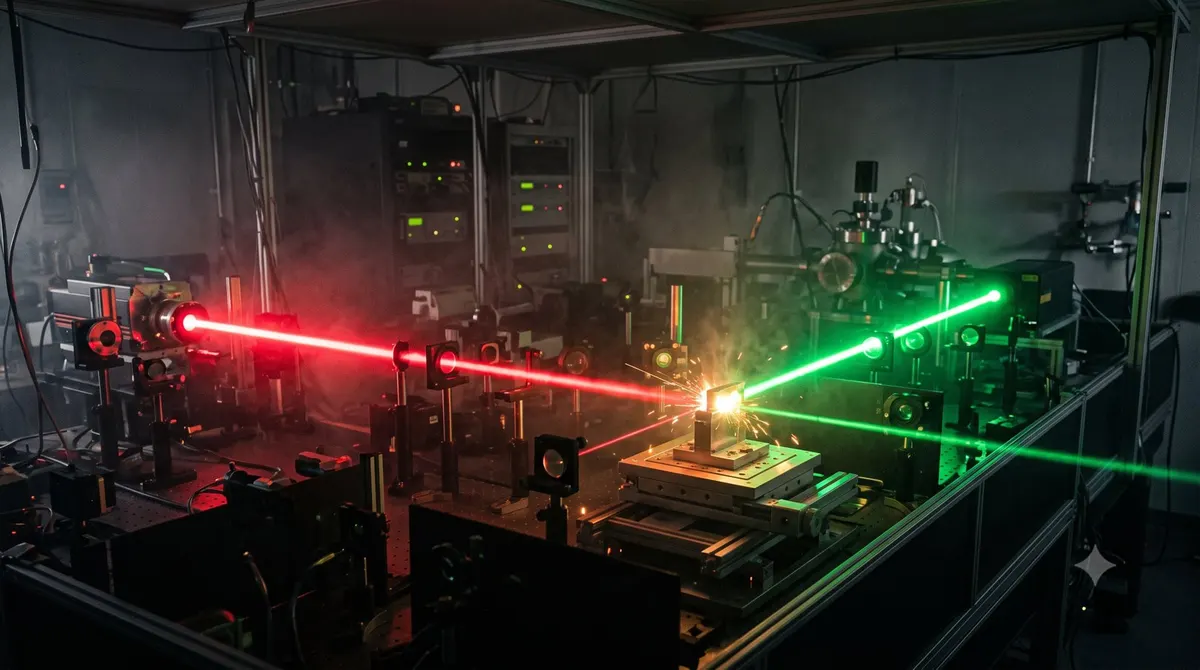
Point a flashlight at a wall and the beam softens and spreads, a fuzzy pool of glow. Point a laser at the same wall and you get a crisp, brilliant dot, sharp as a pinprick, that can travel across a room or even to the Moon without falling apart. Both are light. So what makes a laser so different from the bulb in your kitchen? The answer is a beautiful idea about order, discipline, and getting billions of tiny things to move in perfect step.
Ordinary Light Is a Crowd
Think about the light from a normal lamp. It is a chaotic jumble. The bulb throws out light of many colors mixed together, heading in every direction, with the individual light waves rising and falling completely out of sync with one another. It is like a crowded room where everyone is talking at once, in different languages, at different volumes. The result is useful for seeing, but messy and impossible to aim with precision.
A laser is the opposite of that crowd. Its light is a disciplined army. Every wave is the same single color, all the waves travel in the same direction, and, crucially, they all rise and fall together in perfect unison. Physicists call this being coherent. That coordination is the whole secret, and it is why a laser beam stays tight and intense over long distances instead of spreading into a haze.
The Trick Behind the Name
The word laser is actually an acronym, and unpacking it explains how the device works. It stands for Light Amplification by Stimulated Emission of Radiation. The important phrase is stimulated emission, an idea Einstein predicted long before anyone built a laser.
Here is the core of it. Atoms can hold extra energy, and normally an excited atom releases that energy as a particle of light whenever it feels like it, in a random direction. But Einstein realized something remarkable: if a passing light wave nudges an excited atom, the atom will release its light as an identical twin of the wave that nudged it, same color, same direction, perfectly in step. One photon in, two identical photons out. Now those two can nudge two more atoms, making four, then eight, and so on. The light does not just pass through the material; it multiplies, and every copy is a clone of the original.
Building the Beam
To turn this cascade into a usable beam, a laser needs three basic ingredients working together.
- A material full of atoms that can be excited, which might be a crystal, a gas, or a specially made semiconductor chip.
- An energy source to pump those atoms up into their excited state, ready to release light.
- A pair of mirrors facing each other, with the material between them, so the light bounces back and forth, triggering more and more stimulated emission on each pass.
The light ricochets between the mirrors, growing stronger and more coordinated with every trip. One of the mirrors is made slightly transparent, and a thin, intense, perfectly ordered stream leaks out through it. That escaping sliver is the laser beam. Everything about a laser, from a supermarket scanner to an industrial cutter, comes down to this loop of exciting atoms and letting the light amplify itself.
Lasers Everywhere
Once you understand that a laser is just extraordinarily disciplined light, its versatility makes sense. Because the beam is a single pure color and beautifully coordinated, it can be focused to a spot smaller than a speck of dust, concentrating its energy enormously. That is why a powerful laser can slice through steel or weld metal, while a gentler one can perform delicate surgery on the human eye.
Because the beam stays narrow over long distances, lasers make superb measuring tools. We have bounced laser beams off reflectors left on the Moon to measure its distance with astonishing accuracy, and surveyors and self-driving cars use pulses of laser light to map their surroundings. Because a laser’s light can be switched on and off billions of times a second, it can carry staggering amounts of information: the internet largely travels as pulses of laser light racing through hair-thin glass fibers under the oceans. And because the beam reads surfaces so precisely, lasers scan the barcodes on your groceries and once read the pits on CDs and DVDs.
From Curiosity to Necessity
What is striking is that when the first laser was built, decades ago, no one was quite sure what it was for. It was famously described as a solution looking for a problem, a dazzling scientific curiosity with no obvious purpose. Within a single lifetime it has become woven so deeply into daily life that removing lasers would break modern medicine, manufacturing, communication, and entertainment all at once.
That journey is a small parable about basic science. The physicists who worked out stimulated emission were not trying to invent barcode scanners or fiber-optic internet. They were simply curious about how light and atoms behave. The applications came later, unpredictably, once the underlying idea existed and inventive people got their hands on it.
Not All Lasers Are Alike
It is worth clearing up a common image, because the word laser conjures beams that slice through walls in the movies. In reality lasers come in an enormous range of strengths and characters, and most are gentle. The little laser inside a barcode scanner or a laser pointer carries only a whisper of power, just enough to be seen and read. At the other extreme, research lasers can briefly concentrate more power than entire nations use, focused for a sliver of a second onto a spot smaller than a grain of sand.
They also come in different colors and rhythms, tuned for the task at hand. Some pour out a steady, unbroken beam, ideal for cutting or measuring. Others fire in incredibly short, rapid pulses, which is how a laser can drill or mark a surface without heating everything around it, or deliver precise bursts in surgery. This adaptability is why a single underlying principle can serve jobs as different as reading a supermarket label and igniting fusion fuel. You simply choose the color, power, and timing to fit the work.
So the next time a checkout scanner beeps, or a doctor mentions laser treatment, or you stream a video that has crossed an ocean, spare a thought for the quiet elegance behind it all. A laser is nothing more than light persuaded to march in perfect step, and from that simple discipline flows a surprising slice of the modern world.


