 Talking Science Podcast
Light – Wave, Particle, or Both?
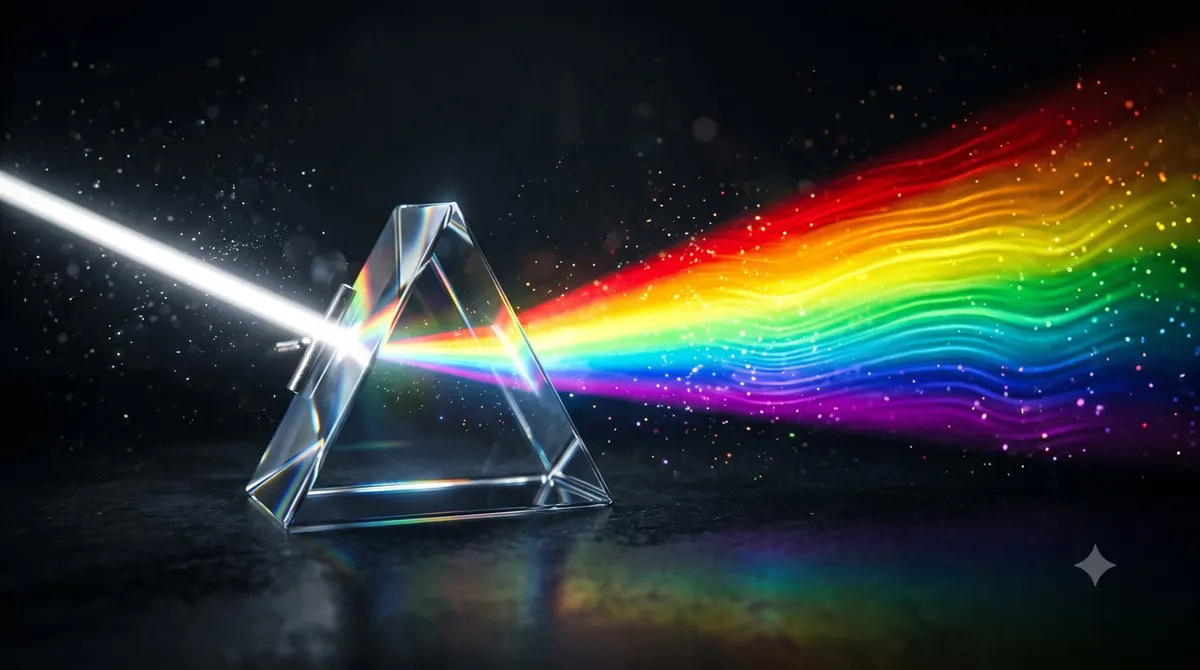
Light is the most familiar thing in the world and one of the strangest. It lets you read this sentence, paints every sunset, and carries the warmth of a summer day. Yet for centuries the greatest minds in science argued bitterly over a deceptively simple question: what actually is it? Is light a wave, rippling through space like a disturbance on a pond? Or is it a stream of tiny particles, like a spray of impossibly small bullets? The answer, it turns out, is stranger and more wonderful than either side imagined.
The Old Argument
Long ago the debate had two camps. One insisted light was made of particles, tiny corpuscles that flew in straight lines. That neatly explained why light casts sharp shadows and bounces off mirrors at clean angles. The other camp insisted light was a wave, because waves could explain the way light bends when it passes from air into water, and the way it spreads and blends.
For a long while the wave picture seemed to win decisively. The clinching evidence came from a beautifully simple experiment. When light is passed through two narrow parallel slits and lands on a screen behind them, it does not make two bright stripes as bullets would. Instead it makes a whole series of bright and dark bands. This pattern is the unmistakable signature of waves: where two ripples overlap they can reinforce each other to make a bright band, or cancel out to leave darkness. Only waves do this. The case looked closed. Light was a wave.
The Particle Strikes Back
Then, at the turn of the twentieth century, cracks appeared. Scientists studying how light knocks electrons out of metal surfaces found something the wave picture could not explain. Shine dim blue light on the metal and electrons fly off. Shine intensely bright red light and, no matter how bright, nothing happens. If light were simply a wave, pouring in more of it should always eventually do the job. But it did not.
The explanation, first proposed by Einstein, was that light comes in discrete packets of energy, later named photons. Each photon carries a fixed amount of energy that depends on the light’s color, not its brightness. A single blue photon packs enough of a punch to kick an electron loose, while a red photon simply does not, and flooding the surface with feeble red photons never adds up to the needed kick. Brightness only changes how many photons arrive, not how hard each one hits. Suddenly light looked like particles again.
Both at Once
So which is it? Here is where nature refuses to pick a side. Light genuinely behaves as a wave in some experiments and as a stream of particles in others, and there is no experiment that catches it being both at the very same moment. This is called wave-particle duality, and it is not a sign that scientists are confused. It is a real, tested feature of how the universe works.
The eeriest demonstration comes from running that two-slit experiment with the light turned down so low that only one photon travels through at a time. Each lone photon lands as a single dot, exactly as a particle should. But let the dots accumulate over thousands of photons and the striped interference pattern slowly builds up, as if each photon somehow passed through both slits and interfered with itself. A single particle behaving like a spread-out wave: that is the puzzle at the heart of quantum physics.
What Light Really Is
The modern resolution is to stop forcing light into human-sized categories. Waves and particles are ideas we borrowed from everyday things, ocean swells and thrown stones, and light is simply not obliged to be either. It is its own kind of thing, a ripple in what physicists call the electromagnetic field, and depending on the question you ask, it shows you a wave-like face or a particle-like face.
Along the way we learned what light is made of in another sense. Visible light is just a thin band of a vast spectrum of electromagnetic waves. Stretch the wave longer and you get infrared, microwaves, and radio waves. Squeeze it shorter and you get ultraviolet, X-rays, and gamma rays. They are all the same phenomenon, differing only in wavelength, and only a narrow slice happens to fall within the range our eyes evolved to see.
Why It Matters
This is not merely a philosophical riddle. Wave-particle duality is the foundation of quantum mechanics, the theory that underpins essentially all of modern technology. The photon idea makes lasers possible, drives the solar cells that turn sunlight into electricity, and explains the glow of every light-emitting screen. Understanding light as both wave and particle is what let engineers design these devices in the first place.
It also cracked open a broader truth. Once physicists accepted that light could be both wave and particle, they discovered that electrons and other particles of matter show the same double nature. The whole quantum world, it turned out, plays by these rules, and light was simply the first place we noticed.
Living With Uncertainty
One of the hardest lessons hidden inside all this is that the quantum world does not deal in certainties, only in probabilities. When a single photon approaches the two slits, physics cannot tell you exactly where it will land, only the odds of it arriving here rather than there. Fire enough photons and those odds paint the striped pattern precisely, yet each individual photon remains a roll of the dice. This unsettled even the scientists who built the theory, and it is why Einstein famously resisted the idea that nature could be so fundamentally chancy.
Decades of ever more careful experiments have only confirmed that the strangeness is real, not a gap in our knowledge waiting to be filled. Light and matter genuinely behave this way, and the mathematics that describes their probabilities is among the most accurate in all of science. We have learned, in a sense, to trust the equations even where our everyday intuition rebels, and that willingness to follow the evidence past the edge of common sense is what modern physics is built on.
There is a lovely humility in all this. We tend to assume the universe should fit the categories our minds find comfortable, and light politely declines to cooperate. Instead it invites us to expand our imagination, to accept that something can be two seemingly opposite things at once. The next time sunlight streams through a window, remember that you are looking at one of the deepest mysteries in science, hiding in plain sight and lighting up your morning.


