 Talking Science Podcast
Nuclear Fusion – The Star in a Bottle
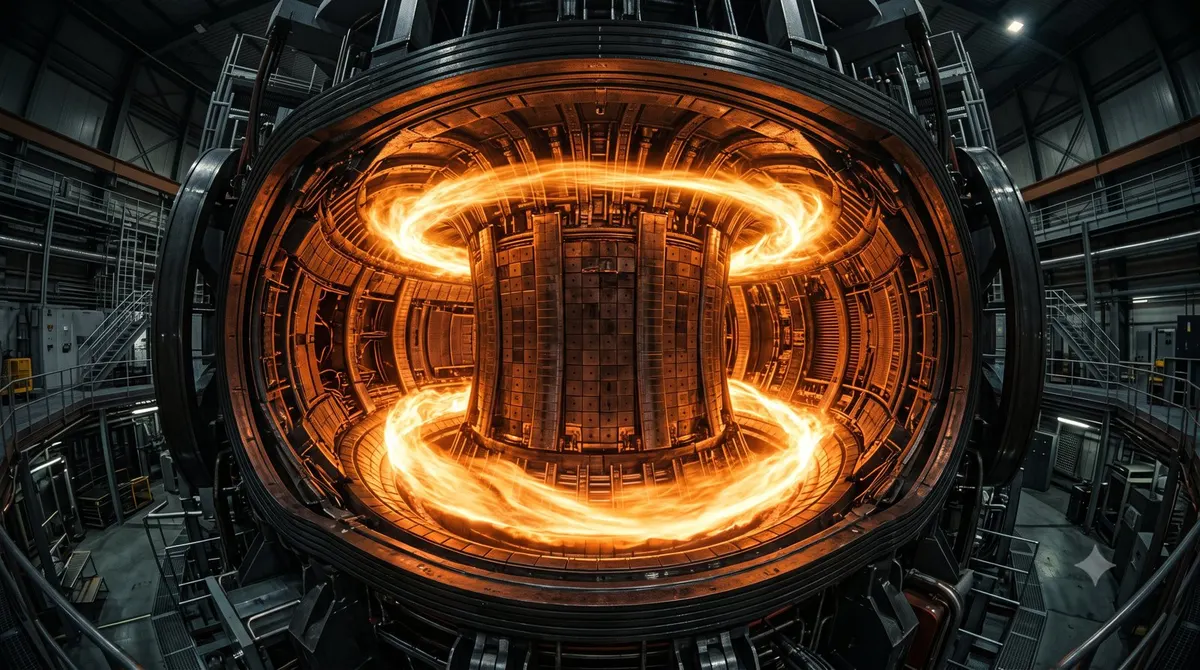
Every warm afternoon you have ever enjoyed was paid for by a furnace ninety-three million miles away. The Sun does not burn like a campfire. It fuses. Deep in its core, hydrogen nuclei are crushed together so hard that they merge, and each merger releases a flicker of energy. Multiply that by the unimaginable number of reactions happening every second, and you get sunlight, seasons, and life itself. For nearly a century, physicists have chased a single audacious idea: what if we could build a small piece of that furnace here on Earth?
What Fusion Actually Is
Everything around you is made of atoms, and at the heart of every atom sits a tiny, dense core called the nucleus. Fusion is what happens when two light nuclei are forced so close together that they stick and become a single, heavier one. The most promising fuel is a pair of hydrogen cousins called deuterium and tritium. Both are forms of hydrogen carrying a little extra weight in their nuclei. When they fuse, they form helium and fling out a fast-moving particle called a neutron, and that flying neutron carries away energy we can capture.
Here is the strange and beautiful part. The helium that comes out weighs very slightly less than the ingredients that went in. That missing mass has not vanished. It has been converted into energy, exactly as Einstein’s famous equation predicts, where a small amount of mass becomes an enormous amount of energy. Fusion is the most efficient energy release nature has on offer, which is why the stars run on it.
Why It Is So Hard
If fusion is so generous, why isn’t every city already powered by it? Because nuclei do not want to touch. Each one carries a positive electric charge, and like the same poles of two magnets, positive charges push each other away. To overcome that shove, you have to hurl the nuclei together at ferocious speed, which in practice means heating the fuel to staggering temperatures. The core of a working fusion reactor must reach well over a hundred million degrees, several times hotter than the center of the Sun.
At those temperatures matter stops behaving like an ordinary gas. The atoms are torn apart into a soup of free-floating nuclei and electrons called a plasma. Plasma is sometimes called the fourth state of matter, alongside solid, liquid, and gas, and it is what the Sun and most of the visible universe are made of. The whole challenge of fusion energy is holding a scrap of this million-degree plasma still long enough, and packed tightly enough, for the nuclei to fuse.
Holding the Sun in Place
You obviously cannot put hundred-million-degree plasma in a metal box, because it would melt any wall instantly. So engineers use two clever tricks to keep it away from anything solid.
- Magnetic confinement uses powerful magnetic fields to hold the plasma in a floating ring, never letting it touch the walls. The most common design is a doughnut-shaped chamber called a tokamak.
- Inertial confinement takes the opposite approach: it blasts a tiny fuel pellet from all sides with intense lasers, crushing it so fast and so hard that fusion happens in a fraction of a second before the fuel can fly apart.
Both methods work in the sense that they genuinely produce fusion reactions. The hard part has always been getting more energy out than you pour in to keep the plasma hot and confined. That break-even point is the finish line researchers have been sprinting toward for decades.
Why We Want It Anyway
The prize is worth the trouble. Fusion fuel is essentially limitless: deuterium can be extracted from ordinary seawater, and the amount in a bathtub of water holds a remarkable quantity of potential energy. Fusion produces no carbon dioxide and no long-lived, highly dangerous waste of the kind that fission reactors leave behind. And it cannot melt down, because the reaction is so delicate that any disturbance simply causes the plasma to cool and stop, rather than run away.
It helps to be clear about the difference from the nuclear power we already use. Today’s plants run on fission, which splits heavy atoms like uranium apart. Fusion joins light atoms together. They are opposites, and fusion’s promise is that it could deliver clean, steady power without the drawbacks that make people wary of fission.
Where We Stand
Progress has been real but hard-won, and the old joke that fusion is always thirty years away has a grain of truth to it. Still, recent years have brought genuine milestones. Laser-based experiments have managed to release more energy from the fuel than the lasers delivered to it, a landmark result that proved the underlying physics can cross the break-even line. Meanwhile a giant international magnetic-confinement project is being assembled, designed to sustain a burning plasma at power-plant scale, and a wave of private companies is racing to build compact reactors with new high-strength magnets.
None of this means fusion electricity will flow into your home next year. Turning a scientific demonstration into a reliable, affordable power station is an enormous engineering task that will take many more years. But the question has quietly shifted from whether fusion can work to how soon we can make it practical.
The Engineering Mountain
Even once a reactor reliably makes more energy than it consumes, a working power plant demands much more. The flying neutrons that carry away fusion’s energy also slam relentlessly into the reactor walls, gradually weakening the materials, so engineers must invent metals tough enough to survive years of that bombardment. The tritium fuel is rare and does not sit around in nature, so a plant has to breed its own supply, cleverly using those same escaping neutrons to manufacture fresh fuel from a blanket of lithium wrapped around the chamber.
Then there is the plasma itself, which is restless and prone to wobbling out of shape in ways that can quench the reaction in an instant. Keeping it stable calls for a constant, delicate dance of sensors and magnets making thousands of tiny corrections every second. None of these problems is a showstopper, but together they explain why the road from a promising experiment to a humming power station is measured in decades rather than years.
There is something humbling about the whole endeavor. For all our machines and mathematics, we are essentially trying to bottle a star: to coax matter into doing on a workbench what it does naturally only in the crushing hearts of the cosmos. If we succeed, we will have learned to light our world with the same fire that lights the sky. That is a goal worth a few more decades of patience.


