 Talking Science Podcast
Quantum Mechanics – The Rules That Make No Sense
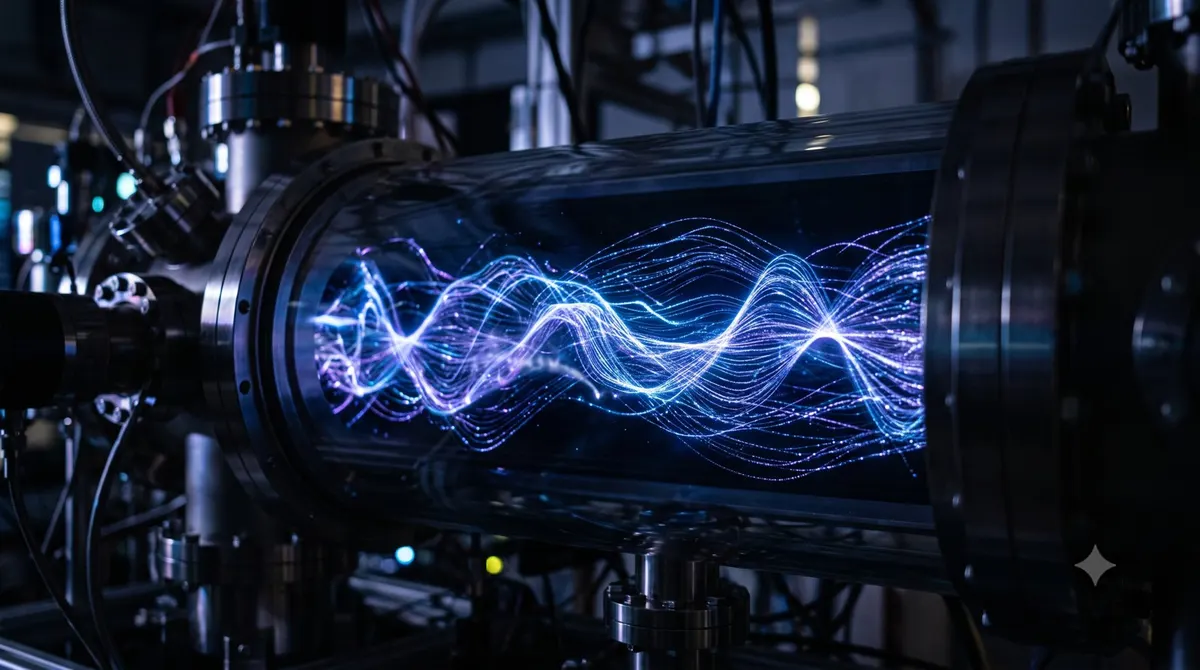
Imagine a world where a single particle can be in two places at once, where looking at something changes it, and where the future is ruled not by certainty but by odds. This is not science fiction. It is the everyday reality of the very small, described by a theory called quantum mechanics. It is one of the most successful ideas in all of science, underpinning lasers, computer chips, and medical scanners. And yet, more than a century after its birth, even the physicists who use it every day admit that nobody truly understands what it means.
The World Gets Grainy
Our story starts around the year 1900, when physicists ran into a wall. The rules they had trusted for centuries, the neat and tidy physics of Isaac Newton, worked beautifully for planets and cannonballs but fell apart when applied to atoms and light. To fix the cracks, scientists were forced to accept a bizarre idea: that energy does not flow smoothly, like water from a tap, but comes in tiny, indivisible lumps. These lumps are called quanta, and they give the whole theory its name.
Think of it like money. You cannot spend a third of a penny; the smallest coin sets a limit. In the quantum world, energy behaves the same way. Light, which we usually picture as a continuous wave, actually arrives in little packets we call photons. This granular nature of reality is invisible to us because the lumps are so unimaginably small, but for an atom, it changes everything.
Both Wave and Particle
Here is where things start to feel genuinely strange. Ask whether light is a wave or a stream of particles, and nature answers, maddeningly, both. Shine light through two narrow slits and it spreads out and overlaps, forming stripes on a screen exactly as ripples of water would. That is wave behaviour. But detect that same light gently enough and you find it arriving one photon at a time, like grains of sand. That is particle behaviour.
Stranger still, this two-faced nature is not limited to light. Electrons, the tiny particles that swarm around atoms, do it too. Fire electrons one by one at a pair of slits, and over time they build up the very same striped pattern, as if each single electron somehow passed through both slits and interfered with itself. No image from everyday life captures this properly, which is precisely the point. The quantum world does not owe us a comfortable picture.
Living With Uncertainty
In the 1920s, the physicist Werner Heisenberg uncovered a rule that shook people deeply. It says there is a fundamental limit to how much we can know about a particle at once. The more precisely you pin down where something is, the more hopelessly blurry its speed becomes, and the other way around. This is not a matter of clumsy instruments or sloppy measurement. It is woven into the fabric of reality itself.
This principle of uncertainty means the crisp, clockwork universe people once imagined simply does not exist at the smallest scales. A particle does not have a definite position and a definite speed sitting there waiting to be discovered. Instead, before you look, it exists as a haze of possibilities. Physicists capture this haze with a mathematical object called the wave function, which does not tell you where a particle is, but only the chances of finding it here or there.
The Trouble With Looking
So what happens when you actually measure a particle? The cloud of possibilities suddenly snaps into a single definite answer. Before you look, an electron might be smeared across many places; the instant you check, you find it at one spot. Physicists call this the collapse of the wave function, and it raises a deep and unsettling question: why should the simple act of observing decide reality?
This puzzle was captured by Erwin Schrodinger with his famous imaginary cat. He pictured a cat sealed in a box with a device that might or might not release a poison, its fate tied to a single quantum event. Until you open the box, the mathematics seems to describe the cat as both alive and dead at the same time. Schrodinger meant this as a challenge, a way of showing how absurd things become when quantum weirdness is scaled up to everyday objects. The absurdity has never fully gone away.
Spooky Connections
Perhaps the eeriest feature of all is entanglement. Two particles can be linked so intimately that measuring one instantly tells you about the other, no matter how far apart they are. Measure the first, and the second seems to respond in the very same moment, even if it sits on the other side of a room, or in principle the other side of the galaxy. Einstein disliked this so much he called it spooky action at a distance and suspected the theory was incomplete.
Yet decades of careful experiments have shown that entanglement is real, and that nature really does behave in this deeply connected way. Importantly, it does not let us send messages faster than light, so the cosmic speed limit stays intact. But it does mean the universe is stitched together far more tightly than our everyday intuition suggests. Today, entanglement is not just a curiosity; it is the beating heart of emerging quantum computers and ultra-secure communication.
Why We Trust the Madness
Given all this strangeness, why do scientists embrace quantum mechanics so wholeheartedly? The answer is simple: it works, with breathtaking precision. Its predictions have been tested again and again and match reality to an accuracy few other theories can rival. Every time you use a smartphone, scan a barcode, or benefit from an MRI, you are trusting your life and your data to quantum rules.
Quantum mechanics teaches a humbling lesson. The universe is under no obligation to make sense to creatures who evolved to dodge predators and pick fruit. At its foundation, reality runs on logic that feels alien, probabilistic, and blurry. And yet, from that strange foundation, the solid, dependable world of our experience somehow emerges. The rules make no sense to us, and still they build everything.


