 Talking Science Podcast
Sound – The Invisible Waves We Live In
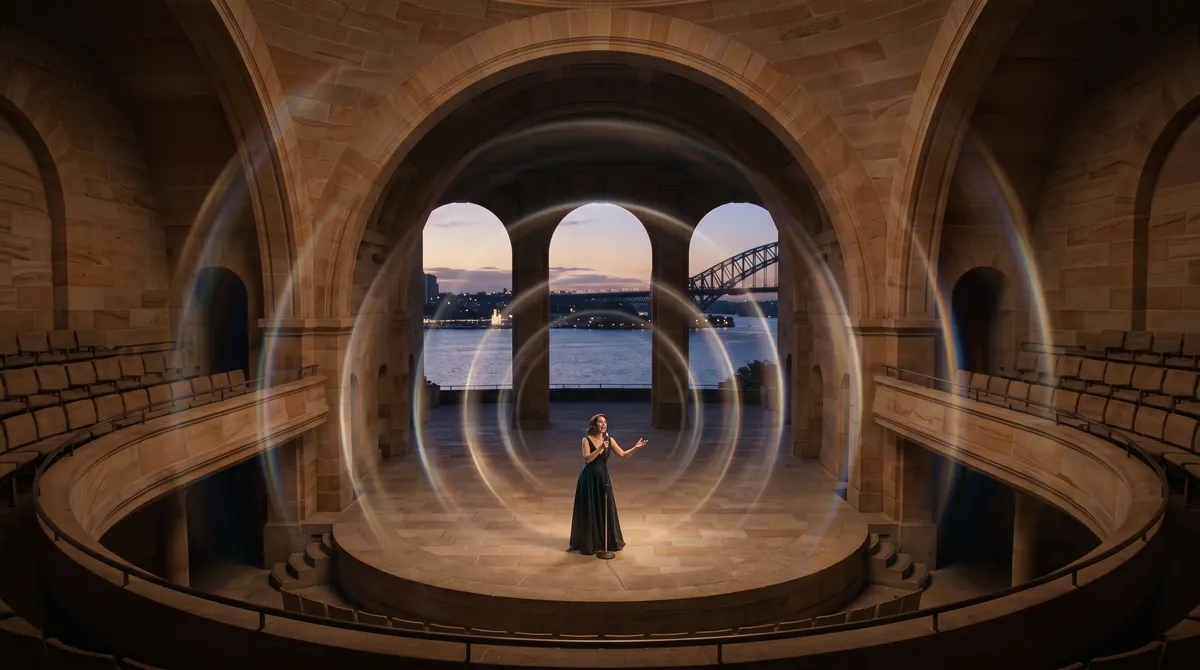
Sing in the shower and you sound better than you have any right to. Say the same words in a bedroom full of pillows and they fall flat. Put your ear to a metal railing while someone taps the far end and you hear the tap before the sound reaches you through the air. None of these is a trick of the mind. Each is a clue to what sound actually is, and to the fact that the material it travels through shapes almost everything about how it reaches us.
We live inside a constant sea of sound, so constant that we rarely think about it as a physical thing at all. Yet it is as physical as a push. Sound is a wave of pressure, rippling through whatever happens to be around, and once you see it that way, a surprising amount of everyday experience suddenly makes sense.
Something Has to Shake
Every sound starts with vibration. A guitar string, a drum skin, the cone of a speaker, the vocal cords in your throat: in each case something is moving rapidly back and forth. As it moves outward, it crowds the nearby air molecules together into a region of slightly higher pressure. As it swings back, it leaves a region of slightly lower pressure behind. Repeat that hundreds or thousands of times a second and you send out a train of squeezes and stretches, spreading in all directions like ripples from a stone dropped in a pond, only in three dimensions.
Importantly, the air itself does not travel from the guitar to your ear. Each molecule only jostles back and forth a tiny distance, nudging its neighbours as it goes. What travels is the pattern, the disturbance passed hand to hand. If you want the fuller story of how those ripples become speech and music, the companion piece Sound – How Vibrating Air Carries Meaning follows it into language. Here the focus is on the journey itself.
Why Space Is Silent
Because sound is a disturbance handed from particle to particle, it needs particles to work with. Take them away and there is nothing to pass the ripple along. That is why sound cannot cross a vacuum, and why space is genuinely silent. The roaring explosions in science-fiction films are pure invention.
Faster Through Water and Stone
We tend to think of sound as something that travels through air, but air is actually a fairly poor carrier. In liquids and solids the particles are packed much more closely and are more tightly linked, so they pass a disturbance along more quickly. Sound moves through water roughly four times faster than through air, and it can travel enormous distances underwater with little loss. Whales take advantage of this, and the low calls of some great whales can be detected across vast stretches of ocean. Off the Australian coast, researchers listen to humpbacks and blue whales with underwater microphones for exactly this reason.
Solids do even better. Sound races through steel many times faster than through air, which is why the old trick of listening at a railway line works, and why you can hear a neighbour's renovations through the walls and floor long before you would hear them through an open window. The medium is not a neutral backdrop. It decides how fast sound goes, how far it carries and how much of it survives the trip.
Pitch, Loudness and the Sounds We Miss
Two simple measurements describe any sound wave. Frequency is how many pressure ripples arrive each second, and we experience it as pitch: rapid ripples give a high whistle, slow ones give a low rumble. Amplitude is how big each squeeze is, and we experience it as loudness. A whisper and a jet engine can share the same pitch while differing hugely in amplitude.
Human hearing covers a generous range, very roughly from about 20 to 20,000 ripples per second in young people, with the top end falling as we age. But plenty of sound lies outside that window. Above it is ultrasound, which bats use to navigate and hunt in the dark and which dogs can hear well beyond our limit. Below it is infrasound, the deep rumbles that elephants are thought to use to keep in touch over long distances. Doctors use ultrasound too, building images from the echoes of high-frequency pulses. The world is full of sound that we simply are not built to notice.
From Ripple to Sensation
When a pressure wave does fall within our range, the ear converts it in a series of steps. The outer ear funnels it to the eardrum, which vibrates in step. Three tiny bones, the smallest in the body, pass that motion to the cochlea, a fluid-filled spiral lined with thousands of hair cells. Different hair cells respond to different frequencies, and when they bend they send electrical signals to the brain. Those hair cells are delicate, and in humans they do not grow back once damaged, which is why very loud or prolonged noise can cause lasting hearing loss.
Why Every Room Has a Voice
Now back to the shower. Sound does not travel only in a straight line from source to listener. It bounces. Hard, smooth surfaces such as tiles, glass and bare plaster reflect most of the sound that hits them, so it ricochets around the room and reaches your ear again and again in overlapping echoes. That lingering wash of reflections is called reverberation. In a small tiled bathroom it fills out a voice and smooths over its wobbles. In a vast stone cathedral it stretches each note into a long, majestic tail.
Soft, uneven surfaces do the opposite. Carpet, curtains, cushions, upholstered seats and even an audience soak up sound energy instead of returning it, so the echoes die quickly and the room sounds muffled and close. This is why an empty house sounds hollow on moving day and cosy once the furniture arrives.
Acoustic design is the craft of managing those reflections on purpose. Concert halls are shaped and lined so that music arrives rich but clear. Lecture theatres are tuned so that speech stays crisp at the back row. Recording studios often go further, using thick absorbent panels to strip out reflections almost completely. The Sydney Opera House is a famous example of how hard this can be: its main concert hall was acoustically renovated in recent years, partly to improve how musicians and audiences hear the sound. Behind every good-sounding room is a piece of applied physics.
Listening With New Ears
Sound turns out to be one of the most tangible things in nature: an object shakes, a medium carries the pattern, and the shape of the space around us colours what arrives. Knowing that does not drain the magic from music or a familiar voice. It adds to it, because every note you hear has made a real physical journey, pressed through air, perhaps through a wall or a window, bounced off a ceiling or two, and finally nudged a tiny membrane inside your head. The next time a room makes you sound wonderful, you will know it is the walls joining in.


