 Talking Science Podcast
Superconductors – Electricity Without Resistance
Imagine pushing a shopping cart that, once you get it rolling, never slows down. No friction, no drag, no need to push again. It simply keeps gliding forever. That is essentially what electricity does inside a superconductor. In these strange materials, an electric current can flow round and round with no loss at all, potentially for years, without any battery to feed it. It sounds like a violation of common sense, and yet it is one of the best-tested facts in physics.
The Problem With Ordinary Wires
To appreciate why this matters, start with an ordinary copper wire. When electricity flows through it, the moving electrons keep bumping into the atoms of the metal, jostling them and losing a little energy with every collision. That lost energy turns into heat. This is exactly how a toaster or an electric heater works, and it is also why the wires carrying power across a country waste a noticeable slice of their energy simply warming the air. Physicists call this stubborn friction electrical resistance, and for most of history it seemed unavoidable. Every material had some.
A Discovery in the Cold
Then, more than a century ago, a Dutch physicist cooling mercury to extreme lows noticed something impossible. As the temperature dropped toward the coldest reaches physics can reach, the mercury’s resistance did not just fall. It vanished completely, dropping abruptly to exactly zero. Below a certain sharp threshold, now called the critical temperature, the metal became a perfect conductor. Push a current into a loop of it and the current would circulate indefinitely, like that frictionless cart, never fading.
This was the birth of superconductivity, and it took another half-century for scientists to explain what was really going on. The rough picture is this: in a normal metal, electrons travel as lonely individuals, constantly colliding. In a superconductor, at low enough temperatures, the electrons pair up and move in a coordinated, cooperative dance. Bound into pairs and marching in lockstep, they slip past the atoms without the collisions that cause resistance. The material’s ordinary friction simply stops applying to them.
The Floating Magnet Trick
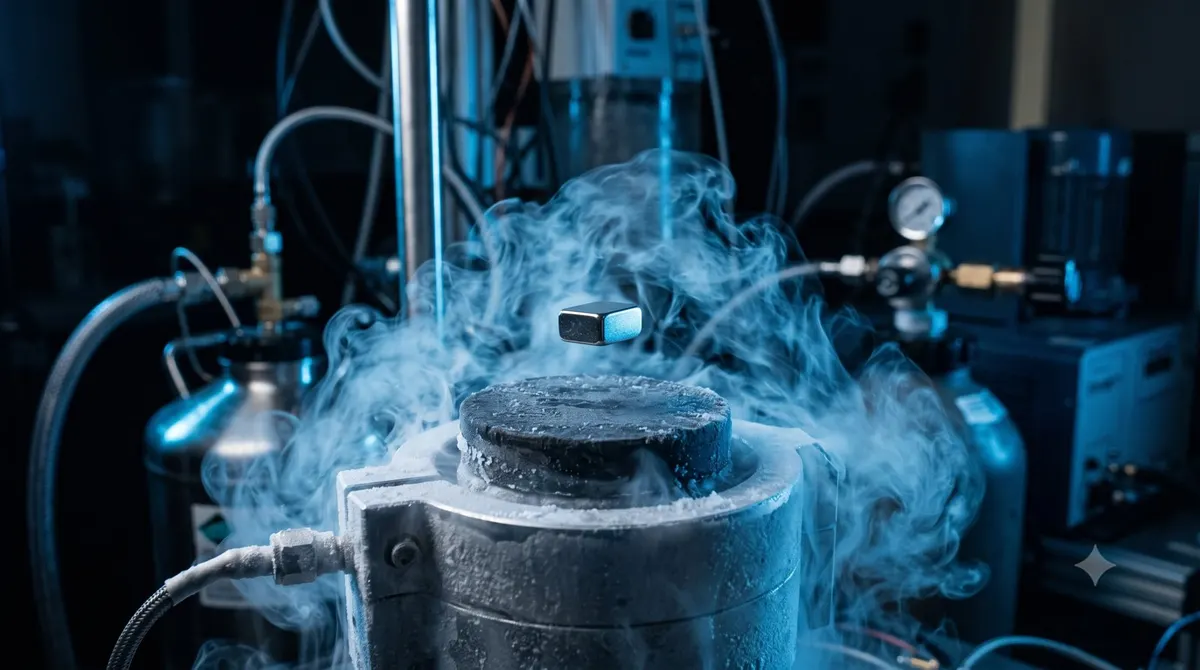
Superconductors have a second party trick that is just as remarkable as their zero resistance. They actively push magnetic fields out of their interior. If you cool a superconductor below its critical temperature and bring a magnet near, the material sets up its own current to cancel the magnet’s field inside itself. The result is that the magnet is repelled, and with a bit of care it will hover in mid-air above the superconductor, floating steadily with nothing holding it up.
This levitation is not a gimmick. It is a direct visual demonstration that something genuinely different is happening inside the material, and it points toward one of the most eye-catching applications: trains that float above their tracks on magnetic cushions, gliding with almost no friction. But the floating magnet is best understood as the everyday face of a deep quantum effect made large enough to see.
Where They Already Work
It is easy to think of superconductors as laboratory curiosities, but you may already have benefited from one. The most familiar example is the MRI scanner used in hospitals. An MRI needs an extremely strong, extremely steady magnetic field to peer inside the human body, and the only practical way to make one is to run a huge current through superconducting coils. Because there is no resistance, the current flows without wasting energy or overheating, holding a powerful field rock-steady for as long as the machine stays cold.
Superconductors also help steer particles around giant physics experiments, feature in some of the most sensitive detectors ever built, and are woven into the magnets that fusion researchers hope will one day contain a star’s worth of plasma. Wherever you need a strong magnetic field or a lossless current, they are the tool of choice.
The Catch, and the Dream
If superconductors are so wonderful, why isn’t every power line made of them? The answer is temperature. Traditional superconductors only work when chilled to hundreds of degrees below freezing, which requires expensive cooling with liquid helium. Keeping wires that cold across a whole country would cost far more than the energy saved. The magic only switches on in the deep cold.
This is why a discovery in the 1980s caused such excitement. Researchers found a new family of ceramic materials that superconduct at much higher temperatures, warm enough to be cooled by cheaper liquid nitrogen instead of helium. They are still very cold by human standards, but the leap was enormous, and it launched a worldwide hunt for the ultimate goal: a room-temperature superconductor that needs no cooling at all.
Such a material would be transformational. Power grids could carry electricity across continents without losing a watt. Motors and computers could shrink and sharpen. Levitating transport could become ordinary. The search is difficult and has seen its share of premature claims, so scientists treat every new announcement with careful skepticism until it is independently confirmed.
Why the Cold Still Pays Off
It might seem that needing deep cold would make superconductors hopelessly impractical, but in many cases the trade is well worth it. The reason is that some jobs simply cannot be done any other way. To generate the intense, unwavering magnetic fields an MRI scanner needs, you would have to pour a colossal, continuous flood of electricity through ordinary copper coils, and they would overheat and fail almost at once. A superconducting coil, once energized, holds the same field steadily using barely any power, and the cost of keeping it cold is small next to what the machine makes possible.
The same logic drives their use in the giant magnets of particle accelerators and the experimental reactors chasing fusion. In each case, the goal is a field so strong and so stable that no normal wire could survive producing it. Cooling is not a nuisance to be tolerated so much as the modest price of doing something otherwise impossible, which is why superconductors have quietly become indispensable in exactly the places that need the strongest magnets.
Superconductivity is a reminder that nature keeps surprises in its coldest corners. A property once thought impossible, current that never dies, turned out to be real, and it opened a door onto quantum behavior we can hold in our hands and watch float. Whether we ever tame it for room temperature or not, the perfect, frictionless flow of electrons remains one of the most quietly astonishing things the physical world allows.


