 Talking Science Podcast
The Higgs Boson – The Particle That Gives Mass
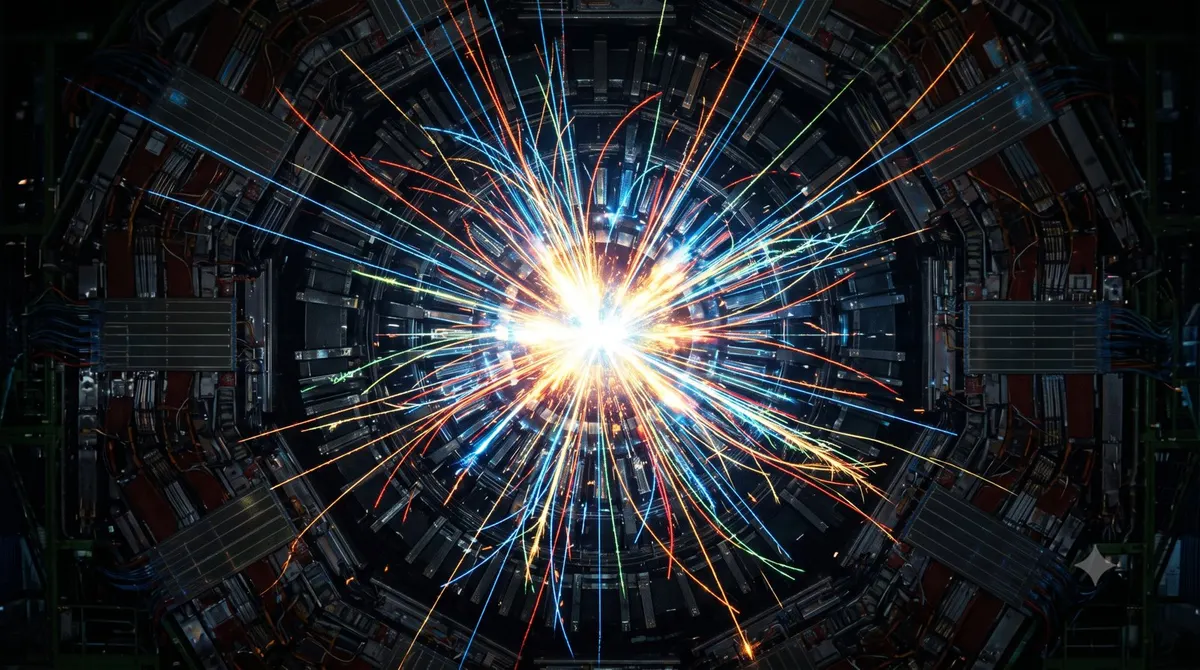
For almost half a century, physicists chased a ghost. They had built a beautiful theory describing the tiny building blocks of the universe, but it carried a stubborn flaw: the mathematics insisted that particles should have no mass at all, zipping about at the speed of light forever. That plainly is not the world we live in, where atoms hold together and stars burn steadily. The missing piece was a particle no one had ever seen, one that would take enormous machines and thousands of scientists to finally reveal. When it was found, the world got a rare glimpse of physics catching up with a bold prediction.
A Universe That Should Not Have Mass
To appreciate the puzzle, it helps to know what physicists mean by mass. In everyday life, mass is the “heft” of a thing, how much it resists being pushed around. A shopping cart full of bricks is harder to get moving than an empty one. In the subatomic world, the same idea applies: a particle with more mass is harder to accelerate.
The trouble was that the leading theory of particles, known as the Standard Model, worked wonderfully as long as its particles had no mass. Adding mass by hand broke the elegant symmetry that made the equations work. Physicists faced a dilemma: keep the beautiful math and lose reality, or keep reality and lose the math. Neither felt right.
An Invisible Field Fills All of Space
In the 1960s several physicists, including Peter Higgs and, working separately, Robert Brout and François Englert, proposed an ingenious escape. Suppose, they said, that all of space is filled with an invisible field, something like an ocean we cannot see or feel. Particles moving through this field would interact with it, and that interaction would slow them down, giving them the property we recognize as mass.
A helpful way to picture it: imagine walking across an empty room versus wading through waist-deep water. In the water you feel sluggish and heavy, not because you gained weight but because the water resists your motion. Particles that interact strongly with the field behave as though they are heavy; particles that barely interact, like the particle of light, stay massless and race along at full speed.
Every Field Has Its Particle
Here is where the story gets its famous character. In modern physics, every fundamental field has an associated particle, a kind of ripple or vibration in that field. The electromagnetic field has the photon; the proposed mass-giving field should have its own particle too. That particle became known as the Higgs boson.
Finding it would be the ultimate test. If the field truly existed, then jostling it hard enough should shake loose one of these ripples, and detectors could catch its fleeting signature. The catch was that the Higgs boson is heavy and unstable, decaying almost instantly into other particles. Producing one would require slamming particles together at staggering energies, energies far beyond anything nature serves up gently on Earth.
The Great Machine at CERN
The search culminated at CERN, the European physics laboratory near Geneva, where scientists built the Large Hadron Collider. It is a ring roughly 27 kilometres around, buried underground, in which protons are whipped to nearly the speed of light and smashed together head-on. Each collision briefly recreates conditions resembling the earliest moments after the birth of the universe.
Detecting a Higgs boson directly is impossible because it vanishes too quickly. Instead, researchers watched the debris of countless collisions, looking for the particular patterns of leftover particles that a decaying Higgs would leave behind. Because ordinary collisions also produce similar debris, the signal had to be teased out statistically from an ocean of background noise, a painstaking hunt across trillions of collisions.
A Discovery Announced to the World
In the summer of 2012, two independent teams at the collider announced that they had found a new particle with exactly the properties the Higgs boson was expected to have. The caution of the announcement, and the excitement behind it, reflected decades of anticipation. A theory sketched on paper in the 1960s had at last been confirmed by experiment. The following year, the Nobel Prize in Physics went to Higgs and Englert for the original idea.
The moment mattered for more than one particle. It confirmed that the mass-giving field is real, filling all of space and quietly shaping the matter around us. Without it, electrons would not settle into atoms, chemistry as we know it could not exist, and the familiar universe of stars, planets, and people would never have formed.
What the Higgs Does and Does Not Explain
It is worth clearing up a common misunderstanding. The Higgs field gives mass to fundamental particles like electrons and quarks, but most of the mass of ordinary matter does not come from the Higgs at all. The protons and neutrons in atomic nuclei get the bulk of their mass from the energy of the forces binding their internal parts together, a reminder that in physics, energy and mass are two faces of the same coin.
So the Higgs is not the source of all mass, but it is the crucial ingredient that lets fundamental particles be heavy in the first place. Take it away, and the whole structure unravels. It is a subtle point, but an important one, because it shows how the different pieces of modern physics fit together, with the Higgs field handling one specific job while the binding energy of the nuclear forces quietly does most of the heavy lifting.
There is another reason the Higgs matters so much to physicists. Its discovery filled the last empty slot in the Standard Model, the framework that lists all the known fundamental particles and describes how three of the four forces of nature behave. For decades the Higgs was the one predicted piece still missing from that picture. Confirming it did not just settle a single question; it validated the whole approach that had guided particle physics for a generation, giving researchers confidence that they were on the right track even as they continue to search for what lies beyond.
The story of the Higgs boson is, in a sense, a story about faith in mathematics. Physicists trusted their equations enough to predict an unseen particle and then spent decades building the tools to look for it. That the universe obliged, revealing the particle right where the theory said it should be, remains one of the most satisfying triumphs in the history of science, and a powerful sign that our strange, invisible descriptions of nature are pointing at something genuinely true.


