 Talking Science Podcast
The Large Hadron Collider – Smashing Atoms to Understand Everything
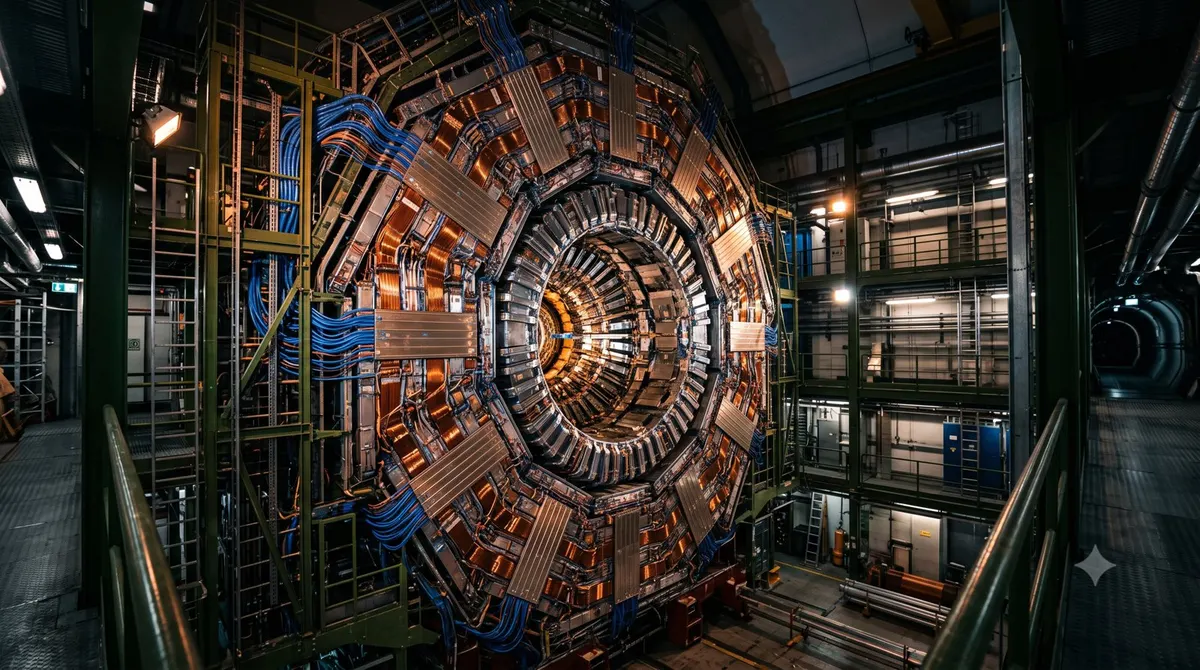
Deep beneath the border of France and Switzerland lies the largest and most complex machine humanity has ever built. It is a ring some seventeen miles around, buried underground, colder than outer space in parts, and capable of hurling tiny particles around its loop at very nearly the speed of light. When those particles smash together, they briefly recreate conditions not seen since the first instants after the Big Bang. This extraordinary instrument is the Large Hadron Collider, and it exists to answer the oldest question of all: what is everything made of?
A Cathedral of Science
The Large Hadron Collider, usually shortened to the LHC, is run by a European laboratory known as CERN. To call it big is an understatement. Its main tunnel forms a vast circular racetrack roughly seventeen miles in circumference, sitting around a hundred metres underground. Building it took decades of planning, thousands of scientists and engineers from around the world, and a level of international cooperation rarely seen in any human endeavour.
Inside the ring runs a pipe emptier than the space between planets, kept in an almost perfect vacuum so that stray air molecules do not get in the way. Powerful magnets, chilled to temperatures colder than deep space, steer the particles around the loop. Everything about the machine pushes at the limits of what technology can achieve. It is, in a very real sense, a cathedral built not to a god but to human curiosity.
Why Smash Things Together?
The basic idea behind the LHC is beautifully simple, even if the engineering is fiendishly hard. To understand what particles are made of, physicists accelerate them to enormous speeds and crash them into one another. In the violence of these collisions, the original particles can shatter and, more importantly, their energy can transform into brand new particles that did not exist a moment before.
This works because of Einstein’s famous insight that energy and mass are interchangeable. Pour enough energy into a tiny collision, and that energy can congeal into massive new particles, some of them heavy and exotic, some so short-lived they vanish almost instantly. By studying the debris that flies out, physicists can reconstruct what was created and learn about the fundamental rules of nature. The more energy you can pack into a collision, the heavier and rarer the particles you can hope to conjure into being.
Racing at Nearly Light Speed
To reach these staggering energies, the LHC accelerates beams of particles, usually protons pulled from ordinary hydrogen, to within a whisker of the speed of light. Two beams race in opposite directions around the ring, guided and focused by the machine’s magnets, until they are steered into head-on collisions at a handful of chosen points. At those points sit gigantic detectors, some as large as a cathedral hall themselves.
These detectors are marvels in their own right. When particles collide, the resulting spray of debris passes through layers of sensitive instruments that track the paths, energies, and identities of everything produced. The collisions happen hundreds of millions of times every second, generating a torrent of data so vast that powerful computers must sift through it, discarding the ordinary and flagging the rare events that might reveal something new. Finding an interesting collision is like finding a specific grain of sand on a very large beach.
The Hunt for the Higgs
The LHC’s most celebrated triumph came in 2012, with the discovery of a particle called the Higgs boson. For decades this particle had been predicted but never seen. It was the missing piece of the Standard Model, our best theory of particles and forces, and it was tied to a profound question: why do particles have mass at all? The theory held that an invisible field fills all of space, and that particles gain mass by interacting with it.
The Higgs boson is the telltale ripple in that field, and detecting it would confirm the whole picture. But it is fantastically rare and decays almost instantly, so finding it required smashing protons together countless times and painstakingly sifting the wreckage. When two separate detector teams announced they had found it, working independently as a cross-check, it was a landmark moment for science. The particle theorists had dreamed up nearly fifty years earlier had finally been caught.
Rewinding the Universe
Beyond hunting specific particles, the LHC lets scientists peer back toward the very beginning of time. The extreme energies of its collisions momentarily recreate conditions that existed just fractions of a second after the Big Bang, when the universe was unimaginably hot and dense. In effect, the machine is a kind of time machine, letting us glimpse the physics of the infant cosmos in a controlled laboratory setting.
By studying these tiny fireballs, physicists learn how matter behaved in that fiery dawn and how the familiar particles of today first emerged. The LHC also probes some of the biggest open mysteries in science. Researchers use it to search for clues about dark matter, the invisible substance that seems to fill the universe, and to test whether there are undiscovered particles or forces beyond those we already know.
Curiosity Made of Steel
Some people ask what the point of all this is, whether such an enormous and expensive machine is worth building just to study particles too small to see. The honest answer is that the LHC is driven above all by curiosity, by the deep human desire to understand what reality is made of and where it all came from. That same curiosity has, throughout history, delivered unexpected practical rewards, from medical technologies to the very foundations of modern computing.
The Large Hadron Collider stands as a monument to what people can achieve when they pool their talents across borders in pursuit of knowledge for its own sake. It smashes atoms not to destroy, but to understand, coaxing the universe into revealing its most fundamental secrets one collision at a time. In its cold tunnels and colossal detectors, humanity is quite literally taking the universe apart to see how it works.


