 Talking Science Podcast
The Standard Model – The Universe’s Ingredient List
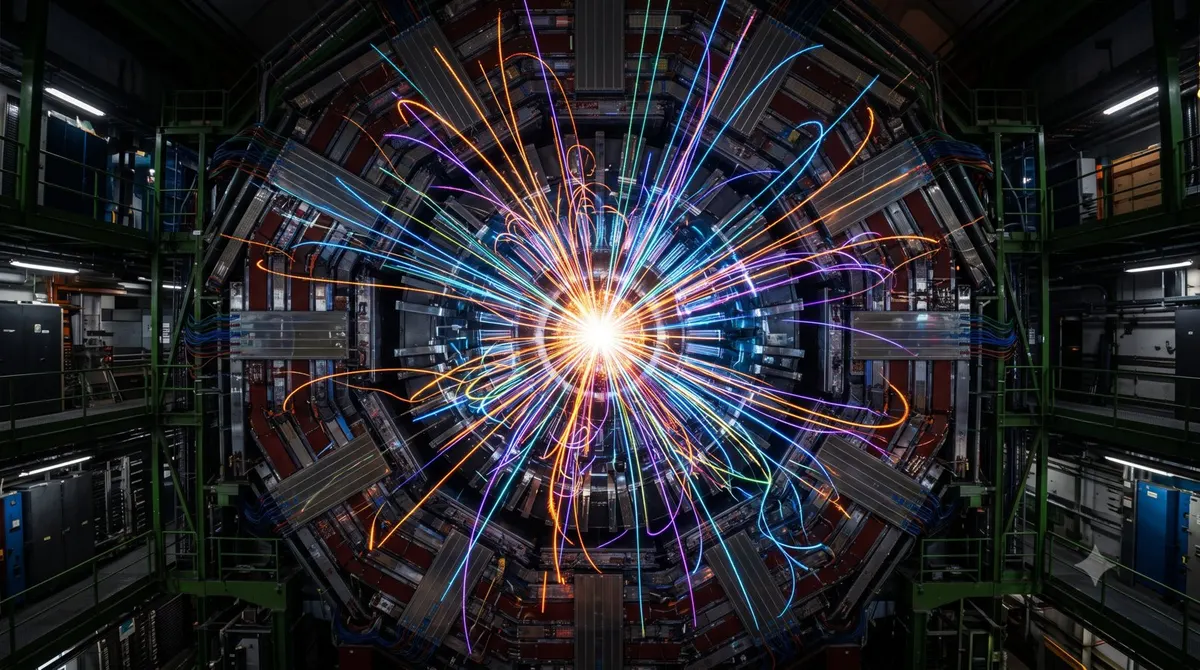
Every recipe has an ingredient list, and the universe is no exception. Strip away the galaxies, the planets, the oceans, and your own body, and you arrive at a surprisingly short roster of fundamental building blocks. Physicists have spent a century assembling this list, and the result is one of the crowning achievements of human thought. It is called the Standard Model of particle physics, and it describes, with astonishing precision, what everything is made of and how it holds together.
Splitting the Uncuttable
For a long time, people believed atoms were the smallest, most indivisible pieces of matter. The very word atom comes from a Greek term meaning uncuttable. But the twentieth century revealed that atoms are not the end of the story at all. Each atom has a dense central nucleus surrounded by a cloud of tiny particles called electrons. Crack open the nucleus, and you find protons and neutrons packed together. Crack those open, and you discover something deeper still.
Protons and neutrons are not fundamental. They are made of even smaller particles called quarks, glued together in threes. So the tidy picture of atoms as ultimate building blocks dissolved, and in its place emerged a richer, stranger inventory. The Standard Model is our best catalogue of the genuinely fundamental particles, the ones that, as far as we can tell, are not made of anything smaller.
What makes this catalogue so satisfying is its economy. From an inventory you could nearly write on the back of an envelope, nature assembles the entire visible universe, from the iron in your blood to the light of distant stars. The particles combine and recombine according to a handful of rules, and out of that simplicity springs staggering variety. Understanding the list is, in a real sense, understanding the alphabet from which all physical things are spelled.
The Matter Particles
The particles that make up ordinary matter fall into two families. The first are the quarks. There are six types, whimsically named up, down, charm, strange, top, and bottom. For everyday matter, only the two lightest count: up and down quarks combine to form the protons and neutrons in every atomic nucleus. The heavier quarks appear only fleetingly in high-energy collisions before decaying away.
The second family are the leptons, and the most familiar of these is the humble electron. Alongside it sit two heavier cousins and three ghostly particles called neutrinos, which barely interact with anything at all. Trillions of neutrinos stream through your body every second, straight through, as if you were not there. Together, quarks and leptons form the complete list of matter ingredients, and remarkably, nearly everything you see is built from just a handful of them.
The Forces That Bind
Ingredients alone do not make a cake; you need something to bring them together. In the universe, that job falls to the fundamental forces, and the Standard Model describes three of them. Each force is carried by its own kind of particle, a tiny messenger that passes between bits of matter and makes them push, pull, or stick.
The electromagnetic force, carried by particles of light called photons, governs electricity, magnetism, and the way electrons cling to atoms. The strong force, carried by particles called gluons, acts like a powerful glue that binds quarks into protons and neutrons and holds the nucleus together. The weak force, carried by heavier messengers, is subtler; it drives certain kinds of radioactive decay and powers the nuclear reactions that make the Sun shine. Notably, gravity is missing from this list, a gap we will return to.
The Particle That Gives Mass
For decades, the Standard Model had a glaring hole. The mathematics worked beautifully, but only if the fundamental particles started out with no mass at all, which plainly contradicts reality. Something had to explain why particles weigh anything. The proposed answer was an invisible field spread throughout all of space, later named the Higgs field, which particles drag against as they move, acquiring mass in the process.
Think of it like wading through water. Some particles push through easily and stay light, while others feel more resistance and become heavy. The theory predicted that this field should have its own particle, the Higgs boson. Finding it became one of the great quests of modern science, and in 2012, experiments at a giant underground machine finally confirmed it existed. The last missing piece of the model clicked into place, and the physicists who first proposed it lived to see their idea vindicated.
A Triumph With Cracks
The Standard Model is spectacularly successful. It predicts the behaviour of particles to a precision that is almost hard to believe, matching experiments to many decimal places. No laboratory result has ever clearly broken it. If you want to know what a particle will do, this model tells you, again and again, with uncanny accuracy. As a description of the small-scale world, it stands among the finest theories humanity has ever built.
And yet, physicists know it cannot be the final word. For all its triumphs, the Standard Model is incomplete, and its authors are the first to admit it. There are things it simply cannot explain, deep mysteries that hint at a larger, hidden picture we have not yet uncovered.
What the Recipe Leaves Out
Consider what is missing. The model says nothing about gravity, the force that shapes stars and galaxies, leaving one of the four fundamental forces out of the recipe entirely. It offers no account of dark matter, the mysterious unseen substance that seems to outweigh ordinary matter several times over across the cosmos. Nor does it explain dark energy, the strange influence driving the universe to expand ever faster. It also cannot say why matter so overwhelmingly won out over antimatter in the early universe.
So the Standard Model is both a masterpiece and a signpost. It is the most complete ingredient list we possess, capturing the ordinary matter and forces that build our world with unmatched precision. But its very gaps point beyond itself, toward physics still waiting to be discovered. The recipe we hold is real and reliable, yet the full cookbook of the universe remains gloriously unfinished.


