 Talking Science Podcast
Time Dilation – Why GPS Satellites Disagree With Your Watch
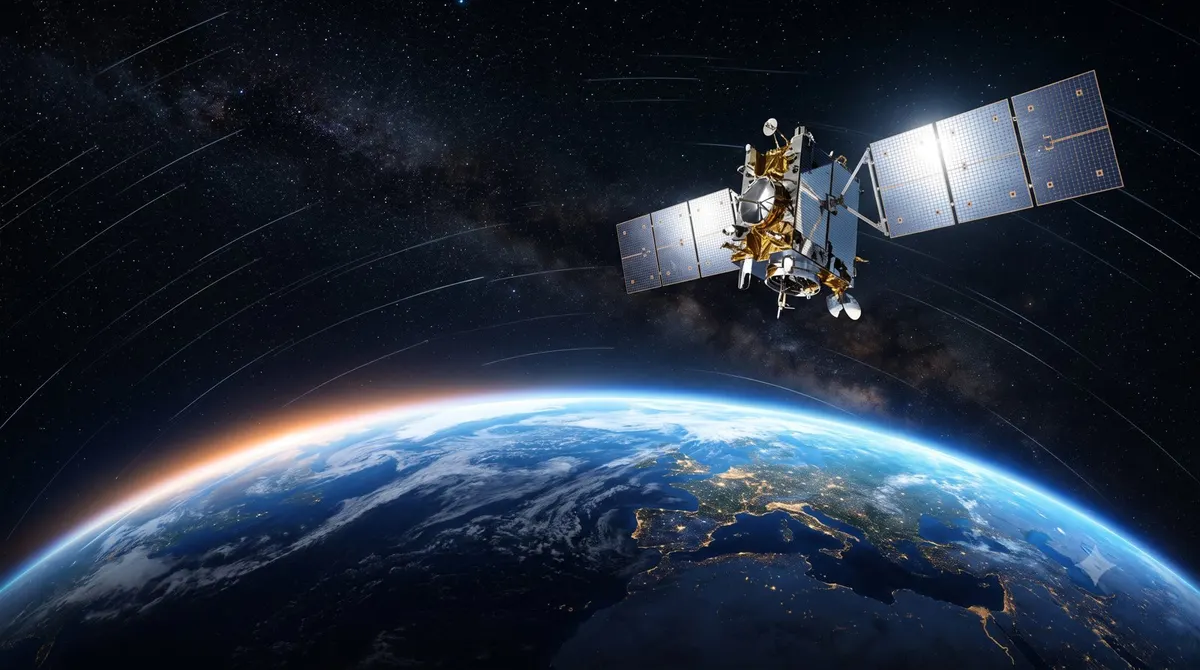
You probably trust your phone to know exactly where you are. What you may not realise is that the satellites making this possible carry clocks that tick at a slightly different rate than the watch on your wrist, and that engineers must correct for this difference every single day, or your navigation would drift badly off course within hours. The reason reaches to the very heart of how the universe works. Time, it turns out, is not the steady, universal thing we imagine. It stretches and shrinks depending on how fast you move and where you are.
Time Is Not the Same for Everyone
We tend to assume that a second is a second, the same for everyone everywhere. It is one of the most natural assumptions in the world, and it is wrong. In the early twentieth century, Albert Einstein overturned this idea with his theories of relativity, showing that time is flexible. Two people can experience different amounts of time between the same two events, and both are equally correct.
This stretching of time is called time dilation. The effects are far too small to notice in everyday life, which is why the idea feels so strange. But they are real, they have been measured many times, and modern technology depends on accounting for them.
Speed Slows Time Down
The first source of time dilation comes from motion. According to Einstein’s special relativity, the faster you move relative to someone else, the slower your clock ticks from their point of view. A clock racing past you runs slow compared with one sitting still beside you.
The key to why this happens is a strange fact about light: its speed is the same for every observer, no matter how they are moving. That single stubborn rule forces space and time to bend and adjust so that the speed of light always comes out the same. One consequence is that rapid motion eats into the passage of time. At the everyday speeds of cars and planes the effect is minuscule, but for satellites orbiting at thousands of kilometres per hour it becomes something engineers cannot ignore.
Gravity Slows Time Too
There is a second, separate effect, and it comes from gravity. In Einstein’s general relativity, gravity is understood as a warping of space and time caused by mass. A large mass like the Earth bends the fabric of spacetime around it, and one result is that clocks closer to a massive object tick more slowly than clocks farther away.
In other words, time runs a touch slower at sea level than on a mountaintop, and slower on the ground than high up in orbit. The difference is tiny, but it has been confirmed with precise clocks, even ones separated by heights of just a metre or so. The stronger the gravity, the more time drags.
Two Effects Pulling in Opposite Directions
Now bring these ideas together and point them at a navigation satellite. Such a satellite is doing two things at once. It is moving very fast, which by the motion effect makes its clock run slow compared with a clock on the ground. But it is also high up, far from the strongest pull of Earth’s gravity, which by the gravity effect makes its clock run fast compared with one on the surface.
The two effects push in opposite directions, but they do not cancel out. For a satellite at the altitude used for navigation, the gravity effect wins. The net result is that the satellite’s clock runs slightly fast compared with clocks on the ground, gaining a small fraction of a second each day.
Why a Tiny Error Would Wreck Navigation
A fraction of a second sounds trivial, but navigation is exquisitely sensitive to timing. Here is why. A satellite works out your position by comparing the timing of signals, which travel at the speed of light. Because light covers enormous distances in a single second, even a tiny timing error translates into a large error in distance.
If the clocks were left uncorrected, the position your phone reports would not stay slightly off; it would drift further and further wrong as the errors piled up through the day, quickly growing to hundreds of metres and then far more. The clean blue dot on your map would wander uselessly. To prevent this, the satellites are deliberately engineered so that, once relativity is accounted for, their clocks stay in step with clocks on the ground.
Everyday Proof of a Strange Universe
What makes this story so striking is that satellite navigation is a working, everyday confirmation of Einstein’s ideas. These are not abstract theories confined to blackboards and thought experiments. They are baked into a system that billions of people carry in their pockets and rely on to find their way.
Scientists have tested time dilation in many other ways as well. Precise clocks flown on aircraft return showing slightly different times than identical clocks left on the ground. Particles created high in the atmosphere, which should decay almost instantly, survive long enough to reach the surface precisely because their fast motion stretches out their internal clocks. Modern atomic clocks are now so accurate that researchers can even measure the gravitational slowing of time between two clocks separated by a difference in height of just a few centimetres. Again and again, the universe confirms that time is flexible.
It is worth pausing on how counterintuitive this all is. Nothing in our daily experience prepares us for the idea that raising a clock a little higher, or setting it moving a little faster, changes how much time it records. Our intuitions were shaped by a world of slow speeds and modest heights, where these effects are far too small to sense. Only when we build instruments of extraordinary precision, or send objects racing around the planet, does the true, flexible nature of time reveal itself.
So the next time your phone quietly guides you to a new address, spare a thought for the invisible physics at work overhead. High above, clocks are ticking at their own pace, faster than yours, and clever engineering is bridging the gap. It is a small daily miracle, and a reminder that the strange, beautiful rules Einstein uncovered are not distant abstractions. They are woven into the ordinary fabric of modern life, shaping something as simple as knowing where we stand.


