Talking Science Podcast
Animal Intelligence – Minds Unlike Our Own
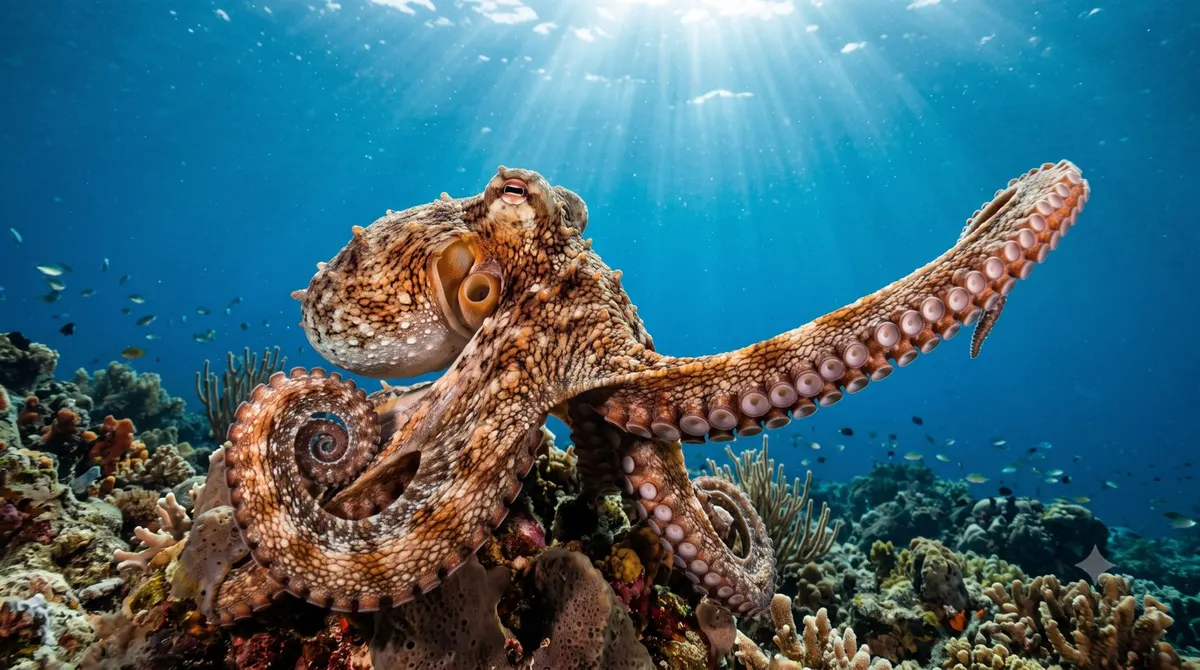
An octopus unscrews a jar to reach the crab inside. A crow bends a piece of wire into a hook to fish food from a tube. A dolphin recognizes itself in a mirror. For most of history, we told ourselves a comfortable story: humans think, and animals merely react, running on instinct like clever machines. The more closely scientists look, the harder that story is to defend. The animal world is full of minds—just not minds shaped like ours.
The trouble with measuring intelligence
Part of the challenge is that we tend to measure other animals against ourselves. We ask whether they can use language, solve human-style puzzles, or do the things we happen to be good at. But intelligence is not a single ladder with humans at the top and everything else ranked below. It is better imagined as a sprawling bush, with different creatures evolving different mental tools to solve the particular problems their lives throw at them.
A migrating bird navigating thousands of miles using the stars and the Earth’s magnetic field is doing something no unaided human could manage. A dog reading a world of information in scents we cannot even detect lives in a richer olfactory reality than we do. Calling one of these smarter than the other misses the point. Each mind is exquisitely tuned to its own way of life.
It helps, too, to separate intelligence from raw brain size. For a long time people assumed bigger brains meant smarter animals, with humans conveniently near the top. But some of the cleverest creatures we know have small brains built on entirely different plans. Certain birds pack an astonishing number of neurons into a brain the size of a walnut, and the octopus distributes much of its nervous system down its arms, so that in a sense it thinks with its whole body. Intelligence, it turns out, can be assembled in many ways.
Tool users and problem solvers
Still, some animals display the kind of flexible cleverness that stops us in our tracks. Certain crows and their relatives are among the most striking. Members of this family have been seen crafting tools, bending materials into hooks, and even solving multi-step puzzles where they must use one tool to obtain another before reaching a reward. This is not blind trial and error; it looks a great deal like planning.
Chimpanzees strip leaves from twigs to fish termites from their mounds and use stones to crack nuts, passing these techniques from one generation to the next. Octopuses, whose lineage split from ours an almost unimaginably long time ago, solve problems, escape enclosures, and seem to show curiosity and even something like play. That an animal so distantly related to us, with a nervous system organized so differently, can be so inventive suggests intelligence has evolved more than once, by more than one route.
Memory, planning, and the sense of time
Intelligence is not only about solving puzzles in the moment. Some animals show signs of remembering the past and preparing for the future. Certain birds hide thousands of food items across a wide area and later recall where they buried them, apparently keeping track of not just the location but which caches will spoil first—returning to the perishable ones before they rot.
This kind of behavior hints at a memory for specific events, not just general habits, and at some ability to act with the future in mind. Squirrels caching nuts for winter, and predators that seem to anticipate the movements of their prey, suggest that many animals live in a world with a past and a future, not just an eternal present. The old assumption that only humans can mentally travel through time looks increasingly shaky.
Feeling and knowing others
Perhaps the most moving discoveries concern the social and emotional lives of animals. Elephants show intense interest in the bones of their dead, touching and lingering over them in ways that are hard to explain away. Many social animals appear to console distressed companions, cooperate to reach shared goals, and remember who has helped or wronged them.
A handful of species—great apes, dolphins, elephants, and some others—can recognize themselves in a mirror, a classic test of self-awareness that many animals fail. Meanwhile, research on creatures we once dismissed as simple keeps overturning our assumptions. Even fish and insects show more sophisticated behavior than anyone expected a generation ago, learning, remembering, and responding to their fellows in surprisingly nuanced ways.
Communication, too, is turning out to be richer than we assumed. Many social animals use varied calls, gestures, and signals to coordinate, warn one another of danger, and even, it seems, refer to specific things in their world. Some species have distinct alarm calls for different predators, so that a single sound can mean roughly “eagle above” or “snake below.” This is not human language, but it is a reminder that the line we drew around ourselves as the only communicators was always more of a hopeful assumption than a settled fact.
Why we keep underestimating them
Why did we get this so wrong for so long? Part of the reason is that recognizing minds in animals raises uncomfortable questions about how we treat them. Part of it is simple bias: it is easy to overlook intelligence that does not resemble our own. And part of it is the genuine difficulty of the science. We cannot ask an octopus what it is thinking, so researchers must design ingenious experiments to peer into minds that cannot speak.
There is also the opposite danger to guard against—reading too much into animal behavior, seeing human thoughts and feelings where there are none. Good science walks a careful line, neither denying animals their real abilities nor projecting our own imaginations onto them. The goal is to understand each creature on its own terms.
What emerges from all this is a humbler and far more wonderful picture of life on Earth. We are not the lonely possessors of thought on an otherwise mindless planet. We are one branch among many, sharing the world with a vast array of minds—some that navigate by starlight, some that see in smells, some that solve problems with eight arms. To take animal intelligence seriously is not to make animals more like us. It is to open our eyes to the astonishing variety of ways there are to be a thinking thing.