Talking Science Podcast
Fossils – How Life Turns to Stone
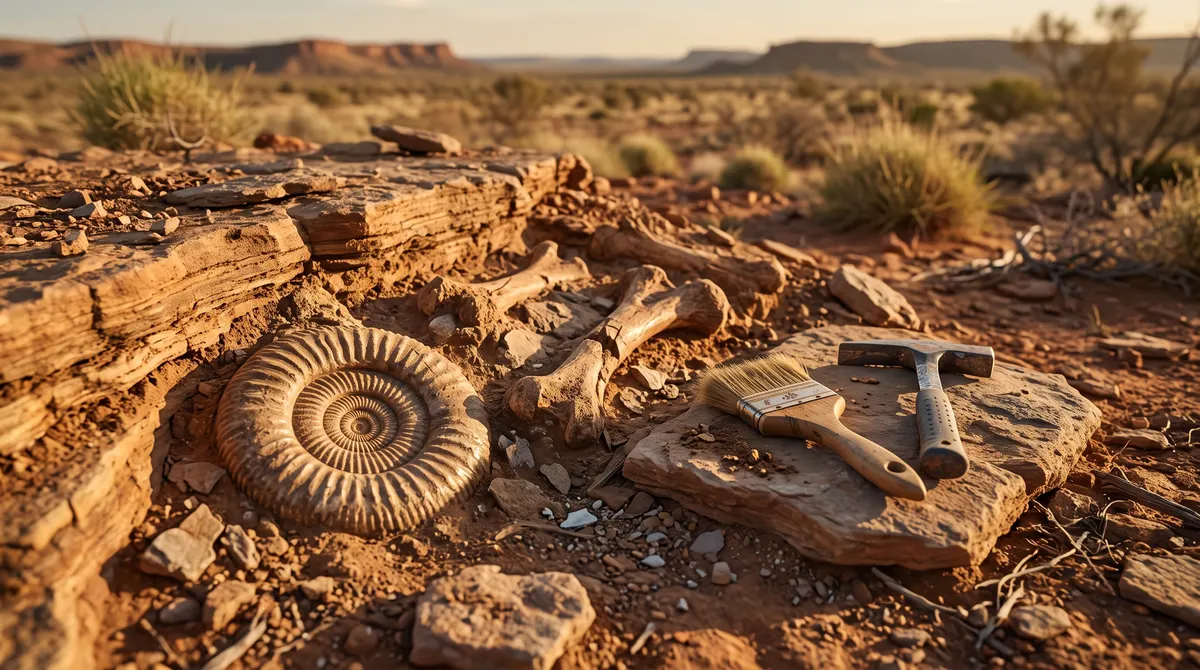
Walk through the fossil hall of a big museum and it can seem as if the past is crowded with skeletons. Dinosaurs tower over you, ancient fish lie pressed into slabs of stone, and drawers are full of shells and teeth. It is easy to come away thinking that turning into a fossil is a fairly normal thing to happen after death.
In fact it is extraordinarily rare. Most living things that have ever existed vanished without leaving any trace at all. Every fossil is the survivor of a long chain of lucky accidents.
Why Fossilisation Is So Rare
When an animal or plant dies, the natural world gets to work recycling it. Scavengers tear it apart, insects and microbes break down the soft tissues, and weather and water scatter and dissolve whatever remains. Within a few years, often much sooner, there is nothing left.
For a fossil to form, that process has to be interrupted. The odds improve dramatically when a few conditions come together:
- Rapid burial in mud, sand or volcanic ash, which hides remains from scavengers and the weather.
- Low oxygen, which slows the microbes that drive decay.
- Hard parts such as bones, teeth, shells and wood, which last far longer than skin or muscle.
- Stable surroundings over millions of years, so the rock is not melted, crushed or eroded away.
That is why the fossil record is strongly biased. Shellfish living on muddy sea floors are common as fossils, while jellyfish, worms and animals that lived on dry hillsides are rare. Even once a fossil forms, it must survive the slow churn of the rock cycle and then be exposed at the surface at just the right time for someone to find it.
The Many Ways Life Turns to Stone
"Fossil" covers several quite different kinds of evidence.
Permineralisation is the classic way bones and wood become stone. After burial, groundwater seeps through the tiny pores and spaces inside the remains, and dissolved minerals such as silica or calcite slowly crystallise there. The original structure is preserved in fine detail, sometimes down to individual cells, while the remains become heavy and rock-like. In some cases the original material is gradually replaced altogether, molecule by molecule, as in petrified wood.
Moulds and casts form when an organism is buried and then dissolves away completely. It leaves a hollow in the rock with its shape, which is a mould. If that hollow later fills with minerals or sediment, the result is a cast, a natural replica of the original.
Trace fossils preserve behaviour rather than bodies: footprints, burrows, bite marks, nests and even fossilised dung. They can reveal how fast an animal walked or whether it lived in groups. At Lark Quarry near Winton in Queensland, thousands of small dinosaur footprints are preserved in what was once the muddy edge of a lake.
Windows of Exceptional Preservation
Every so often, conditions are so perfect that even soft tissues are preserved: feathers, skin, eyes, guts and delicate creatures that usually leave nothing behind. Palaeontologists call these remarkable deposits Lagerstätten, a German word meaning roughly "storage places".
Famous examples include Canada's Burgess Shale, which preserves strange soft-bodied sea creatures from more than 500 million years ago, and the fine limestone of Solnhofen in Germany, home of the feathered Archaeopteryx. Lagerstätten matter because they show the parts of ancient ecosystems that ordinary fossils miss.
How Fossils Are Dated
Scientists use two broad approaches to work out how old a fossil is.
Relative dating relies on the order of rock layers. In undisturbed sediments, deeper layers were laid down before the ones above them, so fossils lower down are older. Certain widespread, short-lived species, known as index fossils, help geologists match layers of the same age in different parts of the world.
Absolute dating gives an age in years. Most fossils cannot be dated directly. Instead, geologists date layers of volcanic ash or lava above and below the fossil using radioactive elements such as uranium and potassium, which decay at known rates. That brackets the fossil between two ages. Radiocarbon dating only works on material up to roughly 50,000 years old, so it is useless for dinosaurs.
Gaps in the Record, and What They Mean
Because fossilisation is so rare, the record will always have gaps. Critics of evolution sometimes point to these as a weakness, but an incomplete record is exactly what science expects.
What matters is that the fossils we do find appear in a consistent order. Simple life comes before complex life, fish before amphibians, and reptiles before mammals and birds. No one has ever found a rabbit in rocks from before the age of animals. The record also makes testable predictions. In 2004, researchers searching rocks of the right age in the Canadian Arctic found Tiktaalik, a fish with features of the limbed animals that would later walk on land, in the kind of rock and time period they had predicted. Fossils are one strand of evidence alongside genetics and anatomy, as our piece on evolution by natural selection explains.
Riversleigh: A Library of Australian Mammals
In north-west Queensland, in Boodjamulla National Park, lies Riversleigh, one of the richest fossil mammal sites in the world. Its fossils span a long stretch of roughly the last 25 million years, recording how Australia's animals changed as the continent drifted north and its rainforests gave way to drier country.
Many of the fossils were preserved in lime-rich pools and caves, where bones were sealed in limestone with little crushing. Researchers often free them by soaking blocks of rock in weak acid, which dissolves the limestone and leaves the bones behind in remarkable three-dimensional detail. Riversleigh has yielded ancient platypuses, marsupial lions, early relatives of the thylacine, huge flightless birds and a great many bats. Together with the Naracoorte Caves in South Australia, it is World Heritage listed as one of the Australian Fossil Mammal Sites.
The Flinders Ranges and the Dawn of Animals
Far older are the fossils of the Ediacara Hills in South Australia's Flinders Ranges. In 1946, geologist Reg Sprigg noticed strange impressions in the sandstone there. They turned out to be some of the earliest large, complex living things known, dating from more than 550 million years ago, before the burst of animal life in the Cambrian.
These soft-bodied organisms, such as the flat, ribbed Dickinsonia, were preserved as impressions when sand buried them on sea floors covered with microbial mats. For decades scientists debated what they were. Chemical traces found in Dickinsonia fossils have since strengthened the case that it was an early animal.
The site is so important that in 2004 geologists named a new period of Earth history after it: the Ediacaran, the first new geological period added in more than a century. The marker that defines the start of that period sits in the Flinders Ranges.
Rare Survivors of a Vast Past
Every fossil is an improbable survivor: something that was buried quickly, escaped decay, outlasted millions of years of heat and pressure, and was then exposed and noticed. Read carefully, with rock layers and atomic clocks to give them dates, these rare survivors let us reconstruct the history of life, from the soft-bodied pioneers of the Flinders Ranges to the marsupials of Riversleigh.