Talking Science Podcast
Batteries – How We Store Energy
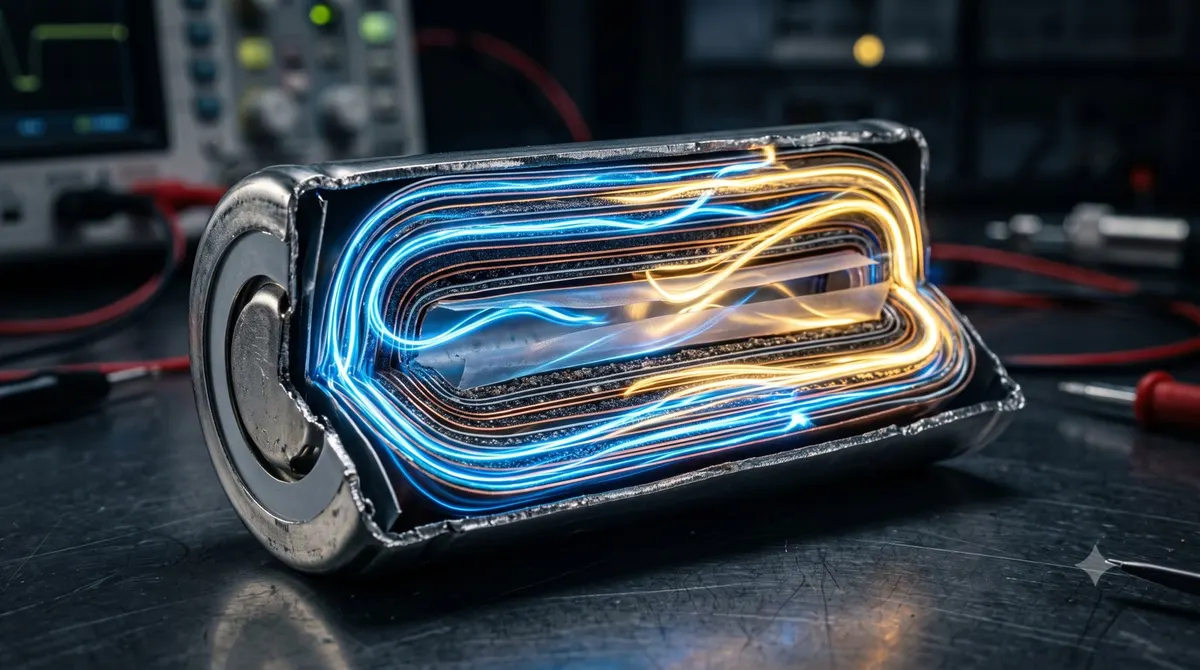
Reach into your pocket, glance at your wrist, or look at the car in your driveway, and chances are a battery is at work. These unassuming objects have become the invisible backbone of modern life, storing energy so we can carry it wherever we go. Yet most of us rarely stop to wonder what actually happens inside them. The answer is a beautiful piece of chemistry, one that has been refined over two centuries and is now reshaping how the whole world uses energy.
Bottling Electricity
The core challenge a battery solves is simple to state and hard to achieve: electricity is difficult to store. You cannot easily keep a current sitting in a jar the way you might store water. A battery gets around this by not storing electricity directly at all. Instead, it stores energy in chemical form and converts it into an electric current only when you ask for it.
Think of it as a coiled spring made of chemistry. When you build the battery, you load it with substances that would like to react with each other but are kept apart. When you connect the battery to a device, you give those chemicals a controlled path to react, and the energy released flows out as electric current.
The Three Essential Parts
Every battery, from a tiny watch cell to a car pack, shares the same three ingredients. There are two electrodes, called the anode and the cathode, and between them sits a substance called the electrolyte.
The anode is the negative terminal, eager to give away electrons. The cathode is the positive terminal, ready to receive them. The electrolyte is a material, often a liquid or gel, that allows charged particles called ions to travel between the two electrodes while blocking electrons from taking the same shortcut. That last point is the key trick.
The Chemistry of a Discharge
When you switch on a torch, a chemical reaction begins at the anode that releases electrons. These electrons cannot pass through the electrolyte, so they are forced to take the long way around, through the wire and the bulb, doing useful work as they go. That flow of electrons through the external circuit is the electric current powering your device.
Meanwhile, to keep everything balanced, positively charged ions travel through the electrolyte from the anode to the cathode. When the electrons arrive at the cathode after their journey through the circuit, they meet those ions and complete a second reaction. The battery keeps delivering power until the reactive chemicals are largely used up, at which point we say it is flat.
This also explains why a battery has a voltage, the figure printed on its side. Voltage is a measure of how strongly the battery pushes electrons around the circuit, and it depends on the particular chemicals chosen for the electrodes. Different chemistries give different voltages, which is why a small button cell and a car battery, though built on the same principles, are suited to such different jobs. Combining several cells in a row adds their voltages together, which is how larger battery packs reach the levels needed to run demanding devices.
Recharging: Running the Film Backwards
Some batteries can only be used once, but the ones in phones, laptops, and cars can be recharged many times. The difference lies in whether the internal chemistry can be reversed. A rechargeable battery uses reactions that run backwards when you push electricity in from a charger.
During charging, an external power source forces the electrons and ions to move in the opposite direction, driving the chemicals back to their original, energy-rich state. It is a bit like winding that spring back up. No battery is perfectly reversible, though. Each cycle causes tiny amounts of unwanted change, which is why a phone battery slowly holds less charge after a few years of daily use.
The Rise of Lithium
Most of today’s portable electronics rely on lithium-ion batteries, and for good reason. Lithium is the lightest metal and readily gives up an electron, which means a lithium battery can pack a lot of energy into a small, light package. In these batteries, lithium ions shuttle back and forth between the electrodes during charging and discharging, sliding in and out of the electrode materials like books moving on and off shelves.
This combination of light weight and high energy storage is exactly what made modern smartphones and long-range electric cars possible. It is hard to overstate how much lithium-ion technology has shaped the past few decades of gadgets. The trade-off is that lithium batteries must be carefully managed, since damaging or overheating them can cause them to fail dangerously, which is why they include built-in protection circuits.
Batteries and the Bigger Picture
Batteries are no longer just about personal gadgets. As the world shifts toward renewable energy, they are becoming vital to the power grid itself. The trouble with wind and solar power is that the wind does not always blow and the Sun does not always shine, yet we need electricity around the clock. Large banks of batteries can soak up energy when generation is high and release it when demand peaks or the weather turns calm, smoothing out the gaps.
This is one of the reasons researchers are working hard on new battery designs. The goals are familiar: store more energy, charge faster, last longer, cost less, and use materials that are abundant and safe. Some promising directions include:
- Solid electrolytes that replace flammable liquids and may improve safety.
- Batteries built around cheaper, more common elements than those used today.
- Designs aimed at very long lifespans for grid storage rather than portability.
From a simple stack of metal discs in an early experiment to the sophisticated cells powering our world today, the battery has come a remarkably long way. At heart, though, it is still doing the same elegant job: taking energy, tucking it away in chemical form, and handing it back the instant we need it. As we lean ever more on stored electricity to run our lives and clean up our energy supply, the humble battery is quietly becoming one of the most important technologies of our age.