Talking Science Podcast
Fire and Explosives – Chemistry in a Hurry
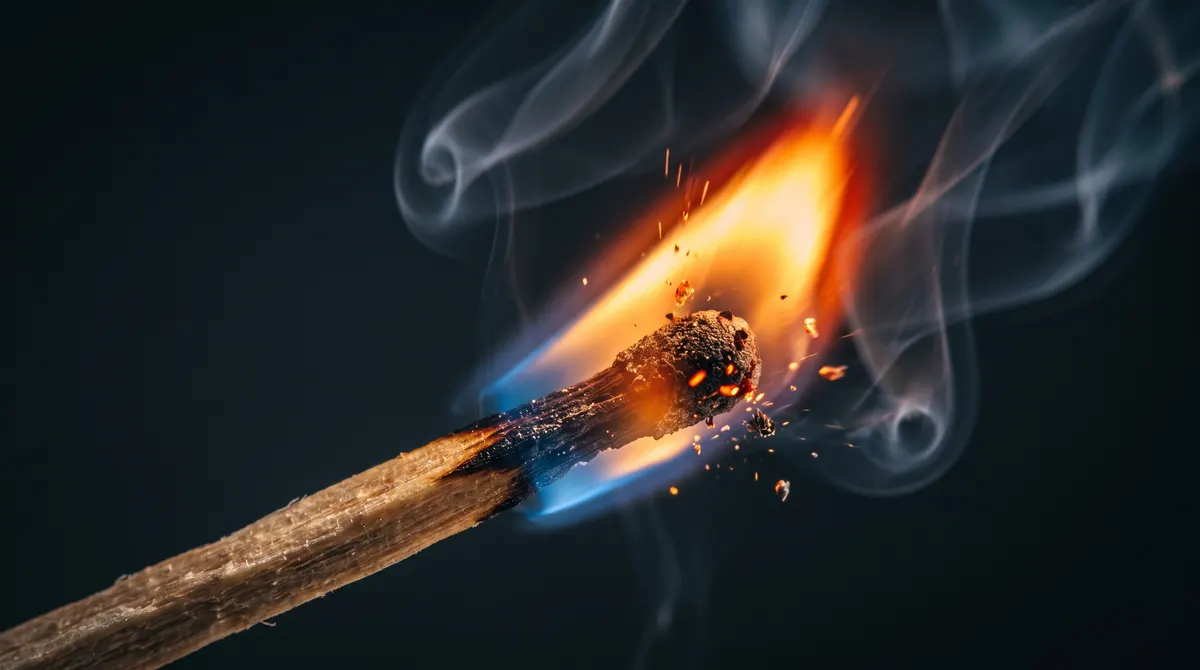
Strike a match and, in well under a second, you set off a small chemical event that has shaped human life for an extraordinarily long time. A flame seems almost alive, flickering, moving and hungry, yet underneath the drama it is simply chemistry running fast.
A campfire and a demolition charge look like completely different things, but they are really variations on one process running at wildly different speeds. Understanding it explains why fires start and spread, how we put them out, and how the same chemistry is tamed in car engines, mines and the airbag in your steering wheel. This is strictly about the underlying science, with no recipes, formulations or methods.
Rust in a Hurry
The scientific name for burning is combustion, and chemically it is rapid oxidation. Oxidation means a substance losing electrons to another substance, very often by combining with oxygen. When wood burns, its carbon and hydrogen join with oxygen from the air. Old chemical bonds break and new ones form, mostly making carbon dioxide and water vapour, and the rearrangement releases a lot of energy as heat and light.
An old iron gate slowly rusting is doing the same basic chemistry. The difference is speed. Rust releases its energy over years, so gently you would never feel it. Fire releases energy so quickly that its surroundings heat up and glow, and a visible flame is simply a region of gas hot enough, and in the right chemical state, to give off light.
The Fire Triangle and Its Fourth Side
Every fire needs three things at once, usually drawn as the fire triangle:
- Fuel, anything that can undergo rapid oxidation, such as wood, petrol, gas or even some metals.
- An oxidiser, almost always the oxygen in the air.
- Heat, enough to start the reaction and keep it going.
Take away any side and the fire stops, which is the logic behind nearly every way of fighting one. Water cools burning material. A fire blanket or sand cuts off oxygen. A firebreak cleared ahead of a bushfire removes the fuel, so however hot the day, the fire has nothing left to burn when it reaches the gap.
Fire scientists add a fourth element, making a tetrahedron: the chain reaction. Burning is sustained by highly reactive molecular fragments called free radicals that trigger further reactions around them. Some specialised extinguishing agents, historically compounds called halons and now their more environmentally acceptable replacements, mop up those fragments and break the chain even while fuel, oxygen and heat remain. That is why aircraft engine bays and server rooms have favoured them over water or foam.
The Push Over the Hill
Wood in a room full of oxygen would release energy by burning, so why does it not burst into flame? The answer is activation energy. Every reaction needs a minimum initial input of energy before it can begin, rather like pushing a boulder over the lip of a shallow hollow before it can roll downhill. At room temperature there is not enough heat around to clear that hurdle.
A match, a spark or sunlight focused through a magnifying glass supplies the first push. Once a small patch of fuel reacts, the heat it releases pushes neighbouring molecules over the hump, and the flame becomes self-sustaining while fuel and oxygen last.
Some materials need far less of a push. A liquid's flash point is the lowest temperature at which it gives off enough vapour to form an ignitable mix with air. Petrol's is well below room temperature, which is why the vapour above an innocent-looking open container is so dangerous. The autoignition temperature is the point where a substance catches fire with no spark at all. Much of the seemingly fussy regulation on storing flammable liquids traces straight back to these two measurements.
Why Flames Look the Way They Do
A candle flame's teardrop shape comes from convection. Hot gas is less dense than the air around it, so it rises, drawing fresh air in at the base and stretching the flame upward. On the International Space Station, without gravity to drive convection, flames burn as dim, rounded blobs.
The yellow-orange of a candle or campfire comes mostly from tiny specks of unburnt carbon, soot, heated until they glow, like the filament of an old incandescent bulb. A hotter, cleaner gas flame makes little soot, and its blue comes from energised molecules releasing light at particular wavelengths. Related physics gives fireworks their colours, with different metal compounds each glowing in their own shade.
What Makes an Explosive Different
The key difference is where the oxidiser comes from. A fire must draw oxygen from the surrounding air, which is why smothering works. An explosive typically carries its oxidiser within its own chemical makeup. With fuel and oxidiser already mixed at the molecular level, the reaction need not wait for oxygen to drift in, so it can run enormously faster. Rockets use a related idea, carrying their own oxidiser so they can burn where there is no air, as explained in how rockets actually work.
Speed then splits into two modes. In deflagration, the reaction spreads slower than the speed of sound in the material, as heat pushes each next layer over its activation hurdle. Gunpowder deflagrates: astonishingly fast, but still a kind of burning. In detonation, a shockwave travelling faster than sound compresses and sets off the material directly ahead of it, so pressure rather than creeping heat drives the reaction. Detonation releases energy far faster and more destructively, and professionals treat the distinction as fundamental to how a substance must be stored and handled.
An Old Servant, Carefully Handled
Burnt bone and ash at ancient sites suggest our ancestors may have been using fire a million years ago, making it arguably the oldest applied chemistry in the human story. Gunpowder, generally traced to China more than a thousand years ago, was for centuries essentially the only explosive in common use. In the nineteenth century the Swedish chemist Alfred Nobel, now better remembered for his prizes, found a way to make a notoriously unstable liquid explosive far safer to handle by absorbing it into an inert solid. That safety-first instinct still runs through the strict licensing that governs explosives today.
Harnessed carefully, this chemistry is everywhere. A petrol engine runs on thousands of tiny, precisely timed deflagrations of fuel and air every minute, each pushing a piston. Licensed blasting specialists break rock in mines and quarries. In a crash, a car's airbag is inflated by a rapid, tightly engineered gas-producing reaction in a few dozen milliseconds, faster than a blink.
Same Chemistry, Different Speeds
Next time you strike a match, notice what is happening: fuel meeting oxidiser, a burst of heat clearing the activation energy hurdle, and a self-sustaining reaction racing out from a single spark. The same chemistry warmed the first human campfires, drives the family car and, rigorously controlled, keeps mines running safely. In a country that lives with bushfire, those three sides of the triangle are worth knowing well, because they explain why a fire starts, why it keeps going and how to make it stop.