Talking Science Podcast
Catalysts – Chemistry's Quiet Matchmakers
Chew a piece of plain bread for a minute without swallowing and it starts to taste faintly sweet. Nothing has been added. What has happened is that a substance in your saliva has begun breaking the starch in the bread into sugars, and doing it remarkably quickly. Pour hydrogen peroxide on a fresh graze and it fizzes for a similar reason: a substance in your tissues is tearing the peroxide apart into water and oxygen far faster than it would ever break down on its own.
In both cases the substance doing the work comes out the other end unchanged, ready to do it again. Substances like this are called catalysts, and although the word sounds technical, the idea is one of the most elegant in science. Catalysts are why the chemistry inside you runs fast enough to keep you alive, and why a huge share of modern products can be made at all.
Helpers That Are Never Used Up
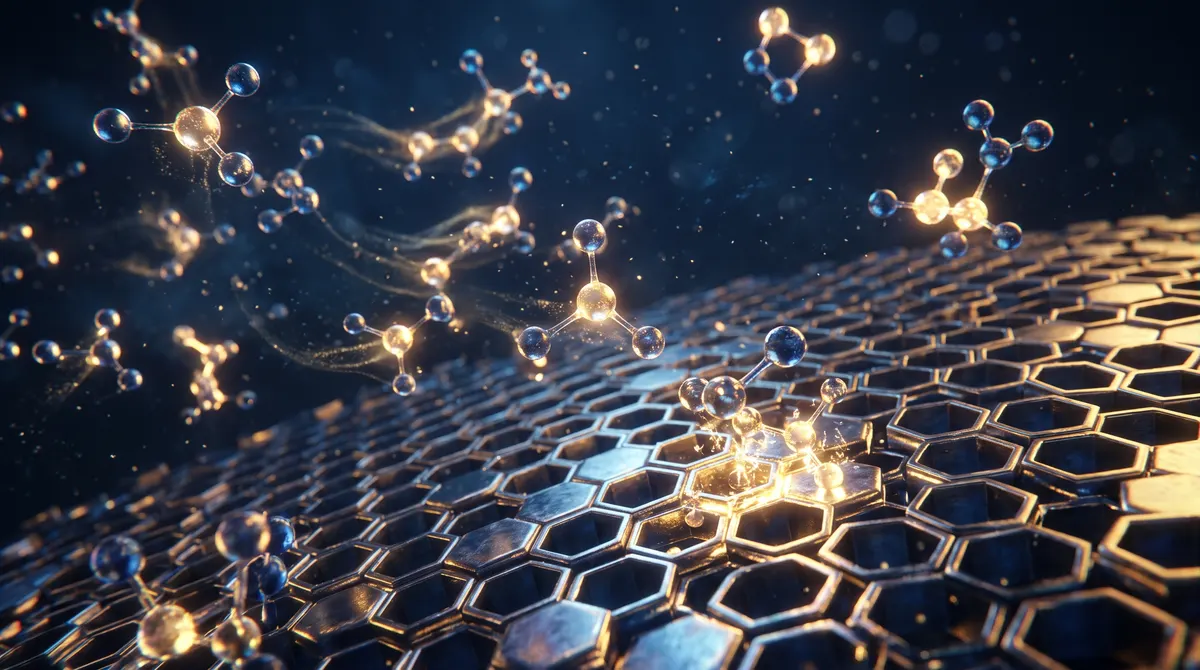
A catalyst is a substance that speeds up a chemical reaction without being consumed by it. That last part is what makes catalysts special. In an ordinary reaction, the starting ingredients are used up as they are turned into products. A catalyst joins in, helps the reaction along, and emerges unchanged, free to help the next reaction, and the next.
That means a small amount of catalyst can assist an enormous number of reactions. It is less like an ingredient and more like a matchmaker: it brings two parties together, helps them pair up, then steps aside to introduce the next couple, never altered by any of it.
The Hill Every Reaction Must Climb
To see how a catalyst speeds things up, one idea is essential: activation energy. Most reactions, even those that release energy overall, do not happen the instant the ingredients meet. Existing chemical bonds, described in Chemical Bonds – Why Atoms Stick Together, have to be loosened or broken before new ones can form, and that takes an initial push.
Picture two valleys separated by a hill. The reaction would happily roll from the higher valley down into the lower one, but first it has to get over the hill. If the hill is high, only a few particularly energetic molecules make it across at any moment, and the reaction is slow. That is why a pile of wood can sit in air for years without bursting into flame, even though burning releases plenty of energy.
A catalyst offers an easier route, in effect lowering the hill or opening a pass through it. With a lower barrier, far more molecules can cross at any given moment, and the reaction can speed up by a staggering amount. Crucially, a catalyst does not move the valleys. It does not change the overall energy of the reaction or make an impossible reaction possible. It simply lets an allowed reaction happen much faster.
Enzymes, the Catalysts of Life
The most sophisticated catalysts on Earth are inside you right now. They are called enzymes, and almost all of them are proteins, the folded molecular machines explored in Proteins – The Molecular Machines of Life. The enzyme in saliva that sweetens your bread is amylase; the one that makes peroxide fizz is catalase.
Nearly every reaction that keeps you alive, from digesting food to releasing energy from sugar to copying DNA, would on its own run far too slowly to sustain life. Some would take years or longer. Enzymes speed them up to fractions of a second, and they do it with exquisite precision. Each enzyme typically has a pocket shaped to grip particular molecules and assist one particular reaction. When you sprint for a bus, enzymes in your muscles are catalysing the reactions that release energy. Without them, the chemistry of a living cell would grind almost to a halt.
Feeding the World With a Catalyst
The same trick powers a great deal of industry. Refining oil into fuels, making plastics and medicines, producing countless everyday chemicals: much of it depends on finding the right catalyst to make a sluggish reaction run at a useful rate and cost.
One example changed the course of history. Plants need nitrogen to grow, and the air is mostly nitrogen, but in a form plants cannot use because its atoms are bound together extremely tightly. In the early twentieth century the German chemists Fritz Haber and Carl Bosch developed a way to combine nitrogen from the air with hydrogen to make ammonia, the basis of most synthetic fertiliser. The reaction is only practical because an iron-based catalyst speeds it up. Today, fertiliser made this way helps grow food for a large fraction of the world's population.
The Catalyst Under Your Car
There is a good chance a catalyst is working beneath your car right now. The catalytic converter, fitted to petrol vehicles and in modified forms to diesels, uses small amounts of precious metals such as platinum, palladium and rhodium as catalysts. As hot exhaust rushes through a honeycomb coated with these metals, harmful gases like carbon monoxide and unburnt fuel are converted into less harmful ones before they leave the tailpipe.
Catalytic converters arrived in Australia alongside unleaded petrol, which new cars were required to use from 1986. The reason was chemical: lead in petrol coats the catalyst's surface and stops it working. True to form, the catalyst is not used up as it cleans the exhaust, which is why a converter can last for many years. It is the same principle as the enzymes in your saliva, put to work cleaning the air.
Hunting for Better Matchmakers
Many of the technologies hoped to help with big challenges depend on better catalysts: splitting water to make clean hydrogen, capturing carbon dioxide, and making industrial chemistry less wasteful and less energy-hungry. Australian researchers are among the many around the world searching for cheaper, more effective catalysts, particularly ones that avoid scarce precious metals. Progress is real, but turning a promising laboratory catalyst into something that works cheaply at industrial scale is genuinely hard and often slow, so patience is warranted.
The Unsung Heroes of Chemistry
Catalysts ease the path, speed reactions up enormously and walk away unchanged to do it all again. The same quiet trick runs through the enzymes keeping every living thing alive, the factories making fertiliser, fuel and medicine, and the converter scrubbing a car's exhaust. The matchmakers of the molecular world ask for nothing and are never used up. They simply make things happen that otherwise never would, or never would in time to matter.