Talking Science Podcast
Glass – The Solid That Never Quite Settled
Visit an old church or heritage building with its original windows and a guide may tell you that the panes are wavy and thicker at the bottom because glass is secretly a liquid. Over centuries, the story goes, it has been creeping downward under its own weight and pooling at the base of the frame.
It is a charming idea that turns up on plenty of tours and trivia nights, and it is wrong. Working out why is a wonderful way into what glass really is, and the true answer is stranger than the myth. It explains why glass is clear, why a windscreen and a shower screen break so differently, and how hair-thin strands of glass came to carry the internet.
The Myth of the Flowing Window
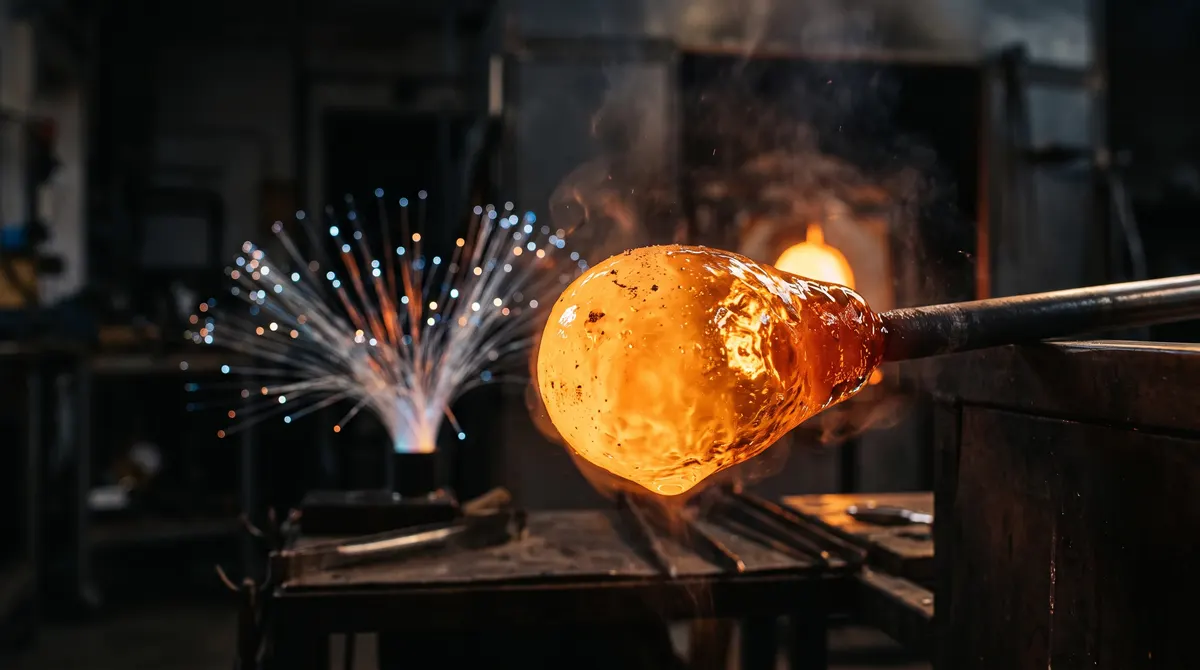
Before modern manufacturing, flat glass was often made by blowing a large bubble and spinning it while soft so it flattened into a disc, a method called crown glass, or by blowing a cylinder, then cutting and flattening it. Neither gave an even thickness, and glaziers sensibly fitted panes with the heavier, thicker edge at the bottom for stability, the same instinct that makes you set a wine glass down on its base. The ripples are imperfections frozen in during hand manufacturing, not signs of movement. At room temperature, glass does not flow, not even over centuries.
A Solid Without a Pattern
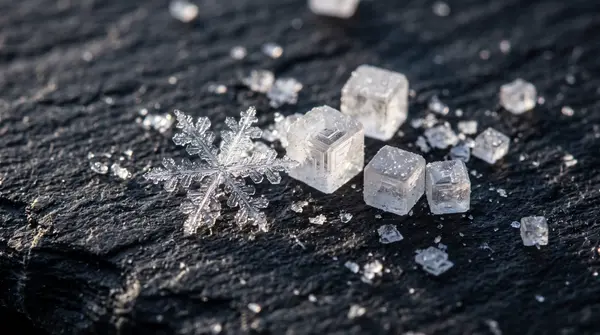
Most familiar solids, such as table salt, quartz and ice, are crystalline. Their atoms sit in a highly ordered, repeating three-dimensional pattern called a lattice, like a perfectly regular brick wall extending in every direction. Glass is different. Its atoms have essentially no long-range order, in a jumbled arrangement that looks remarkably like a snapshot of a liquid frozen in place.
Scientists call this an amorphous solid, from a Greek root meaning without form, which refers to the internal atomic arrangement rather than the outer shape. Glass is sometimes loosely called a supercooled liquid, and there is a grain of truth in that given how it is made, but most physicists prefer to treat it as its own distinct kind of rigid matter. At room temperature it holds its shape indefinitely and behaves as a true solid.
From Sand to Window
The main ingredient is silica, silicon dioxide, usually from sand, which on its own melts at well over 1,500 degrees Celsius. Glassmakers add soda ash, sodium carbonate, to lower the melting point dramatically, plus limestone to improve durability. This mix, soda-lime glass, makes up most windows, bottles and drinking glasses.
The crucial moment is cooling. Given enough time, silicon and oxygen atoms would settle into a neat crystal. Cool the melt quickly enough and they are frozen in their disordered arrangement first. That change, where a cooling liquid becomes rigid without ever crystallising, is called the glass transition.
People were making glass long before anyone knew about atoms, with beads and small objects from ancient Mesopotamia and Egypt dating back more than four thousand years. Glassblowing emerged in the eastern Mediterranean around the first century BCE and spread through the Roman world, making glass affordable for ordinary households. Modern windows come from the float glass process, developed by the British company Pilkington in the late 1950s, in which molten glass is poured onto a bath of molten tin. The two do not mix, so the glass floats into a sheet of remarkably even thickness with smooth, parallel faces, then is cooled slowly, a process called annealing, to relieve internal stresses.
Why Light Passes Straight Through
Whether a material is transparent depends on how its electrons respond to light, which arrives in packets of energy called photons. In many solids, electrons readily absorb photons across a wide range of energies, including visible light, so the material looks opaque. In glass, the electrons are bound in a way that leaves a wide band gap, a range of energies they cannot absorb, and that gap is larger than the energy of any visible photon. Visible light has nothing to interact with and passes through. The amorphous structure helps too: with no grain boundaries, the seams where crystal regions meet, there is less to scatter light.
The same story explains coloured glass. Small amounts of metal oxides add electrons that absorb particular slices of the spectrum. Iron impurities in ordinary sand give plain glass its faint green edge, cobalt gives deep blue and chromium gives green.
Built to Break Safely
Ordinary glass is brittle and breaks into sharp shards. Two clever technologies tackle that in different ways.
- Toughened (tempered) glass is heated, then its surfaces are rapidly cooled with jets of air while the inside cools more slowly. The outer layers end up locked in compression and the core in tension, making the pane much stronger. When it does fail, the stored stress releases at once and the whole pane crumbles into small, relatively blunt granules, a deliberate safety feature used in car side windows and shower screens.
- Laminated glass sandwiches a thin, tough, transparent plastic layer, usually polyvinyl butyral, between two sheets of glass. When struck, the glass cracks but the interlayer holds the pieces in place, which is why it is standard for car windscreens.
Threads of Light, Lenses and Mirrors
Optical fibres are strands of extraordinarily pure glass, often barely thicker than a human hair, far purer than window glass because flaws invisible across a few millimetres matter over many kilometres. A glass core is wrapped in a cladding of glass with a slightly different refractive index, a measure of how strongly it bends light. Light striking the boundary at a shallow enough angle reflects entirely back into the core, a process called total internal reflection, and bounces along for kilometre after kilometre. Calls, videos and webpages travel as rapid pulses of light through these fibres, including the undersea cables linking Australia to the world.
Laboratory beakers are usually borosilicate glass, which expands far less with heat and so survives sudden temperature changes. Glass vials still hold many vaccines and injectable medicines because glass is chemically inert and essentially impermeable, and bundles of optical fibre form the heart of medical endoscopes. Large research telescopes, such as the Anglo-Australian Telescope at Siding Spring Observatory in New South Wales, depend on huge precision-ground glass or glass-ceramic mirrors. Casting a blank that size means extremely slow annealing, sometimes over many months, to avoid locking in the very stresses toughened glass relies on.
Frozen Mid-Flow
The next time you look through a wavy old pane in a heritage building, you are not seeing a liquid quietly defying physics. You are seeing disordered atoms frozen in place by a glassmaker who cooled the melt just quickly enough, centuries ago, to lock in that ripple for good. A material that never settled into the tidy order most solids take for granted turned out clear enough to light our homes, tough enough to protect us in a crash and precise enough to carry much of the world's information at the speed of light.