Talking Science Podcast
Bioluminescence – Living Light
On a warm summer evening, points of golden light drift and blink across a darkening meadow. Fireflies are performing one of nature’s most enchanting displays, and they are doing something almost magical: making light inside their own bodies. This ability, called bioluminescence, appears across the living world, from insects in the grass to fish in the crushing dark of the deep sea. It is light without fire, glow without heat, and once you understand how it works, the ordinary rules of chemistry start to feel a little wondrous.
Light Without Heat
The first surprising thing about living light is how cool it is, in the literal sense. When a normal light bulb of the old-fashioned kind shines, most of the energy it uses escapes as heat, with only a small fraction becoming light. Bioluminescence is almost the opposite. Nearly all of the energy goes into producing light, and hardly any is wasted as heat. That is why you can hold a glowing firefly in your palm and feel no warmth at all. Scientists sometimes call it “cold light,” and it is one of the most efficient light-making processes known.
This efficiency matters for the creatures that use it. Making light costs energy, and energy is precious. A process that squandered most of it as heat would be a poor bargain. By turning nearly all that energy into light, living things get the most out of every glow.
The Chemistry of the Glow
So how does a body make light? The trick comes down to a chemical reaction between two main players. The first is a molecule generally called luciferin, and the second is an enzyme called luciferase. Both names come from the Latin word for “light-bearer.” When luciferin reacts with oxygen, and the enzyme luciferase speeds the reaction along, a small burst of energy is released, not as heat but as a particle of light. Repeat this across many molecules and you get a visible glow.
Different organisms have evolved their own versions of these light-making chemicals, which is why the details vary from a firefly to a jellyfish. But the basic principle is shared: a fuel molecule, oxygen, and an enzyme to make it happen. It is a beautifully simple recipe that nature has reinvented independently many separate times, in creatures that are only distantly related. That repeated invention is a strong hint of just how useful light can be.
An Ocean Full of Light
While fireflies get most of the attention on land, the true home of bioluminescence is the sea. In the deep ocean, sunlight fades to nothing not far below the surface, leaving vast dark realms where creatures must make their own light or live blind. A remarkable share of deep-sea animals can glow, from tiny plankton to fish, squid, and jellyfish. Some produce a shimmering blue-green light, the colour that travels best through seawater. Drift through these depths with the right eyes and you would find them sparkling with living stars.
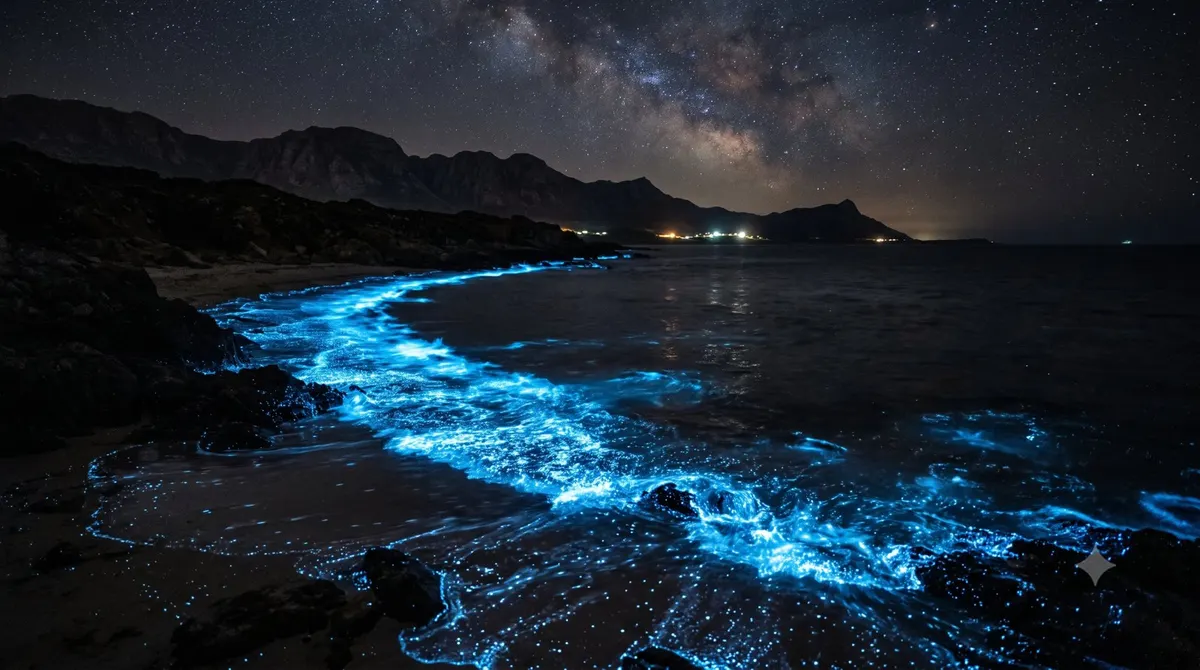
Even at the surface, the ocean sometimes glows. In certain places, disturbing the water at night, by a passing boat or a swimmer’s hand, sets off flashes of blue light. This comes from vast numbers of microscopic organisms that flash when jostled, painting the waves with an eerie, beautiful shine that has amazed sailors for centuries.
Why Make Light at All?
Producing light takes effort, so evolution would not favour it unless it paid off. It turns out there are many good reasons to glow, and different creatures use their light for different purposes:
- Attracting mates, as fireflies do with species-specific patterns of flashes that let them recognise their own kind in the dark.
- Luring prey, like the deep-sea anglerfish, which dangles a glowing lure in front of its mouth to draw curious victims within reach.
- Confusing or startling predators, with a sudden flash or a burst of glowing fluid that buys time to escape.
Some animals even use light as camouflage, a clever trick called counter-illumination. In the dim upper ocean, an animal seen from below appears as a dark silhouette against the faint light from the surface. By glowing gently on their undersides, some creatures erase that shadow, blending into the light above and hiding in plain sight.
Partners in Light
Not every glowing creature makes its own light directly. Some strike a partnership with light-producing bacteria, housing colonies of them in special organs and letting the bacteria do the shining. Certain squid, for example, cultivate glowing bacteria and use their light for camouflage. In return, the bacteria get a safe, nourishing home. It is a small reminder that even something as personal as a creature’s own glow can be a collaboration between species.
Light in the Laboratory
Human curiosity being what it is, we have found ways to put living light to work. The molecules behind bioluminescence and related glowing proteins have become invaluable tools in biology and medicine. Researchers can attach these light-producing systems to particular cells or molecules, making them glow so they can be tracked and studied. This has helped scientists watch how diseases spread, how genes switch on, and how living processes unfold, all by borrowing a trick that fireflies and deep-sea creatures perfected long ago.
There is something deeply moving about living light. It turns a quiet meadow into a field of drifting lanterns and fills the black depths of the ocean with soft, unexpected radiance. Behind the beauty lies elegant chemistry and the patient work of evolution, which discovered again and again that a little glow can help a creature find a mate, catch a meal, or slip away from danger. The next time you see a firefly blink or read of the glowing creatures of the deep, remember that life, when it needs to, has learned to make its own stars.