Talking Science Podcast
Black Holes – What Happens at the Edge of Forever
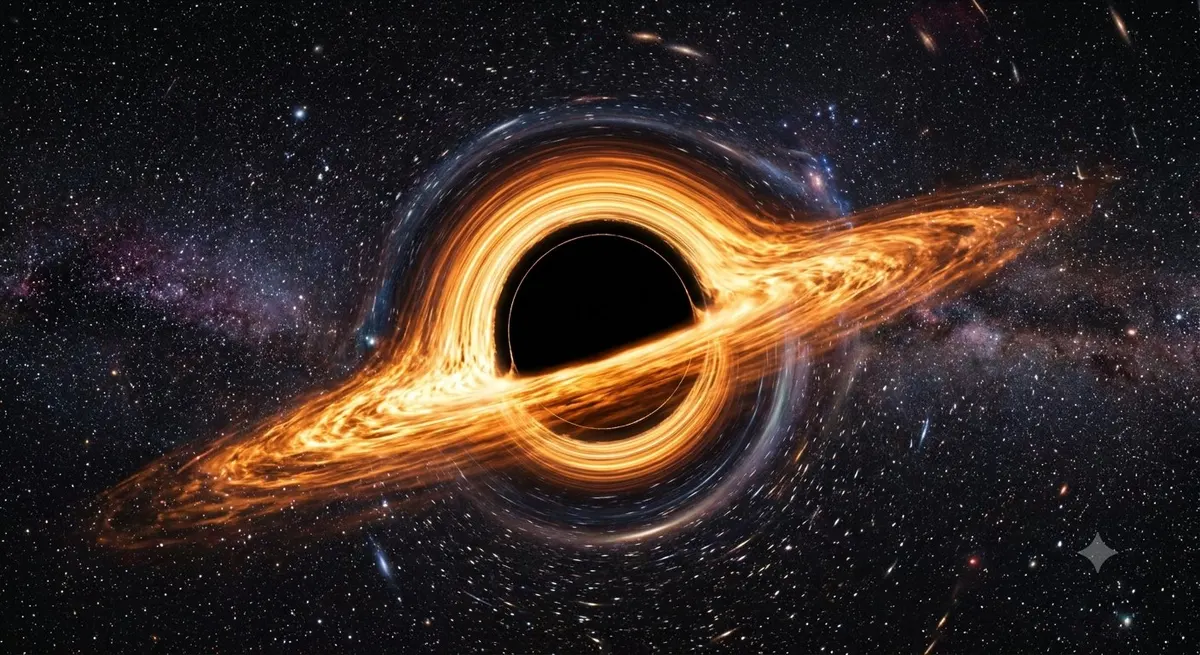
Imagine a place where gravity becomes so overwhelming that not even light can escape. Where the fabric of space and time bends until the rules we live by simply stop applying. This is not the stuff of fantasy. It is a real feature of our universe, and we have photographed one. Black holes are among the most extreme objects nature can build, and standing at the edge of one would mean standing at the edge of forever.
What Is a Black Hole, Really?
At its heart, a black hole is a very simple idea. Take a large amount of matter and squeeze it into a small enough space, and its gravity becomes inescapable. The famous boundary around it is called the event horizon. Cross that line, and there is no coming back, because escaping would require traveling faster than light, which nothing can do.
The event horizon is not a solid surface. It is more like a point of no return, an invisible line drawn in empty space. From the outside, it looks completely black, because no light from within can reach your eyes. Everything about the object beyond, we must infer from how it affects its surroundings.
How Nature Builds One
Most black holes we know about form when a massive star runs out of fuel. For millions of years, a star holds itself up by burning nuclear fuel in its core, the outward push of that furnace balancing the inward crush of its own weight. When the fuel is gone, gravity wins. The core collapses in an instant, and if the star was heavy enough, nothing can stop the fall. The result is a stellar-mass black hole, typically a few to a few dozen times the mass of our Sun.
There is another family, far larger. At the center of nearly every big galaxy, including our own Milky Way, sits a supermassive black hole weighing millions or even billions of Suns. Exactly how these giants grew so large so early in cosmic history is still an open question that keeps astronomers busy.
Between these two families, astronomers also suspect a middle class of black holes, ones weighing hundreds or thousands of Suns, though these have proven surprisingly elusive. Finding and understanding them may help explain how the supermassive giants assembled themselves in the first place. It is a reminder that even the basic census of black holes across the universe is still being worked out, one careful observation at a time.
The Strange Physics of the Edge
Near a black hole, time itself behaves in ways that defy everyday intuition. According to Einstein’s theory of gravity, the stronger the gravitational field, the slower time flows. If you watched a friend fall toward a black hole from a safe distance, you would see them slow down as they approached the horizon, their image fading and reddening, seemingly frozen forever at the edge. Yet from your friend’s own point of view, nothing strange would happen at that moment. They would sail across the horizon without noticing a boundary at all.
This mismatch between perspectives is one of the deepest and most beautiful puzzles in physics. It tells us that space and time are not the fixed backdrop we imagine, but flexible, stretchable things shaped by mass and energy.
Can We Actually See Them?
For most of history, black holes were purely theoretical, a consequence of equations that many scientists, including Einstein himself, doubted could exist in reality. That changed dramatically. Today the evidence is overwhelming and, in one remarkable case, visual.
A global network of radio telescopes working together, known as the Event Horizon Telescope, produced the first direct image of a black hole’s shadow. The picture showed a dark central region surrounded by a bright ring of glowing gas, exactly as theory predicted. We have also watched stars whip around the invisible heart of our galaxy at tremendous speeds, held in orbit by something enormous and unseen. The list of ways we detect them keeps growing:
- Watching stars orbit an invisible mass
- Detecting the glow of superheated gas spiraling inward
- Capturing ripples in spacetime when two black holes collide
Where Everything Falls Apart
At the very center of a black hole, our best theories break down. General relativity predicts a point of infinite density called a singularity, but infinity is usually a sign that a theory has reached its limits rather than a genuine feature of nature. To understand what truly happens there, we would need a theory that unites gravity with quantum mechanics, the physics of the very small. We do not yet have one. In that sense, the deep interior of a black hole is one of the last great unknowns.
Even the horizon holds surprises. The physicist Stephen Hawking showed that black holes are not perfectly black after all. Through subtle quantum effects near the edge, they should slowly leak a faint glow now called Hawking radiation, meaning that over unimaginably long timescales, black holes very gradually evaporate. For the black holes we observe, this process is so slow as to be negligible, but it hints at profound connections between gravity, heat, and information.
Why They Matter to Us
It would be easy to think of black holes as cosmic curiosities, distant and irrelevant. In truth they are woven into the story of the universe. The supermassive black hole at a galaxy’s center influences how that galaxy grows, regulating the birth of stars through the powerful jets and winds it can unleash. Collisions between black holes send waves through spacetime that we can now detect on Earth, opening an entirely new way of listening to the cosmos.
Black holes sit at the meeting point of the two great pillars of modern physics, and their mysteries push us toward a deeper understanding of reality itself. They remind us that the universe is stranger and grander than our daily experience suggests. At the edge of a black hole, at the edge of forever, the familiar rules dissolve and we glimpse something profound. We do not yet have all the answers, but the questions alone are enough to leave anyone staring up at the night sky in wonder.