Talking Science Podcast
Meteorites – Rocks That Fall from the Sky
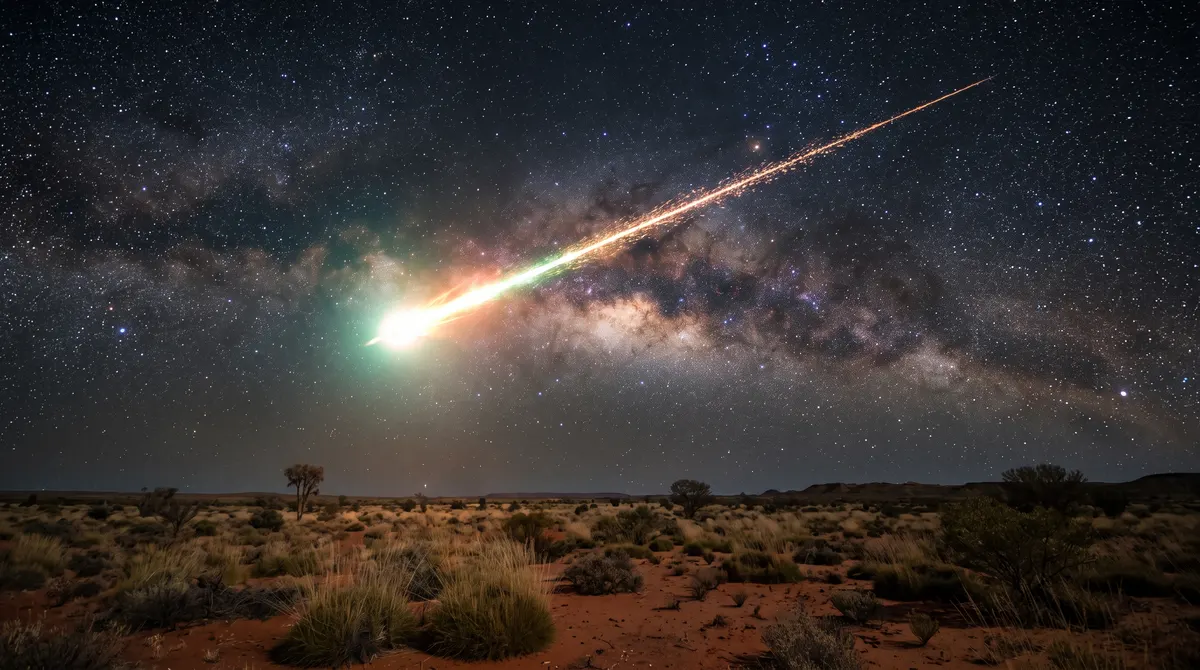
Watch a dark, clear sky for long enough and you will almost certainly see a shooting star: a speck of space dust, often no bigger than a grain of sand, burning up high overhead. Every day Earth sweeps up a large amount of this material, with estimates ranging from tens of tonnes to around a hundred, almost all of it fine dust. Occasionally, though, something bigger arrives, survives the fiery plunge and lands in a paddock, on a salt lake or, very rarely, through someone's roof.
Those survivors are meteorites, prized by scientists. Many are older than any rock that has survived on our planet's restless surface, and they carry a record of how the Sun and planets were born.
Meteoroid, Meteor, Meteorite
These three words describe different stages of the same journey. A meteoroid is a small rocky or metallic body travelling through space, smaller than an asteroid, often a fragment of one or debris shed by a comet. When a meteoroid plunges into Earth's atmosphere and glows, the streak of light is a meteor, and an especially bright one is called a fireball. If any part of the object survives to reach the ground, that piece is a meteorite.
Most meteors come from tiny particles that never get anywhere near the ground. Meteor showers, such as the Geminids each December, happen when Earth crosses a trail of debris left along a comet's or asteroid's orbit. Our piece on comets and asteroids explains where they come from.
The Fiery Fall
Meteoroids hit the atmosphere fast, at between about 11 and 72 kilometres per second. At those speeds the air in front of the object can't get out of the way. It is squeezed and heated intensely, and it is mainly this compressed, glowing air, rather than rubbing friction, that heats the rock. Its outer layers melt and are stripped away in a process called ablation, and the glow typically begins somewhere around 100 kilometres up.
The air also acts as a brake. Larger meteoroids often break apart, and the surviving fragments lose their cosmic speed while still many kilometres up, then fall unlit in what is called dark flight. The heating lasts only seconds, so it doesn't penetrate far. A fresh meteorite is usually coated in a thin, dark, glassy fusion crust while its interior is essentially unchanged, and contrary to popular belief, meteorites are generally not glowing hot when they land.
Three Families of Space Rock
- Stony meteorites are by far the most common among observed falls. Most are chondrites, named for the small, once-molten beads called chondrules packed inside them. Chondrites come from asteroids that never melted, so they preserve the raw ingredients of the early solar system. Some contain light-coloured inclusions rich in calcium and aluminium that are among the oldest solids known, about 4.57 billion years old.
- Iron meteorites are mostly iron and nickel metal. They are thought to be pieces of the metal cores of early planet-like bodies that melted and were later smashed apart. Cut and etched with acid, many reveal a striking crisscross pattern of interlocking crystals that could only grow by cooling extremely slowly, over millions of years, deep inside a parent body.
- Stony-iron meteorites are a mix of metal and rock. The most beautiful, pallasites, hold green olivine crystals suspended in metal.
Some stony meteorites, the achondrites, come from bodies that did melt. A few have been matched by their chemistry to the Moon and Mars, blasted off by impacts, and a large group is linked to the big asteroid Vesta.
Murchison: Australia's Most Famous Fall
On the morning of 28 September 1969, a fireball broke up over the town of Murchison in Victoria, scattering fragments across the countryside. Locals collected more than 100 kilograms of a dark, crumbly stone said to smell like methylated spirits. It turned out to be a carbonaceous chondrite, a rare type rich in carbon and water-bearing minerals.
The timing was fortunate: laboratories had just been prepared to analyse the first Moon rocks from Apollo 11, returned that same year. Murchison turned out to contain amino acids, the building blocks of proteins, including many types that are rare or absent in life on Earth. The amino acids came in roughly equal mixtures of left- and right-handed forms, unlike the overwhelmingly left-handed amino acids used by living things, a strong sign they formed in space rather than being contamination. Later studies revealed a vast diversity of organic molecules and tiny grains of stardust that formed around other stars before our Sun existed. Murchison remains one of the world's most studied meteorites, and it lends real weight to the idea that the raw chemistry behind the origin of life was widespread in the young solar system.
Where Meteorites Are Found
Meteorites fall all over the globe, but most are lost in oceans, forests and farmland. Australia's Nullarbor Plain is one of the best hunting grounds on Earth. It is flat, sparsely vegetated and paved with pale limestone, so dark stones stand out, and the dry climate means meteorites weather slowly and can survive for many thousands of years. Antarctica is another treasure trove, where flowing ice carries meteorites to spots where the ice wears away, leaving them concentrated on the surface.
Australian scientists also watch the sky directly. The Desert Fireball Network, run from Curtin University in Perth, photographs fireballs from several remote camera sites to calculate where fragments landed and the orbits they came from. At the end of 2015, it guided a team to a meteorite buried in the mud of Kati Thanda–Lake Eyre, recovered just before rain could wash away the trail.
When Big Ones Hit
Most meteorites are small, but occasionally a much larger body strikes at nearly full cosmic speed. The atmosphere barely slows it, and the impact releases its energy almost instantly, like an explosion. A shock wave blasts outward, rock is vaporised, melted and thrown aside, and the crater that results is many times wider than the object that made it.
Wolfe Creek Crater in the Kimberley region of Western Australia is one of the best-preserved examples anywhere, a near-circular bowl a little under a kilometre across, made by an iron meteorite whose rusted fragments have been found nearby. The Henbury craters in the Northern Territory are a cluster formed when an incoming object broke up just before impact. At the extreme end, the Chicxulub impact in Mexico 66 million years ago is closely tied to the extinction of the dinosaurs.
From Disbelief to Science
Strange as it seems, many eighteenth-century scholars dismissed reports of stones falling from the sky as folklore. In 1794, the German physicist Ernst Chladni argued that such stones came from space, an idea many of his peers found absurd. The turning point came in 1803, when thousands of stones rained down near the town of L'Aigle in France. The physicist Jean-Baptiste Biot gathered eyewitness accounts and samples and showed convincingly that the stones really had fallen from the sky.
Messages from the Beginning
A meteorite is a free sample from places we may never visit: the shattered cores of lost worlds, the surfaces of Mars and the Moon, and primitive asteroids that hold the leftovers of the solar system's birth. Each shooting star is a reminder that a few of its larger cousins make it all the way down, carrying four and a half billion years of history with them.