Talking Science Podcast
The Cosmic Microwave Background – The Universe’s Baby Photo
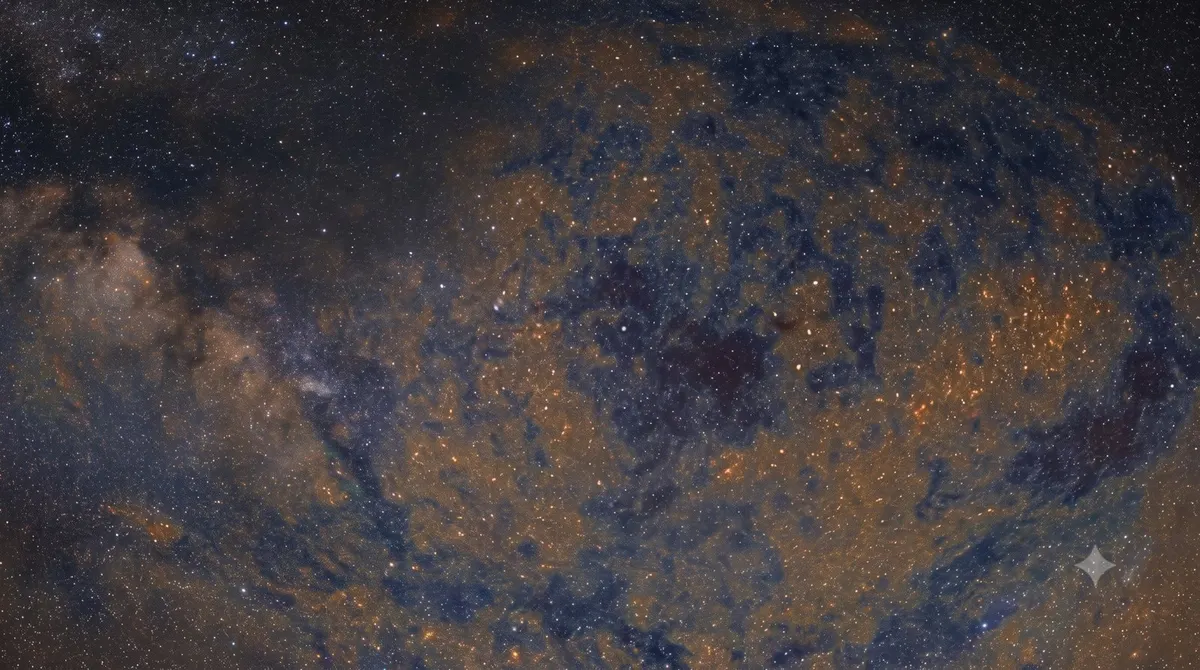
Everywhere you look in the sky, in every direction, there is a faint hum of light too dim for your eyes to see. It fills the entire universe, arriving equally from all sides, and it has been traveling toward us for more than thirteen billion years. This is the oldest light in existence, a snapshot of the cosmos when it was still an infant. Scientists call it the cosmic microwave background, and it may be the single most important photograph ever taken, even though no camera in the ordinary sense was involved.
An Accidental Discovery
The story of how we found this ancient glow is one of the most charming in all of science. In the 1960s, two researchers were working with a large, sensitive antenna and kept picking up a faint, persistent hiss of static that they could not get rid of. It came from every direction, day and night, no matter where they pointed. They checked their equipment, cooled their instruments, and even cleaned out droppings left by pigeons roosting in the antenna, but the signal remained.
What they had stumbled upon was not a flaw in their equipment. It was the afterglow of the young universe itself. At the same time, other scientists had been predicting that such a glow should exist as a leftover from the early cosmos. The two teams connected their findings, and an accidental annoyance became one of the greatest discoveries of the century, cementing our modern picture of how the universe began.
Light From the Dawn of Time
To understand what this glow is, we have to rewind the history of the universe. According to the well-supported Big Bang picture, the cosmos began in an extremely hot, dense state and has been expanding and cooling ever since. In its earliest moments, the universe was so hot that atoms could not hold together. It was a glowing fog of particles and radiation, so thick that light could not travel freely. It kept bouncing off loose particles, trapped like sunlight in a dense mist.
Then, after roughly a few hundred thousand years, the universe cooled enough for the particles to settle into stable atoms. Suddenly the fog cleared, and light was free to stream across space for the first time. That newly released light has been traveling ever since. The cosmic microwave background is precisely that light, the moment the universe became transparent, preserved and delivered to us across billions of years.
Why It Is Now Microwaves
When this light was first set free, it was not microwaves at all. It was a fierce glow, the radiation of a hot, young universe. But over the vast stretch of time since then, the universe has expanded enormously, and that expansion has stretched the light along with it. As the waves of light were stretched, they shifted from the energetic glow of intense heat down to the low-energy microwaves we detect today.
This stretching is why we call it the microwave background. The light itself is a faithful record of that early moment, merely cooled and lengthened by the expansion of space. In fact, the same signal shows up in an unexpected everyday place. A small fraction of the static on an old untuned television, in the days of analog broadcasts, came from this ancient cosmic glow, a whisper from the birth of the universe leaking into your living room.
Reading the Baby Photo
What makes this glow so valuable is not just that it exists, but that it is astonishingly uniform and yet not perfectly so. Across the whole sky, the background has almost exactly the same temperature in every direction, a remarkable smoothness. But when scientists measure it with extreme care, they find tiny variations, patches that are very slightly warmer or cooler than average.
These faint ripples are the true treasure. They are the seeds from which everything grew. The slightly denser regions, marked by those temperature differences, had a little more gravity, so over billions of years they pulled in more material and eventually grew into galaxies, clusters, and the great cosmic web of structure we see today. In this baby photo of the universe, we are quite literally looking at the origins of everything, including ourselves.
A Precision Tool for Cosmology
Modern space telescopes have mapped this background in exquisite detail, and the patterns in it carry a wealth of information. By carefully analyzing the sizes and distribution of the warm and cool patches, cosmologists can deduce some of the most fundamental facts about the universe. The measurements tell us the age of the cosmos, its overall shape, and even the proportions of its ingredients.
Strikingly, these studies reveal that the ordinary matter making up stars, planets, and people is only a small fraction of the whole. Most of the universe appears to be made of mysterious dark matter and dark energy, substances we cannot see directly and do not fully understand. The cosmic microwave background is one of our strongest pieces of evidence that this strange inventory is correct.
The background carries even subtler clues. The ancient light is slightly polarized, meaning it vibrates a touch more in some directions than others, a faint imprint left as the light last bounced among particles in the early universe. By mapping this polarization, cosmologists can test their ideas about the very first instants after the beginning, including the notion that the infant universe underwent a burst of extraordinarily rapid expansion. In these delicate patterns, researchers are searching for fingerprints of events that took place unimaginably early, long before the first atoms formed.
All of this makes the cosmic microwave background a cornerstone of modern cosmology. It agrees with independent lines of evidence, such as the observed expansion of the universe and the measured abundances of the lightest chemical elements, and together they weave a remarkably consistent story of a cosmos that began hot and dense and has been growing and cooling ever since. Few scientific pictures rest on such firm and varied foundations.
It is humbling to think that a faint hiss, once mistaken for interference and nearly blamed on pigeons, turned out to be a message from the dawn of time. The cosmic microwave background is the closest thing we have to a portrait of the universe as a newborn, and hidden in its gentle glow is the story of how a smooth, hot beginning grew into the vast, structured cosmos we call home.