Talking Science Podcast
Sagittarius A* – The Monster at the Milky Way's Heart
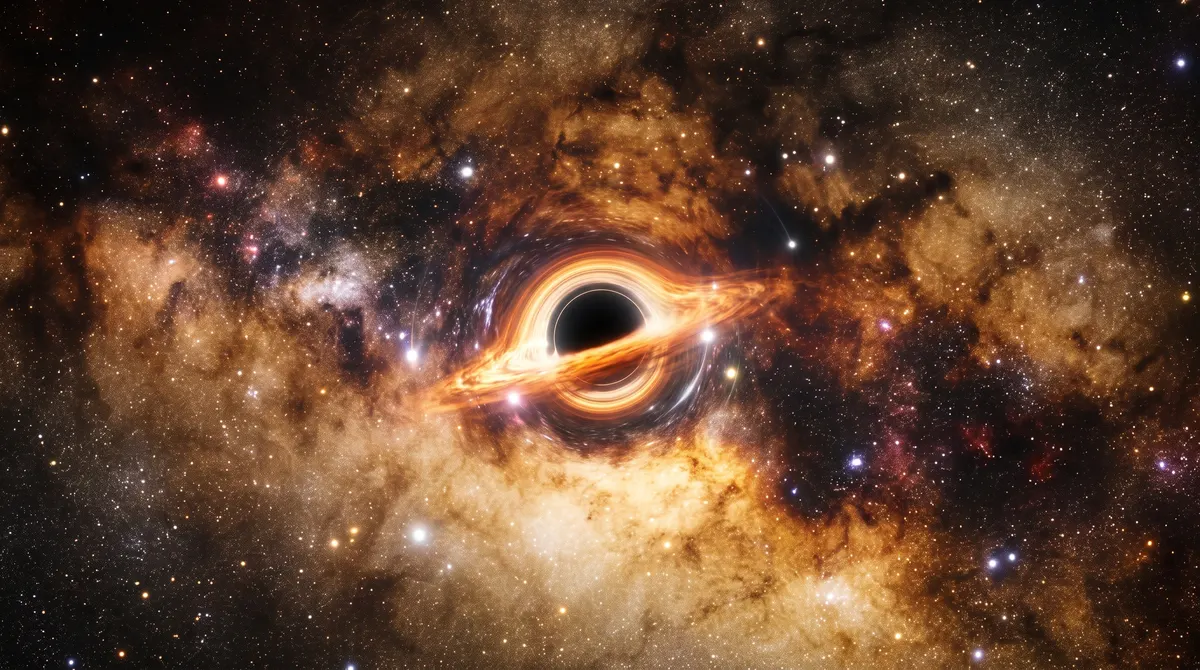
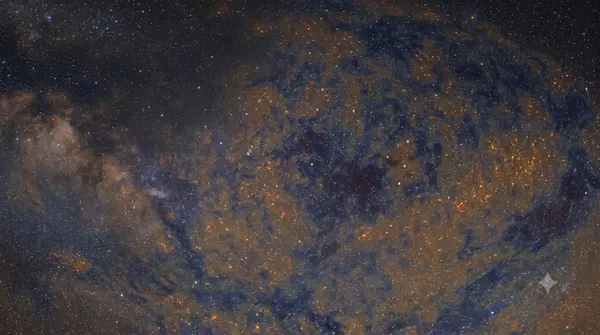
On a winter night in the Australian outback, the Milky Way rises high overhead as a bright, patchy river of light. Follow it towards the constellations of Scorpius and Sagittarius and it grows thicker and brighter, crowded with stars and dark lanes of dust. That glowing bulge is the centre of our galaxy, about 26,000 light years away.
Hidden in the middle of it sits something you cannot see with your eyes or any ordinary telescope: a black hole roughly four million times the mass of the Sun. It is called Sagittarius A*, pronounced "Sagittarius A-star", and working out what it is took astronomers decades of patience, some of the sharpest telescopes ever built and a planet-sized network of radio dishes.
What a Black Hole Is, and Isn't
A black hole is a region where matter has been squeezed so tightly that its gravity stops anything, even light, from escaping. Its boundary is the event horizon, a point of no return rather than a solid surface. For the full story of how they form and why the physics at the edge is so strange, see our guide to black holes.
One common misconception is that black holes are cosmic vacuum cleaners, sucking in everything around them. They are not. From a safe distance, a black hole's gravity is no different from that of any other object with the same mass. If the Sun were replaced by a black hole of equal mass, the Earth would keep orbiting just as before, only in the cold and dark.
The event horizon of Sagittarius A* has a radius of only about twelve million kilometres, which means the whole thing would fit comfortably inside the orbit of Mercury.
A Strange Signal From the Centre
The first clue came from radio astronomy. In 1974, astronomers Bruce Balick and Robert Brown detected a compact, bright source of radio waves at the very heart of the galaxy. It was later named Sagittarius A*, the asterisk marking it out as something special within the larger radio region called Sagittarius A.
A small, powerful radio source suggested something unusual, but it did not prove a black hole. Thick clouds of dust block visible light from the galactic centre, so astronomers could not simply look.
Weighing the Invisible
From the early 1990s, two teams set out to watch the stars that orbit the centre of the galaxy. One, led by Reinhard Genzel, used telescopes of the European Southern Observatory in Chile. The other, led by Andrea Ghez, used the giant Keck telescopes in Hawaii. Both worked in infrared light, which passes through dust far better than visible light does, and used adaptive optics to undo the blurring of Earth's turbulent atmosphere.
Year after year, they tracked stars near the centre and found them whipping around an invisible point on tight, fast orbits, like planets around a sun, except that the "sun" gave off almost no light. One star, known as S2 or S0-2, completes an orbit roughly every sixteen years. At its closest approach it passes within about seventeen light hours of the centre and moves at several thousand kilometres per second, a few per cent of the speed of light.
By applying the same orbital physics that Johannes Kepler and Isaac Newton developed for the planets, astronomers could calculate how much mass must lie inside those orbits. The answer was about four million solar masses, packed into a region so small that no cluster of stars or dark objects could plausibly fit. The only reasonable explanation was a supermassive black hole.
In 2020, Genzel and Ghez shared half of the Nobel Prize in Physics for this discovery. The other half went to Roger Penrose for his theoretical work showing that black holes are a natural consequence of Einstein's general relativity.
The Quiet Giant
Many galaxies host central black holes that blaze with light. As gas spirals inwards, it forms a disc that heats up to extreme temperatures and can outshine all the stars in its galaxy combined. The brightest of these, called quasars, can be seen across billions of light years. Some, like the one in the galaxy M87, launch enormous jets.
Sagittarius A* is remarkably calm by comparison. It is currently swallowing only a small trickle of gas, so it glows very faintly for its size. It does flicker and flare, and there is evidence it was more active in the past, but for now it is a sleeping giant. To learn how the galaxy around it came together, see our piece on how the Milky Way was built.
A Picture of the Shadow
In May 2022, the Event Horizon Telescope collaboration released the first image of Sagittarius A*. It shows a dark central region ringed by a glowing, lumpy orange halo. The dark part is the black hole's shadow, the area from which no light reaches us. The bright ring is radio light from extremely hot gas swirling just outside the event horizon, its path bent by the black hole's gravity.
No single telescope could take such a picture. Seen from Earth, Sagittarius A* is about as large as a doughnut would look on the surface of the Moon. To resolve it, astronomers linked radio observatories across the world, from Hawaii and Chile to Europe and even the South Pole, turning the planet itself into one enormous virtual dish. The observations were made in 2017 and took years to analyse.
Sagittarius A* was actually harder to image than the much larger black hole in M87, photographed first in 2019. Because it is far smaller, the gas around it completes an orbit in minutes rather than days, so its appearance was changing while the telescopes were watching. The ring matched the size general relativity predicts for a four-million-solar-mass black hole, so the stars and the image tell the same story.
How Did Giants Grow So Big So Fast?
Sagittarius A* raises a bigger puzzle. Astronomers have found quasars powered by black holes of a billion solar masses or more that existed when the universe was less than a billion years old. More recent observations, including those from the James Webb Space Telescope, have revealed actively growing black holes even earlier in cosmic history.
Growing that large that quickly is difficult. A black hole left behind by a dying star starts at a few to a few dozen solar masses, and there are limits to how fast it can feed before the radiation from infalling gas pushes more gas away. One idea is that some black holes began much heavier, perhaps forming directly from the collapse of huge gas clouds in the early universe. Another is that small seeds grew in short bursts faster than usually expected, or merged repeatedly. The question remains open.
Our Galaxy's Dark Heart
The black hole at the centre of the Milky Way was discovered not by seeing it directly, but by patiently watching what it does to everything nearby. A faint radio signal, decades of star tracking and a planet-wide network of telescopes all point to the same conclusion. When you next look up at the Milky Way from somewhere dark, the brightest, densest part of that river of stars marks the direction of a quiet giant holding its neighbours in tight, fast orbits.