Talking Science Podcast
Cells – The Basic Unit of Life
Hold your hand up to the light and you are looking at roughly thirty trillion tiny machines, each one alive, busy, and quietly cooperating. Your skin, your blood, your brain, the muscles moving your fingers right now: all of it is made of cells. So is the grass outside, the mould on old bread, the whale in the deep ocean, and the bacteria on the doorknob you touched this morning. Life comes in astonishing variety, yet strip any organism down to its smallest working part and you find the same basic thing. The cell is the sentence from which the entire library of life is written.
What Exactly Is a Cell?
A cell is the smallest unit that can be called truly alive. That is a big claim, so it is worth unpacking. A cell can take in energy and raw materials, use them to grow and repair itself, respond to its surroundings, and make copies of itself. A rock cannot do any of these things. A virus, interestingly, cannot do them alone either, which is why many scientists hesitate to call viruses fully alive. A cell can, and that self-sufficiency is what makes it the fundamental unit of biology.
Each cell is wrapped in a thin membrane, a kind of flexible skin only two molecules thick. This membrane is not just a bag. It decides what comes in and what goes out, keeping the useful chemistry inside while shutting out the rest of the world. Inside sits a watery, jelly-like substance packed with the machinery of life. In that crowded interior, thousands of chemical reactions happen every second, all coordinated so smoothly that the cell stays alive from one moment to the next.
A Discovery Under Glass
We did not always know cells existed, because they are far too small to see with the naked eye. Most are measured in micrometres, thousandths of a millimetre. It took the invention of the microscope in the seventeenth century to reveal them. An English scientist named Robert Hooke, peering at a thin slice of cork, saw a pattern of tiny boxes that reminded him of the small rooms monks lived in. He called them cells, and the name stuck. Not long after, the Dutch lens-maker Antonie van Leeuwenhoek turned his own remarkable lenses on pond water and was amazed to see it teeming with moving creatures, single cells swimming about, that no human had ever glimpsed before.
Over the following centuries, careful observation led to one of the great unifying ideas in science: cell theory. It holds that all living things are made of cells, that the cell is the basic unit of life, and that every cell comes from a pre-existing cell. That last point is quietly profound. It means there is an unbroken chain of cell dividing into cell, stretching back billions of years to the very first living thing.
Two Great Families of Cells
Not all cells are built the same way. Life has settled on two main designs. The simpler and far more ancient type is the prokaryotic cell, the kind that makes up bacteria and their distant cousins the archaea. These cells keep their genetic material loose in the interior, with no separate compartments. They are small, tough, and staggeringly successful, having thrived on Earth for billions of years and colonised nearly every environment imaginable.
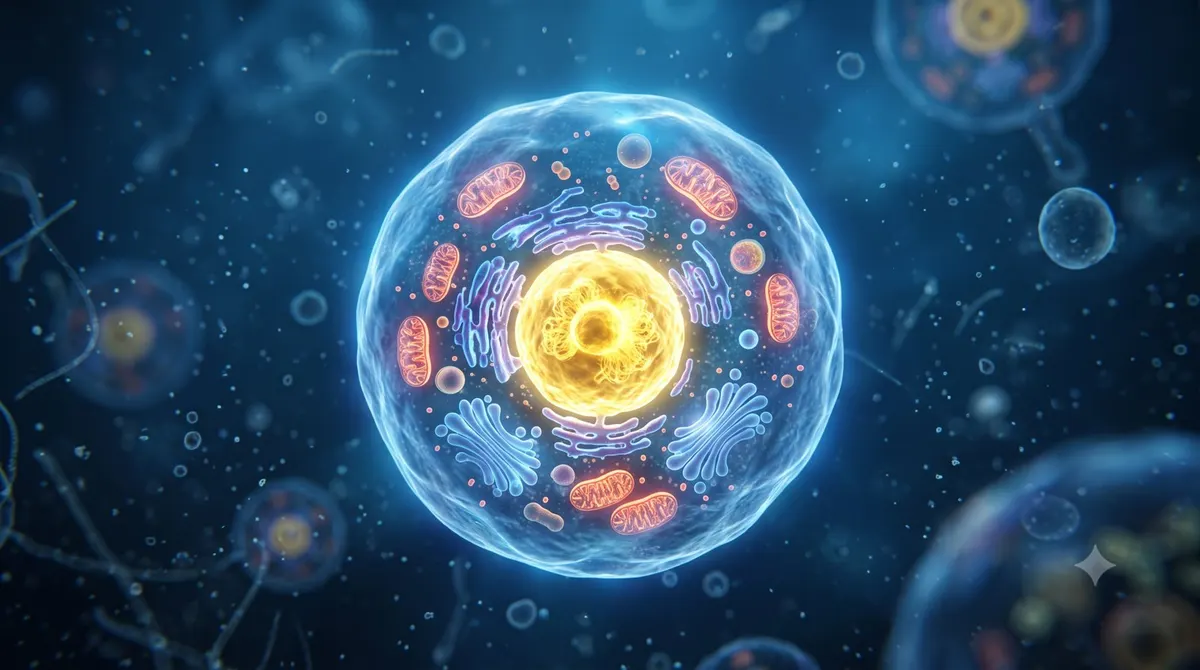
The second type is the eukaryotic cell, the kind that builds animals, plants, fungi, and countless microscopic organisms. These cells are larger and more elaborate, with internal compartments that divide the labour of living. Chief among them is the nucleus, a walled-off library that safeguards the cell’s genetic instructions. The word eukaryote actually means “true kernel,” a nod to that central nucleus.
The Machinery Inside
Zoom into a eukaryotic cell and you find a bustling city. Structures called organelles each carry out a special job. Mitochondria act as power plants, releasing energy from food in a form the cell can use. In plants and algae, chloroplasts capture sunlight and turn it into chemical energy, the process that ultimately feeds nearly everything else on the planet. A network of internal membranes folds, packages, and ships the cell’s products. Long protein fibres form a scaffold that gives the cell shape and lets it move.
Presiding over all of this is DNA, the molecule that carries the instructions for building and running the cell. Think of DNA as a master recipe book. When the cell needs to make a particular protein, it copies out the relevant recipe and hands it to tiny factories called ribosomes, which assemble the protein piece by piece. This flow of information, from genes to working molecules, is happening inside your cells constantly.
From One Cell to Many
Life often begins as a single cell. A human being starts as one fertilised egg, which divides into two, then four, then eight, and onward until trillions of cells exist. What is remarkable is that these cells do not all stay the same. Guided by which genes they switch on, they specialise, becoming nerve cells, muscle cells, blood cells, and hundreds of other types. Every one of them carries the same DNA, yet each reads a different part of the recipe book, like musicians in an orchestra playing from one shared score but sounding entirely different notes.
This cooperation is the secret behind every plant and animal. Individual cells give up their independence to serve the whole, and in return the whole keeps them fed and protected. It is one of the most successful partnerships in the history of the planet.
The next time you feel the beat of your own heart or watch a leaf turn toward the sun, remember that you are witnessing the work of cells, invisible and uncountable, carrying on the same essential business of life they have practised for billions of years. Everything alive, from the humblest microbe to the largest tree, is a variation on this single, elegant theme. Understanding the cell is, quite literally, understanding what it means to be alive.