Talking Science Podcast
Chemical Bonds – Why Atoms Stick Together
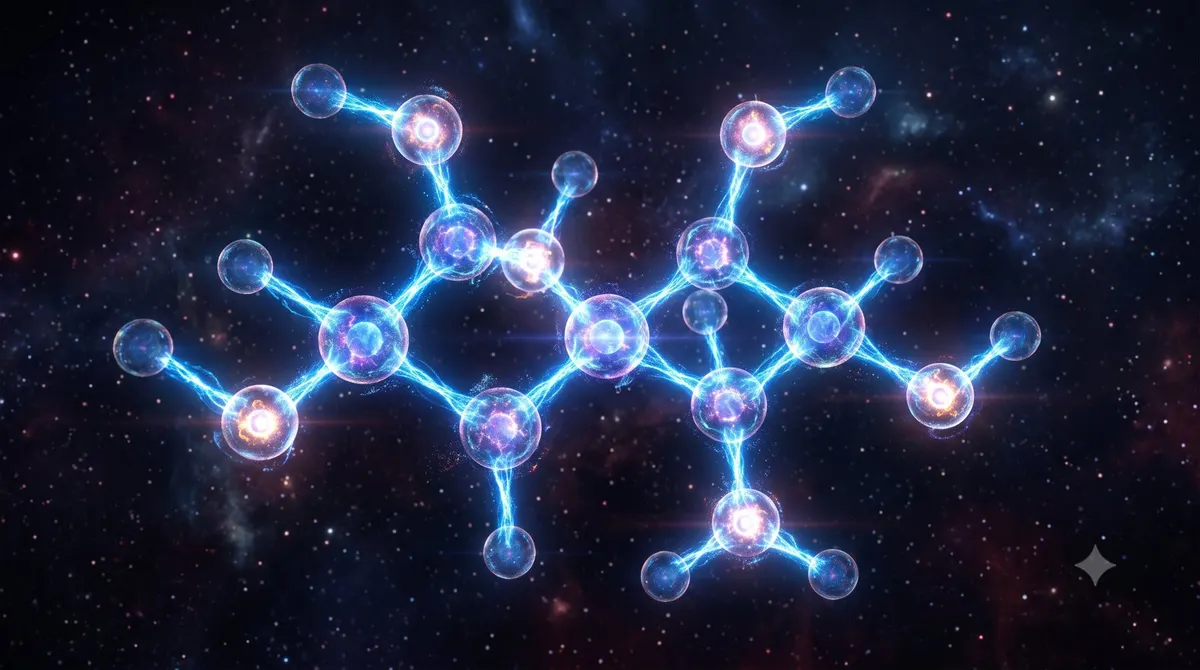
Pick up a glass of water. It stays a liquid, pouring and splashing, rather than drifting apart into an invisible fog. Grip a steel spoon and it keeps its shape no matter how hard you squeeze. Bite into an apple and your body pulls energy from its sugars. All of this happens because atoms hold on to one another. The bonds between atoms are the invisible rivets of reality, and understanding them is understanding why anything has substance at all.
The Restless Outer Electrons
To see why atoms bond, we have to look at their electrons – the tiny negatively charged particles that swarm around each atom’s central core. These electrons sit in layers, and the outermost layer is the one that matters for chemistry. Think of it as the atom’s handshake, the part that meets the outside world.
Here is the crucial fact: atoms are most stable, most comfortable, when their outer layer is full. Some atoms already have a full outer layer, and these are the noble gases like helium and neon. They are the loners of the periodic table, so satisfied that they hardly ever react with anything. But most atoms are not so lucky. They have outer layers that are partly empty or awkwardly full, and this leaves them restless. To reach that comfortable, filled state, they will share, give away, or grab electrons from their neighbours. Every chemical bond is, at heart, an atom solving this problem.
Giving and Taking – The Ionic Bond
One way to fill an outer layer is a straight transfer. Table salt is the classic example. A sodium atom has a single electron rattling around in its outer layer, one it would happily be rid of. A chlorine atom, meanwhile, is one electron short of a full layer and eager to gain one. When they meet, sodium hands its spare electron to chlorine. Both atoms end up with tidy, full outer layers.
But there is a consequence. By giving away a negative electron, the sodium atom is left with a slight positive charge. The chlorine, having gained one, becomes slightly negative. Opposite charges attract, so the two now cling together through simple electrical pull. This is an ionic bond – a bond built on giving and taking, held together by the attraction between positive and negative. Multiply this across billions of atoms and you get the neat cubic crystals of ordinary salt. Their orderly shape is a direct echo of the orderly way the charges lock together.
Sharing – The Covalent Bond
Transfer is not the only option. Sometimes two atoms both need more electrons and neither is willing to give any up. The solution is to share. Two atoms move close and pool a pair of electrons between them, letting both count that pair as part of their own outer layer. This shared arrangement is a covalent bond, and it is the kind that holds together most of the molecules in living things.
Water is a perfect illustration. An oxygen atom shares electrons with two hydrogen atoms, and the result is the familiar molecule we write as H2O. The sharing binds the three atoms into a single stable unit. Covalent bonds can be quite strong; the ones locking carbon atoms together in diamond are so robust that diamond is the hardest natural material we know. Yet the same kind of bond, arranged differently, makes the soft graphite in a pencil. The bond is the same tool; the structure it builds makes all the difference.
The Metallic Bond and a Sea of Electrons
Metals play by their own rules. In a lump of copper or iron, the atoms give up some of their outer electrons entirely, but not to any particular partner. Instead the freed electrons drift through the whole material like a shared sea, while the atoms sit in a fixed lattice bathed in that sea. This loose, communal arrangement explains the very things we associate with metals.
Because the electrons roam freely, they can carry electric current, which is why metals conduct electricity so well. Because the atoms are not locked to specific partners, they can slide past one another without the whole structure shattering, which is why metals can be hammered into sheets or drawn into wire. The metallic bond is a bond of togetherness without possessiveness, and it gives us everything from cutlery to skyscraper frames.
Weak Bonds That Still Matter
Not every attraction between atoms is a full, strong bond. There are gentler tugs too, and they turn out to be surprisingly important. In water, for instance, each molecule is slightly lopsided in its charge, and these lopsided molecules attract one another weakly. This modest pull, called hydrogen bonding, is why water is a liquid at room temperature rather than a gas, and why it clings into droplets.
These weaker bonds do delicate, vital work. The two strands of your DNA are held together by them, gripping firmly enough to store genetic information yet loosely enough to be unzipped and copied when a cell divides. A strong bond would be too permanent for that job. Life relies on getting the strength of its bonds just right.
The same gentle attractions explain small everyday wonders. They are why a water strider can walk across a pond without sinking, the surface holding together like a delicate skin. They are why gecko feet cling to glass, and why some materials feel sticky while others slide. Nature makes constant use of these in-between forces, neither fully bonded nor fully free, to build structures that need to hold together yet also come apart on cue.
So the world stays together for a reason as simple as it is profound: atoms are seeking comfort, filling their outer layers by sharing, giving, or taking electrons. From that single urge flows the salt on your table, the water in your glass, the metal in your tools, and the code in your cells. Chemical bonds are not an obscure detail for exams. They are the reason there is anything solid to stand on at all – the quiet grip that turns a universe of loose atoms into a place with things in it.