 Talking Science Podcast
Climate Change – The Physics Behind It
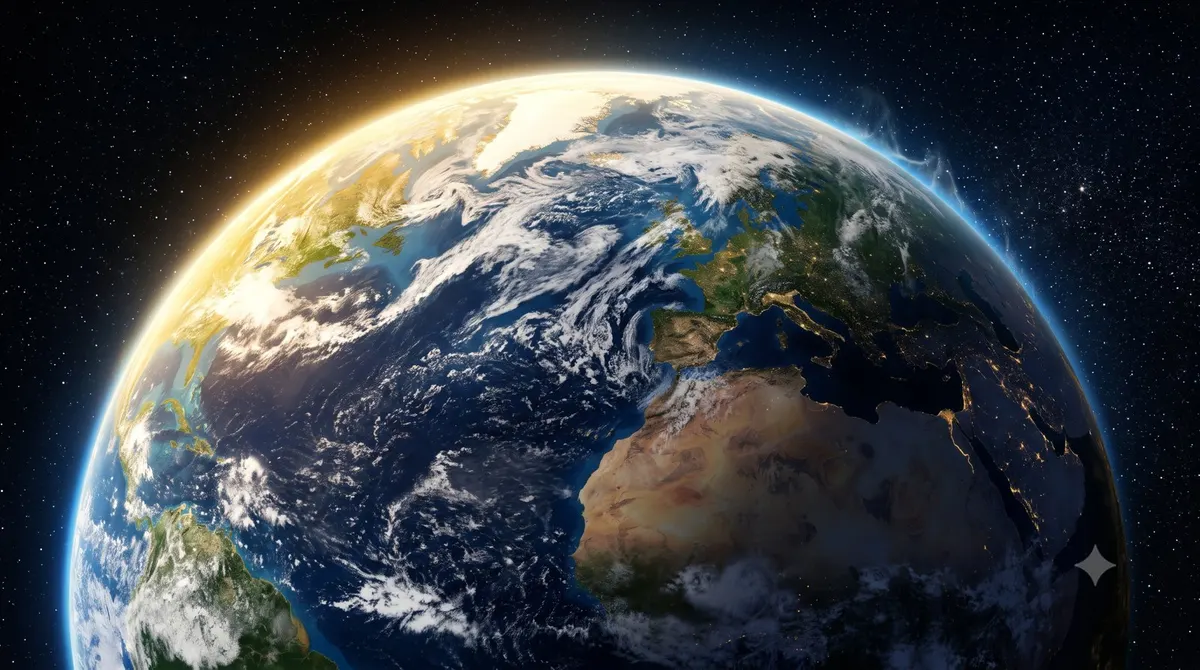
Imagine standing outside on a clear night with no clouds overhead. The air grows cold quickly, doesn’t it? Now picture the same night with a thick blanket of cloud above you. The chill never bites as hard. That everyday difference holds the whole secret of climate change. Our planet is wrapped in an invisible blanket of gases, and when we thicken that blanket, the world grows warmer. There is no mystery here, only physics that has been understood for well over a century.
The Sun Delivers, the Earth Radiates
Everything starts with a balance. Sunlight streams toward Earth carrying energy. Some of it bounces straight back to space off bright surfaces like clouds and ice, but most is absorbed by the land and oceans, warming them. Warm things cannot simply hold that energy forever; they give it back off as heat. This escaping heat is a form of light too, but a kind our eyes cannot see, called infrared radiation.
For the planet’s temperature to stay steady, the energy arriving from the Sun must be matched by the energy leaving as infrared. When those two are in balance, the climate holds roughly steady. Tip the balance so that a little less heat escapes, and energy piles up, and the surface warms until a new balance is reached at a higher temperature. That tipping is exactly what greenhouse gases do.
What Makes a Gas a Greenhouse Gas
Not every gas traps heat. The nitrogen and oxygen that make up most of our air are almost transparent to infrared radiation, letting the planet’s heat pass through untouched. A handful of gases behave differently. Carbon dioxide, methane, water vapour and a few others have molecules built in a way that lets them absorb infrared radiation and then re-emit it in all directions, including back down toward the ground.
The reason lies in how these molecules are shaped and how they wiggle. A molecule made of three or more atoms can bend and stretch in ways that match the energy of infrared light. When such a molecule meets a passing wave of heat, it absorbs the energy, vibrates, and later releases it again. A single carbon dioxide molecule does this countless times, quietly slowing the escape of heat to space. Multiply that by the vast number of molecules in the atmosphere and the effect becomes powerful.
The Greenhouse Effect Is a Good Thing – Up to a Point
Here is something worth pausing on: without any greenhouse gases at all, Earth would be a frozen ball. The natural greenhouse effect keeps our planet’s average temperature comfortably above freezing rather than far below it. Water vapour and carbon dioxide have been doing this useful job for billions of years, making life as we know it possible.
The trouble is not the greenhouse effect itself but its strengthening. By burning coal, oil and gas, and by clearing forests, humans have added a great deal of extra carbon dioxide to the air. The concentration of carbon dioxide is now substantially higher than it was before the industrial age began. That thicker blanket traps a little more heat every second of every day, and the planet responds in the only way physics allows: it warms.
Small Numbers, Large Consequences
People are sometimes puzzled that carbon dioxide, which makes up a tiny fraction of the atmosphere, could matter so much. But potency is not the same as abundance. A pinch of a strong ingredient can transform a whole dish. Because carbon dioxide is so effective at absorbing infrared, even modest increases meaningfully change how much heat leaves the planet.
There is also a multiplying trick built into the system. As the air warms, it can hold more water vapour, and water vapour is itself a greenhouse gas. So a nudge from carbon dioxide warms the air, the warmer air carries more moisture, and that moisture adds still more warming. Scientists call this a feedback. Melting ice does something similar: bright ice reflects sunlight, but dark open ocean absorbs it, so as ice retreats the planet soaks up more energy. These feedbacks amplify the original push.
How We Know This Is Real
The physics of heat-trapping gases was worked out in the nineteenth century, long before anyone worried about climate. Laboratory measurements show precisely how carbon dioxide absorbs infrared light. Instruments on the ground and on satellites confirm that less heat is escaping to space at exactly the wavelengths carbon dioxide absorbs. Thermometers across the world, along with records locked in ice cores, tree rings and ocean sediments, all tell the same story of a warming planet whose changes track the rise in greenhouse gases.
This is what gives scientists such confidence. It is not one clever argument but many independent lines of evidence pointing the same way, all resting on physics you could demonstrate on a laboratory bench.
Weather Is Not Climate
A common source of confusion is worth clearing up. Weather is what happens in the sky from day to day, the rain, sunshine and cold snaps that come and go. Climate is the long-term average of that weather, the pattern you would expect over decades. A single frosty winter no more disproves a warming climate than one hot afternoon proves it. Climate is about the trend across many years, and it is that patient average, measured all around the globe, that has been climbing.
This is also why scientists speak of averages and probabilities rather than certainties about any one storm or season. A warmer world does not switch off cold days; it shifts the odds, making heatwaves more likely and more intense, loading the dice rather than guaranteeing any single roll. The extra energy trapped by greenhouse gases has to go somewhere, and it shows up not only as higher temperatures but as changes in rainfall, stronger storms and rising seas as water expands and ice melts.
The Balance in Our Hands
Climate change can feel overwhelming, wrapped in politics and worry. Yet at its heart lies a wonderfully simple idea. Energy comes in from the Sun and must go back out as heat. Greenhouse gases slow that heat’s escape, and we have been adding more of them. The planet has no choice but to warm until balance returns. The reassuring flip side is that the same physics runs in reverse. Slow the flow of new greenhouse gases into the air, and we ease the pressure on the system. Understanding the physics is the first step toward acting on it, and that physics has been patiently waiting for us to listen.


