Talking Science Podcast
Deep Time – How We Learned the Earth's Age
Pick up a pebble from a creek bed and it feels like the most ordinary thing in the world. Yet the grains inside it may have been sitting in the crust for hundreds of millions of years, long before the first dinosaur or the first flower.
That number is about 4.54 billion years. Getting to it took more than three centuries of argument, fieldwork and clever physics, and along the way some very smart people got the answer badly wrong. The story of how we learned the age of the Earth is really the story of how humans learned to think in deep time.
A World Only a Few Thousand Years Old
For much of European history, the age of the Earth was treated as a question for scholars of scripture rather than of rocks. The most famous attempt came in the 1650s, when the Irish archbishop James Ussher added up the generations and reigns recorded in the Bible and other ancient histories. He concluded that creation took place in 4004 BC, making the world less than six thousand years old.
Ussher was doing careful work with the evidence he trusted. The problem was that written records only reach back a few thousand years, and nobody yet had a way of reading time from the landscape.
Reading the Rocks: Hutton and Lyell
In the late eighteenth century, the Scottish naturalist James Hutton noticed how slowly the land around him changed. Rivers carried away soil grain by grain and sediment piled up in the sea. Over time, he reasoned, those layers could be buried, hardened into rock, pushed up into new land and worn down again. You can read more about that endless loop in our piece on the rock cycle.
The clincher came at Siccar Point on the Scottish coast, where Hutton showed his friends a place in 1788 where nearly vertical layers of rock are capped by gently sloping red sandstone. The lower layers had been laid down flat, tilted on their ends, worn away, and then buried beneath fresh sediment. Each step must have taken an enormous stretch of time. Geologists call a gap like this an unconformity.
In the 1830s, Charles Lyell gathered these ideas into his book Principles of Geology. He argued that the slow processes we can watch today, such as erosion, deposition and volcanic eruptions, could build the whole landscape if given enough time. A young Charles Darwin read Lyell aboard HMS Beagle. Geology had made the Earth old, but nobody could yet say how old.
Lord Kelvin's Confident Mistake
The physicist William Thomson, later Lord Kelvin, thought he could settle the matter with mathematics. He assumed the Earth began as a ball of molten rock and had been cooling ever since. By measuring how quickly heat flows out of the ground today, and knowing how rock conducts heat, he could work backwards to the moment the planet solidified.
His early estimates allowed a wide range, but by the 1890s he favoured something like twenty to forty million years. That was far too short for the geologists and for Darwin, but Kelvin's reputation made it hard to argue with.
His physics was sound. His assumptions were not. Kelvin had no way of knowing that the Earth contains its own heat source. Radioactivity was discovered in 1896, and it soon became clear that elements such as uranium, thorium and potassium release heat as they decay, keeping the interior warm for far longer than simple cooling would allow. Some of his contemporaries also pointed out that the deep Earth is not a rigid solid but slowly churns, carrying heat towards the surface more efficiently than Kelvin assumed.
Clocks Inside the Atom
The same discovery that broke Kelvin's calculation gave scientists a far better clock. A radioactive atom decays into a different element at a steady, predictable rate, described by its half-life: the time it takes for half of any sample to change. You cannot predict when a single atom will decay, but across billions of atoms the rate is extraordinarily reliable. Our article on radioactivity explains why.
If a mineral locks in some of a radioactive parent element when it forms, the ratio of parent to daughter atoms tells you how long the clock has been ticking. Early in the twentieth century, Ernest Rutherford and others realised this could date rocks, and the ages ran into billions of years.
The most trusted method uses uranium decaying to lead. It has a built-in cross-check, because two forms of uranium decay at different rates into two different kinds of lead. If both clocks agree, the sample has probably not been disturbed.
There was still a catch. The Earth's surface is constantly recycled by erosion and plate tectonics, so the very first rocks are long gone. In the 1950s the American geochemist Clair Patterson solved this by measuring lead in meteorites, leftover building blocks from the same cloud that formed the planets. His answer, about 4.55 billion years, has held up remarkably well. The modern figure is about 4.54 billion years, give or take some tens of millions.
The Jack Hills Zircons
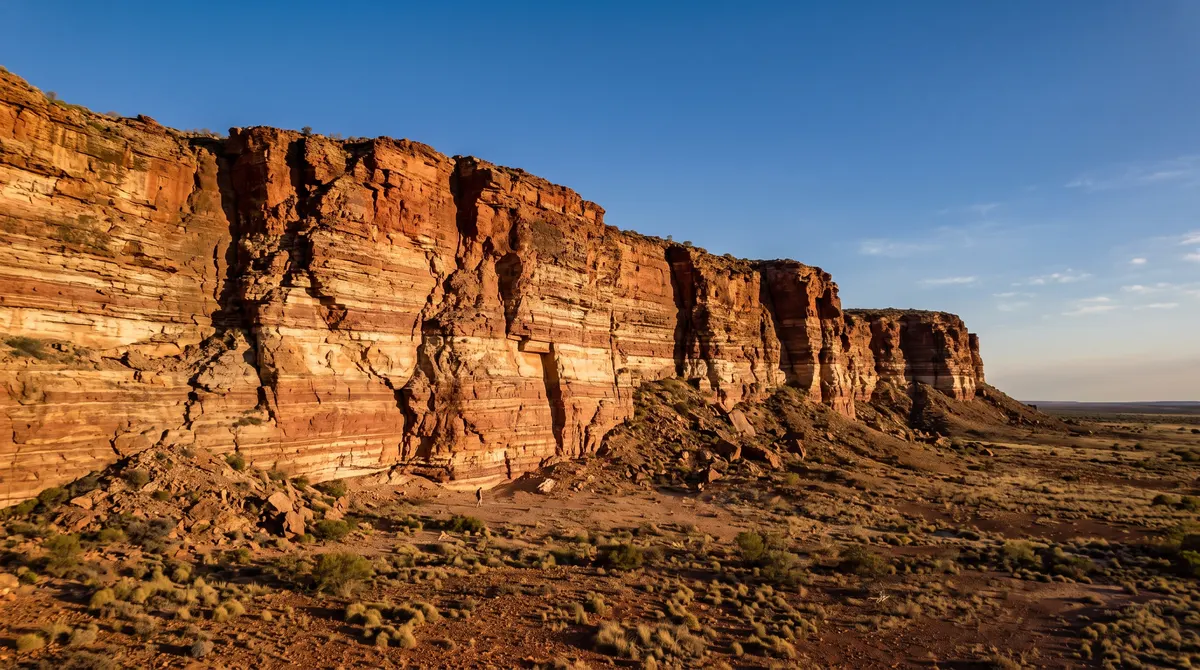
Australia holds a special place in this story. In the Jack Hills of the Murchison region in Western Australia, geologists have found tiny crystals of the mineral zircon, many no wider than a human hair, embedded in ancient sedimentary rock. Some of them formed around 4.4 billion years ago, making them the oldest known pieces of the Earth itself.
Zircon is ideal for this work. It survives erosion and reburial, and when it crystallises it welcomes uranium into its structure while rejecting lead. That means almost all the lead inside a zircon was made by decay, which makes it a very clean clock.
The chemistry of these crystals also hints at what the young planet was like. Their oxygen isotopes suggest they formed from material that had interacted with liquid water near the surface, suggesting the young Earth had oceans sooner than once thought.
Making Deep Time Feel Real
To get a feel for the number, try squeezing the whole history of the Earth into a single calendar year:
- The Earth forms at midnight on 1 January.
- The earliest widely accepted traces of life appear by about late March.
- Complex animals do not show up in the fossil record until around mid-November.
- The dinosaurs vanish on about 26 December.
- Our own species arrives in the last half hour of 31 December.
- All of recorded history fits into roughly the last thirty-five seconds.
Or stretch your arms out wide and imagine the Earth's history running from one fingertip to the other. A single stroke of a nail file across one fingernail would remove the entire span of human existence.
A Number Built From Many Clues
The age of the Earth was not found in a single experiment. It emerged from geologists who learned to read layers of rock, a physicist whose careful mistake revealed a missing piece of physics, and chemists who turned decaying atoms into clocks.
What makes the final number trustworthy is that independent methods agree. Meteorites, Moon rocks and ancient zircons all point to the same early chapter of the solar system. The ordinary pebble from the creek is part of that story, a small reminder that we live on a planet whose past is almost unimaginably deep.