Talking Science Podcast
Minerals and Mining – The Rocks Underneath the Economy
Look around any room and almost everything you see started as rock. The steel frame, the window glass, the copper wiring, the stone benchtop and the lithium in your phone's battery were all dug out of the ground, then crushed, separated and refined.
Why those materials are found where they are comes down to geological processes that have been concentrating useful elements for billions of years, turning ordinary rock into something worth digging up.
Mineral, Rock and Ore
Geologists mean quite different things by these three words. A mineral is a naturally occurring solid with a specific chemical make-up and an orderly internal arrangement of atoms, a crystal structure. Quartz, feldspar, haematite and diamond are all minerals, and more than five thousand species have been described.
A rock is a natural mixture of one or more minerals. Granite, for example, is mostly quartz, feldspar and mica. An ore is a rock containing enough of a valuable mineral that it can be extracted at a profit. That makes "ore" partly an economic idea. A rock that is worthless today can become ore if demand rises or processing gets cheaper.
How Nature Concentrates Metal
Most useful elements are scattered thinly through the Earth's crust. Copper averages only a few dozen parts per million in typical crustal rock, and gold just a few parts per billion. To be worth mining, copper generally needs to be concentrated around a hundred times, and gold roughly a thousand times or more. Ore deposits are the rare places where geology has done that for us.
- Magmatic deposits form as molten rock cools. Dense minerals settle out, or metal-rich liquids separate from the magma like oil from water, as in the nickel deposits around Kambalda in Western Australia.
- Hydrothermal deposits form when hot, salty water circulating through the crust dissolves metals, then deposits them as it cools or reacts with surrounding rock, often filling cracks as veins. Many of the world's gold and copper deposits, including the gold around Kalgoorlie, are hydrothermal.
- Placer deposits form at the surface, where rivers and waves sort particles by weight so heavy, durable minerals collect together. The mineral sands along parts of Australia's coastline, rich in titanium minerals and zircon, formed like this.
- Weathering deposits form when intense tropical weathering washes away the more soluble parts of a rock, leaving resistant, valuable material behind. Like the others, it is part of the rock cycle.
The Pilbara's Iron Story
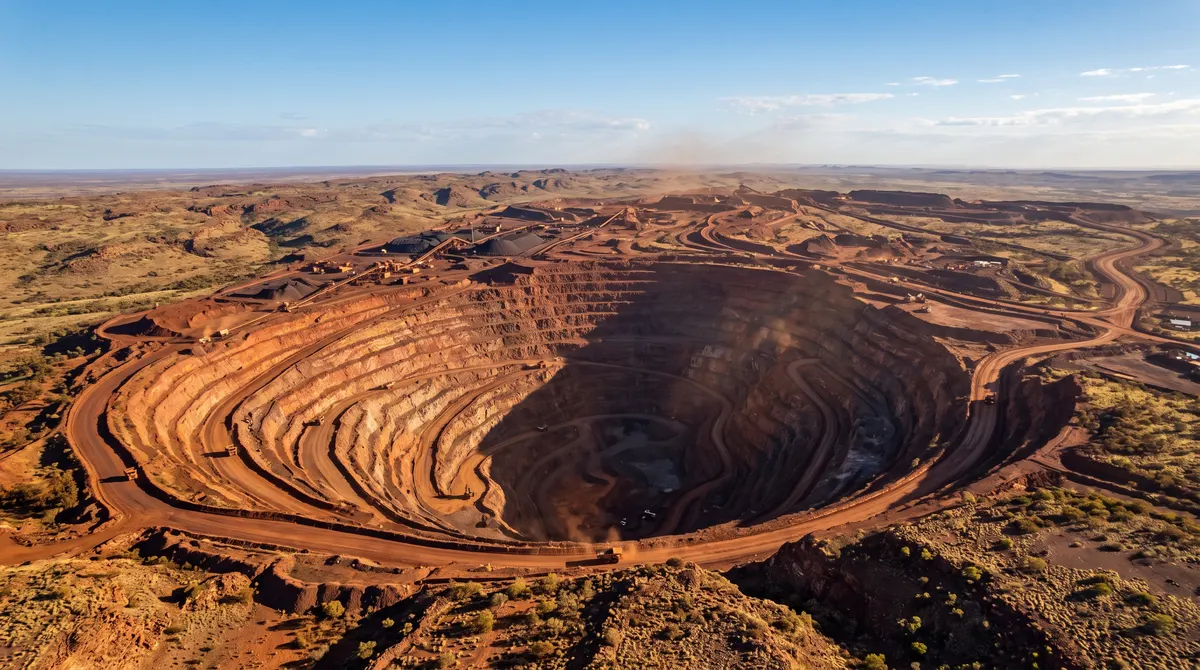
The Pilbara in Western Australia holds some of Earth's largest iron ore deposits, and their origin is a story about the early atmosphere. Around two and a half billion years ago, the oceans held large amounts of dissolved iron, because there was little free oxygen to react with it. As photosynthesising microbes released oxygen, the dissolved iron was oxidised into insoluble forms that settled on the seafloor. Iron-rich layers alternated with silica, building up the striped rocks called banded iron formations, exposed today in the gorges of Karijini National Park.
Banded iron formations are typically around a third iron, but the richest Pilbara ores are much higher grade. Geologists think later circulating fluids and deep weathering dissolved away much of the silica, upgrading parts of these formations into high-grade ore. The Pilbara's ancient crust has also stayed relatively stable for billions of years, so the deposits survived.
From Bauxite to Aluminium
Aluminium is the crust's most abundant metal, yet it is locked tightly into common minerals. Its main ore, bauxite, forms when aluminium-bearing rocks are weathered for a very long time in warm, wet conditions. Rain leaches away silica, leaving a reddish, aluminium-rich residue. Australia has large deposits at Weipa in Queensland, Gove in the Northern Territory and the Darling Range in Western Australia.
In the Bayer process, crushed bauxite is dissolved in hot caustic soda, and aluminium hydroxide is precipitated out and heated to make a white powder, alumina. The alkaline leftover, red mud, must be stored carefully. Alumina is then dissolved in molten cryolite and split by a powerful electric current in the Hall–Héroult process. As a rough rule, four to five tonnes of bauxite yield about two tonnes of alumina, which in turn yield one tonne of aluminium. Smelting uses so much electricity that recycling aluminium, which needs a small fraction of the energy, makes enormous sense.
Lithium and Rare Earths
Much of the world's lithium comes from salty underground brines, mainly in South America, evaporated in ponds. Australia's comes mostly from hard rock, as a mineral called spodumene found in pegmatites. Pegmatites form from the last, fluid-rich portion of a granite magma to crystallise. Elements that don't fit easily into common minerals become concentrated in it, and crystals can grow unusually large. Greenbushes in Western Australia is one of the world's major hard-rock lithium mines.
Spodumene is crushed and concentrated, then roasted to change its crystal structure so the lithium can be released with acid and refined into lithium hydroxide or carbonate for batteries. Rare earth elements pose a different challenge. Deposits such as Mount Weld in Western Australia formed in unusual igneous rocks that were later deeply weathered, but because the rare earths are chemically so similar to one another, separating them takes many repeated stages of solvent extraction. Our piece on rare earth elements explains why they matter.
How Geologists Find Ore
Ore bodies rarely announce themselves, and across much of Australia the bedrock hides beneath deep weathered soil, so exploration combines several lines of evidence.
- Geological mapping identifies the rock types and structures known to host certain deposits.
- Geophysics measures physical properties from the air or ground. Magnetic surveys pick out iron-rich rocks, gravity surveys detect dense bodies and electromagnetic surveys find conductive sulfide minerals.
- Geochemistry looks for traces of metals in soil, stream sediments, groundwater and even plants. CSIRO researchers famously found tiny particles of gold in the leaves of eucalyptus trees whose roots reached down towards buried deposits.
- Drilling is the final test, recovering cores of rock that show whether a deposit is really there and how rich it is.
Once mined, ore is crushed, ground and separated by density, magnetism or surface chemistry. In froth flotation, chemicals make target mineral particles repel water so they cling to rising bubbles and are skimmed off.
The Environmental Trade-Offs
Mining inevitably disturbs land, often for generations. Tailings, the finely ground leftovers from processing, pile up in huge volumes, and dam failures can be catastrophic, as the 2019 collapse at Brumadinho in Brazil tragically showed. Where sulfide minerals are exposed to air and water, they can generate sulfuric acid, a problem called acid mine drainage. The rivers around Queenstown in Tasmania still carry the scars of more than a century of copper mining and smelting.
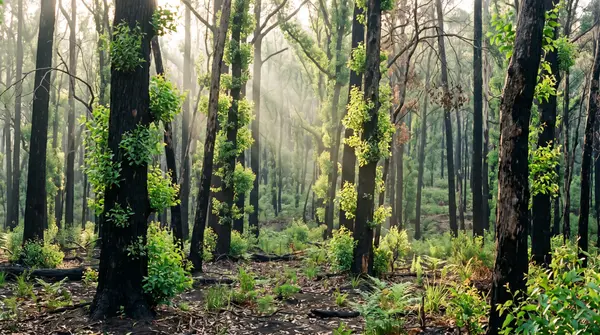
Real improvements are being made. Modern mines are generally required to plan for closure before they open, topsoil is stripped and stored for reuse, and land is rehabilitated progressively rather than left until the end. In Western Australia's jarrah forest, former bauxite pits have been replanted for decades, with researchers working out how to return a diverse native ecosystem rather than just a green cover. Fully restoring complex ecosystems remains genuinely difficult.
The Rock Underneath Everything
The ore bodies we mine today are products of ancient oceans, cooling magmas, hot circulating fluids and endless tropical rain, processes that took millions or billions of years. Understanding that geology helps us find what we need, use and recycle it well, and care for the land we borrow it from.