Talking Science Podcast
Comets and Asteroids – Visitors from the Deep Past
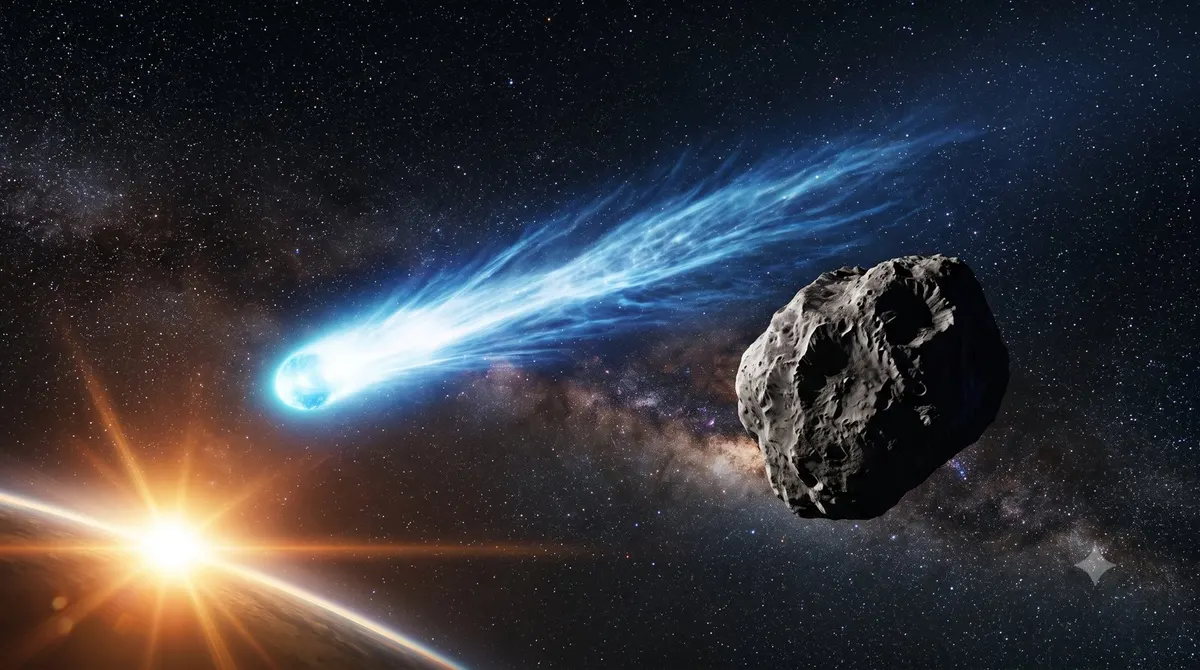
When the solar system was forming, not every scrap of material found its way into a planet. Countless chunks of rock, metal, and ice were left over, scattered and orbiting the young Sun like crumbs from an unfinished meal. Those leftovers are still out there today, and we call them comets and asteroids. They may seem like minor debris, but these humble bodies are time capsules from the dawn of our cosmic neighborhood, and studying them tells us where we came from.
Two Kinds of Leftovers
Asteroids and comets are cousins, but they grew up in different neighborhoods. Asteroids are mostly rocky or metallic bodies that formed in the warmer, inner region of the solar system, where the Sun’s heat drove off lighter, more volatile materials. Most of them circle the Sun in a broad ring between the orbits of Mars and Jupiter, a zone we call the asteroid belt. Despite what movies suggest, this belt is mostly empty space, and its objects are spread so thinly that spacecraft pass through it with ease.
Comets, by contrast, are icy. They formed in the cold outer reaches, far from the Sun’s warmth, so they hold onto frozen water and other ices along with dust and rock. A comet is sometimes described as a dirty snowball, a mixture of ice and grime perhaps a few kilometers across. Most comets spend nearly all their time in the distant, frigid edges of the solar system, only occasionally swinging inward on long, looping paths.
The Anatomy of a Comet’s Tail
A comet is dark and inconspicuous while it drifts in the cold. Everything changes as it approaches the Sun. The rising heat causes its ices to turn straight from solid to gas, a process called sublimation. This releases dust and vapor that form a glowing cloud, or coma, around the solid nucleus, and streams outward into the tails that make bright comets so spectacular.
A comet often shows two tails. One is made of dust, pushed gently outward by the pressure of sunlight, and it tends to curve along the comet’s path. The other is made of electrically charged gas, swept straight back by the stream of particles flowing from the Sun known as the solar wind. Because of this, a comet’s tails always point away from the Sun, no matter which way the comet is traveling. A comet chasing the Sun outward moves tail-first.
Where They Come From
The comets we see come from two great reservoirs. Shorter-period comets, which return every few decades or centuries, mostly originate in a flattened, doughnut-shaped region beyond Neptune called the Kuiper Belt. Longer-period comets, which may take thousands or even millions of years to complete a single orbit, are thought to fall inward from a vast, spherical cloud of icy bodies surrounding the entire solar system, known as the Oort Cloud.
The Oort Cloud has never been seen directly, since its members are far too faint and distant. Its existence is inferred from the paths of long-period comets, which seem to arrive from every direction, suggesting a shell of icy objects wrapped around us at the outer limits of the Sun’s gravitational reach. It is a striking reminder of how large the solar system truly is, extending far beyond the familiar planets.
Messengers of Our Origins
Because comets and asteroids have changed so little since they formed, they preserve the original ingredients of the solar system. Studying them is like reading a recipe for how planets, and ultimately life, came together. Space missions have now visited several of these bodies up close, and a few have even landed on them or brought samples back to Earth for careful analysis.
One of the most tantalizing ideas is that comets and asteroids helped deliver the raw materials for life to the early Earth. Our young planet was hot and may have lost much of its original water, so some of the water in today’s oceans could have been brought by icy impacts long ago. Asteroids and comets also carry carbon-based molecules, including some of the building blocks used by living things. They may have seeded a barren world with the chemistry it needed to eventually stir into life.
Guests That Can Bite
These visitors are not entirely benign. Every so often, an asteroid or comet crosses Earth’s path. Most are tiny and burn up harmlessly in the atmosphere, giving us shooting stars. But larger impacts have shaped our planet’s history in dramatic ways. The most famous example is the impact widely thought to have ended the age of the dinosaurs, when a body several kilometers wide struck Earth and triggered a global catastrophe.
Aware of this risk, astronomers now systematically scan the skies for objects whose orbits bring them near Earth. The good news is that large, dangerous impacts are extremely rare, and finding a threatening object years in advance would give us time to act. Space agencies have even tested the idea of nudging an asteroid off course, showing that planetary defense is moving from science fiction toward genuine capability.
Our growing skill at studying these objects is impressive. Spacecraft have now rendezvoused with comets, flown alongside them as their tails switched on, and even placed a small lander on a comet’s icy surface. Other missions have touched asteroids, scooped up a handful of material, and carried it safely back to Earth. In laboratories, scientists can then examine these pristine grains under microscopes, reading in them the chemistry of a time before any planet existed.
What they find keeps reinforcing the picture of these bodies as messengers. Some asteroids are loose piles of rubble held together by little more than their own feeble gravity. Some comets contain complex carbon compounds and simple organic molecules. Each new sample adds a page to the story of how a swirling disc of gas and dust around the young Sun gradually assembled itself into worlds, and how the leftover pieces preserved a record of that process for billions of years.
So the next time a comet graces the evening sky or a meteor streaks overhead, take a moment to appreciate what you are seeing. These are not random bits of rubble but ancient wanderers, older than the Earth itself, still carrying the memory of how our world began. They connect us, quite literally, to the deep past.