Talking Science Podcast
Convergent Evolution – Nature Repeating Itself
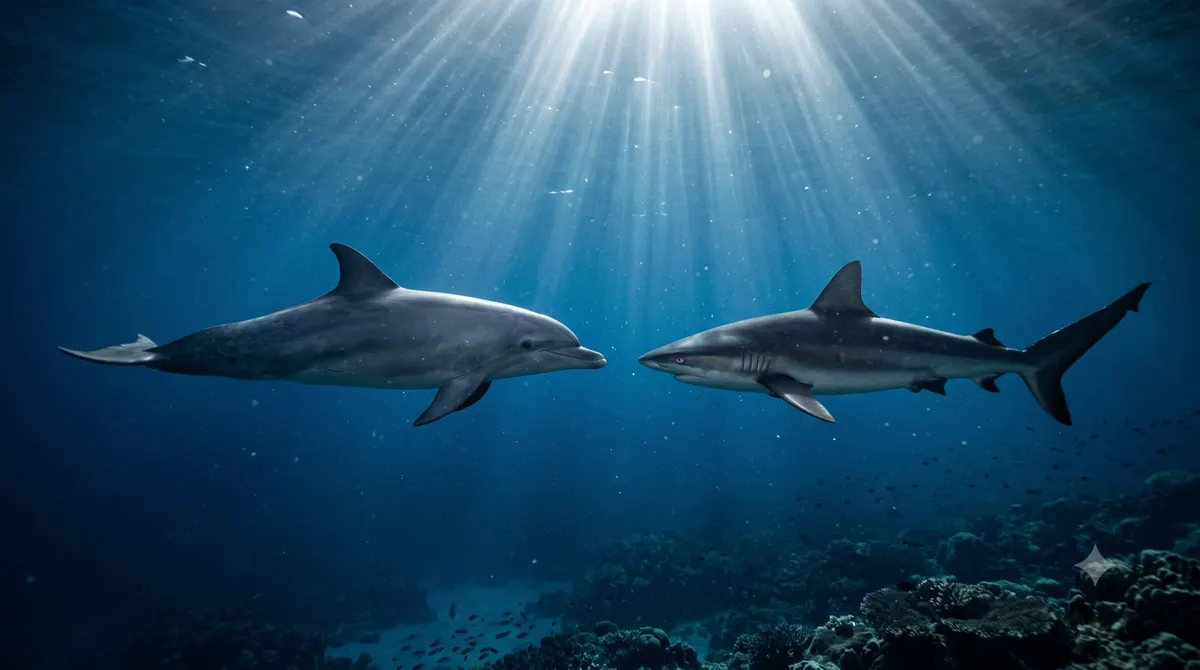
A dolphin and a shark glide through the water with the same sleek, torpedo-shaped bodies and the same powerful fins, yet one is a mammal that breathes air and nurses its young, while the other is a fish that has changed little in hundreds of millions of years. A bird, a bat, and a long-extinct flying reptile all conquered the sky with wings, though none inherited those wings from a common flying ancestor. Look across the living world and you keep finding these echoes, unrelated creatures arriving at strikingly similar solutions. This is convergent evolution, nature solving the same problem twice, and it is one of the most revealing patterns in all of biology.
The Same Problem, the Same Answer
Evolution is often described as a process of endless variation, and it is. But it does not have free rein. The laws of physics and the demands of the environment impose real limits on what actually works. If you want to move quickly through water, there are only so many body shapes that will do the job well. A streamlined form with fins is one of them, and so nature keeps arriving at it, whether the animal in question is a fish, a dolphin, or an ancient marine reptile.
This is the heart of convergent evolution. When different species face the same challenge, be it swimming fast, flying, seeing in the dark, or surviving in the desert, they often stumble onto the same answer, even though they are working from entirely different starting points and are not closely related. The environment poses the question, and there are only a handful of good ways to answer it.
Wings, Fins, and Streamlined Bodies
Flight is a favourite example. Powered flight has evolved separately in insects, in birds, in bats, and in the extinct flying reptiles called pterosaurs. Each of these groups developed wings independently, and each built them differently, a bat’s wing is a webbed hand, a bird’s wing is feathered, an insect’s is something else entirely. Yet all of them obey the same aerodynamic rules, because the physics of staying aloft does not change no matter who is doing the flying.
The streamlined swimmer is another classic. The resemblance between dolphins and fish is so strong that people sometimes forget dolphins are mammals at all. The extinct ichthyosaurs, marine reptiles from the age of dinosaurs, took on much the same shape. Three very different kinds of animal, three separate journeys, one recurring body plan, all shaped by the unyielding demands of moving through water.
The Tale of Two Eyes
Perhaps the most remarkable case of convergence involves the eye. The camera-like eyes of humans and other vertebrates, with a lens that focuses light onto a light-sensitive surface, are wonders of biological engineering. Astonishingly, the octopus and its relatives evolved eyes of a very similar design entirely on their own. Our lineage and theirs split long, long ago, well before either had complex eyes, yet both arrived at the same elegant solution for forming a sharp image.
There are even revealing differences in the details, showing that these eyes really were built separately rather than inherited from a shared blueprint. Nature, working independently on the same problem of how to see clearly, twice hit upon the camera eye. It is hard to imagine a more vivid demonstration that some solutions are so good that evolution keeps rediscovering them.
Telling Convergence Apart from Kinship
Convergent evolution poses a genuine puzzle for scientists trying to work out how living things are related. If two animals look alike, is it because they share a recent ancestor, or because they independently evolved similar features? Getting this wrong can badly distort the family tree of life. A feature that looks the same but arose separately is called analogous, while a feature genuinely inherited from a common ancestor is called homologous. The wings of a bird and a bat are analogous, but the bones inside a bat’s wing and a whale’s flipper are homologous, inherited from a shared four-limbed ancestor and merely repurposed.
To untangle these cases, biologists look beneath the surface, at anatomy in fine detail, at development, and increasingly at genetics. Reading the genetic record often reveals whether a resemblance runs deep, reflecting true kinship, or is only skin deep, the product of convergence. It is detective work, and convergent evolution is one of the trickiest suspects.
What Convergence Tells Us
Beyond sorting out family trees, convergent evolution carries a deeper message. It suggests that evolution, though it depends on chance mutations, is not entirely random in its results. The environment channels it, favouring certain solutions again and again. When the same eye, the same wing, or the same streamlined body keeps appearing, it hints that life is being nudged toward particular workable forms by the shared physics and chemistry of our world.
This idea even reaches beyond our planet. Some scientists wonder whether, if life exists elsewhere in the universe, it might independently arrive at familiar solutions, eyes to sense light, limbs to move, streamlined bodies to swim, driven by the same physical constraints. We cannot know, but convergent evolution at least makes the speculation reasonable. The same forces that shaped a dolphin might shape creatures under alien seas.
The next time you notice how a hummingbird hovers like an insect, or how a desert plant on one continent resembles an unrelated one on another, you are seeing convergent evolution at work. It is nature repeating itself, not out of unimaginativeness but out of a kind of practical wisdom. Faced with the same problems, life keeps finding the same good answers, an insight that reveals both the boundless creativity of evolution and the deep constraints that give it shape. In the echoes between unrelated creatures, we glimpse the rules that quietly govern the living world.