Talking Science Podcast
Coral Reefs – Rainforests of the Sea
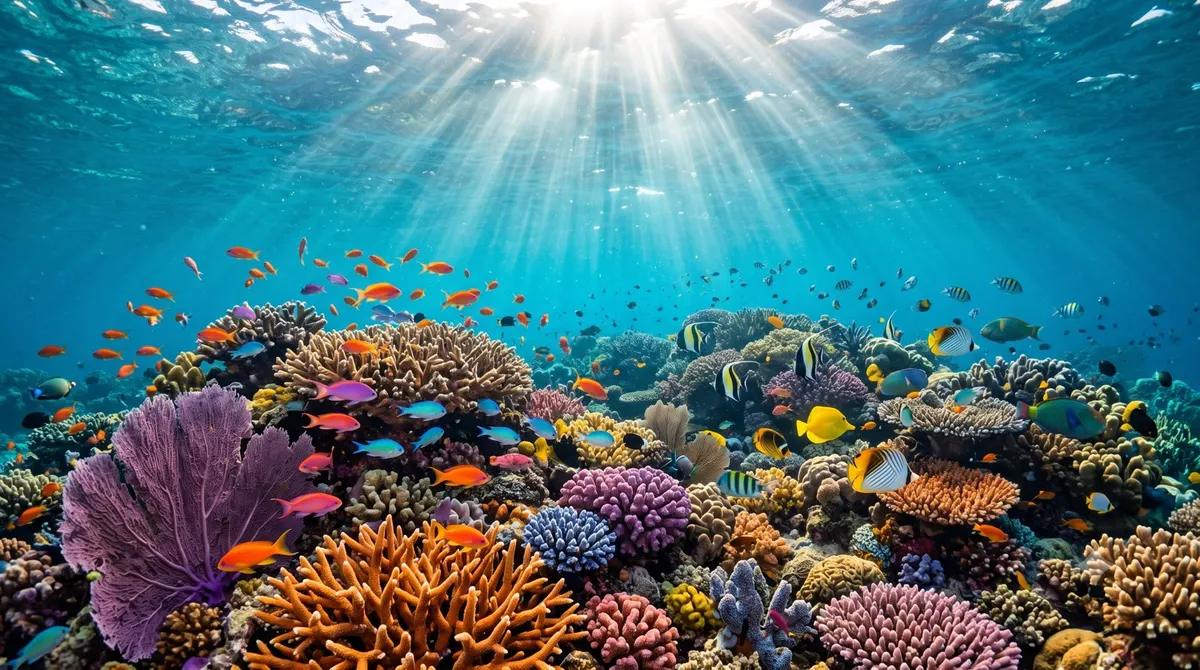
Slip beneath the surface of a tropical sea and you enter one of the most crowded, colorful places on the planet. Fish in every shade dart between branching structures; creatures cling, crawl, and drift through a labyrinth of nooks and crannies. Coral reefs cover well under one percent of the ocean floor, yet they shelter roughly a quarter of all marine species. That is why they are often called the rainforests of the sea—and, like rainforests, they are both spectacularly alive and alarmingly fragile.
The animal that builds a city
The first surprise is that coral is not a rock or a plant. It is an animal, or rather a vast colony of them. Each reef-building coral is made of thousands of tiny creatures called polyps, soft-bodied relatives of jellyfish and sea anemones. Each polyp is little more than a mouth ringed by stinging tentacles, but together they achieve something extraordinary: they pull dissolved minerals from seawater and lay down hard skeletons of limestone beneath themselves.
Generation after generation, polyps build on the skeletons of those that came before, and over centuries and millennia these deposits accumulate into the massive structures we call reefs. The largest reef systems are so big they can be seen from space, making them the greatest structures ever built by living things—constructed grain by grain by animals smaller than a fingertip.
Because reefs grow so slowly, they are also archives of time. The oldest living reefs have been growing for thousands of years, and the rock beneath them records far longer histories still. When you look at a reef, you are really looking at layer upon layer of accumulated life, a coral cathedral raised without any architect, following nothing but the simple, patient chemistry of countless tiny animals doing what they do.
A partnership at the heart of the reef
None of this would be possible without a hidden partnership. Living inside the tissues of reef-building corals are enormous numbers of microscopic algae. Through photosynthesis, these algae capture sunlight and turn it into sugars, sharing much of that food with their coral hosts. In return, the coral gives the algae a safe, sunlit home and the raw materials they need. It is one of nature’s great collaborations, and it is what makes tropical reefs so productive in otherwise nutrient-poor waters.
These algae are also the source of much of a reef’s color. And here lies a vulnerability. The partnership works only within a fairly narrow band of conditions. When the water grows too warm, the relationship breaks down: the coral expels its algae, loses its main food supply and its color, and turns a ghostly white. This is the phenomenon known as coral bleaching, and a bleached coral is a starving one.
Why reefs matter to everything around them
Reefs are not just beautiful; they are the foundation of entire ecosystems and human communities. The crevices and branches of a reef offer food and shelter to a staggering diversity of life, from tiny shrimp to sharks. Countless fish species spend at least part of their lives on reefs, which act as nurseries where young fish can hide and grow before venturing into open water.
People depend on them too. Reefs support fisheries that feed hundreds of millions of people, and they draw tourists whose spending sustains coastal economies. They also act as natural breakwaters, absorbing the force of storms and waves before they reach the shore, protecting coastlines and the communities living along them. A healthy reef is, in effect, both a supermarket and a sea wall for the people nearby.
There may be hidden treasures in reefs as well. The creatures that live packed so tightly together are locked in constant chemical warfare, producing an arsenal of unusual compounds to defend themselves and compete for space. Some of these substances have already inspired medicines, and researchers suspect that many more useful molecules are waiting to be discovered among reef organisms. To lose a reef, then, is not only to lose beauty and food and shelter, but potentially cures we have not yet found.
A world under pressure
All of this is now under serious threat. The gravest danger comes from a warming ocean. As the climate heats up, marine heat waves push reefs past the temperature they can tolerate, triggering mass bleaching events across huge areas. If the heat passes quickly, corals can recover their algae and survive. If it lingers, they die—and reefs that took centuries to build can be lost in a matter of weeks.
Warming is not the only pressure. The ocean is also absorbing much of the carbon dioxide we release, which makes seawater more acidic and harder for corals to build their limestone skeletons. On top of that come more local harms:
- Pollution and runoff from land that smother and poison corals.
- Overfishing that removes the animals keeping the reef in balance.
- Physical damage from careless anchoring, coastal development, and destructive fishing.
Together these stresses have already degraded many of the world’s reefs, and the trend is deeply worrying.
Reasons for hope
Yet the story is not only one of loss. Reefs are resilient when given a chance, and people around the world are working to give them that chance. Marine protected areas, where fishing and development are limited, allow reefs to recover and thrive. Scientists are experimenting with growing coral in nurseries and replanting it, and are studying corals that seem naturally more tolerant of heat, hoping to help reefs adapt.
But the single most important factor is the global one. Local protection buys time and preserves what remains, yet the future of reefs ultimately depends on how quickly the world curbs the greenhouse gas emissions driving ocean warming. That is a daunting challenge, but it also means the fate of these underwater cities is genuinely in our hands.
Coral reefs are among the oldest and richest expressions of life on Earth, built patiently over ages by creatures we can barely see. To lose them would be to lose not just a spectacle of color and diversity but a living system that feeds, shelters, and protects millions. To save them is one of the defining tests of whether we can share the planet wisely—and the rainforests of the sea are still waiting to see how we answer.