Talking Science Podcast
Dark Energy – Why the Universe Is Flying Apart
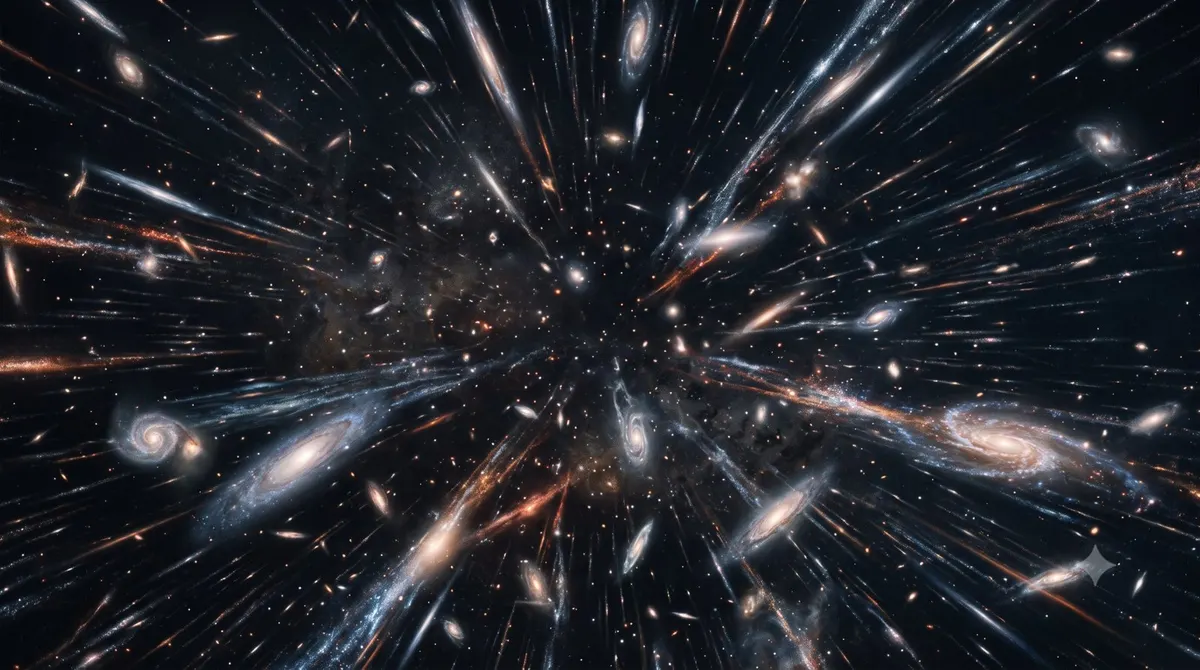
For most of the twentieth century, scientists assumed the universe’s expansion had to be slowing down. It seemed obvious. Everything in the cosmos pulls on everything else through gravity, so surely that mutual pull would gradually put the brakes on the expansion, like a ball thrown upward slowing as it rises. Then, in a discovery that stunned the scientific world, astronomers found the exact opposite. The universe is not slowing down. It is speeding up. And the mysterious cause of this cosmic acceleration is what we now call dark energy.
A Universe in Motion
To appreciate the mystery, we first need to understand that the universe has been expanding for a very long time. Nearly a century ago, astronomers discovered that distant galaxies are rushing away from us, and the farther away a galaxy is, the faster it recedes. This was the first solid evidence that the whole universe is growing, with space itself stretching and carrying galaxies apart like raisins in rising bread dough.
This expansion traces back to the beginning of everything, the moment we call the Big Bang. Ever since, space has been stretching outward. For decades the great question was simply how fast the expansion was slowing, and whether it might one day reverse into a collapse. Nobody seriously expected the answer that nature had in store.
The Discovery That Changed Everything
The breakthrough came from studying a special kind of exploding star that shines with a reliable, predictable brightness. Because astronomers know how bright these stellar explosions truly are, they can measure how far away they lie by seeing how faint they appear. These cosmic mile markers let researchers trace the expansion of the universe far back in time.
Two teams of astronomers set out to measure how much the expansion had slowed, fully expecting to find the cosmic brakes gently engaged. Instead they found the distant explosions were dimmer, and therefore farther away, than expected. The only sensible explanation was that the expansion of the universe had been speeding up. It was such a surprising result that the researchers double-checked it exhaustively before believing it themselves. The finding was so important it eventually earned a Nobel Prize.
What Could Be Pushing?
If the universe is accelerating, something must be driving it, some influence acting against the inward pull of gravity on the largest scales. Scientists gave this unknown driver the name dark energy, a placeholder that honestly reflects how much remains unknown. The word dark here means hidden and mysterious, not literally black.
The most remarkable feature of dark energy is that it seems to fill all of space evenly. As the universe expands and creates more space, there is simply more dark energy, and so its pushing effect grows stronger over time relative to gravity. This is why the acceleration took over only in the later chapters of cosmic history. In the early universe, matter was packed closely and gravity dominated, gradually slowing things down. But as space spread out and matter thinned, dark energy eventually gained the upper hand.
This behavior is deeply strange when you stop to think about it. Ordinary things thin out as they spread over more space, like a drop of dye dispersing in water. Dark energy does not seem to dilute in the same way. Emptier space does not mean weaker dark energy. That property, more than anything, is what makes many scientists suspect dark energy is a feature of empty space itself, rather than a substance floating within it. Understanding why empty space would push outward at all is one of the hardest problems in physics.
How Much of the Universe Is This Stuff?
Perhaps the most humbling part of the story is just how much dark energy there appears to be. When scientists tally up everything in the cosmos, the results are staggering. Ordinary matter, the stuff of stars, planets, and people, makes up only a small slice. Dark matter, the invisible material that holds galaxies together, makes up a larger portion. But dark energy dominates everything else, accounting for the majority of the total content of the universe.
Think about what that means. The atoms that form everything we have ever seen or touched are a minor ingredient in the cosmos. The largest component of reality is something we cannot see, cannot hold, and do not truly understand. Dark energy is not a small correction to our picture of the universe. It is the main event.
Competing Ideas
So what is dark energy, really? Here we reach the frontier of knowledge, where honest scientists admit they do not yet know. Several possibilities are being explored, each with its own appeal and its own difficulties:
- It might be an inherent energy of empty space itself, a property of the vacuum that pushes outward
- It might be a new kind of field spread throughout the cosmos, one that could change subtly over time
- It might be a hint that our theory of gravity needs revising on the very largest scales
Each idea makes slightly different predictions, and astronomers are building ambitious new telescopes and surveys designed to tell them apart. By mapping the positions of millions of galaxies and tracing how cosmic expansion has changed over billions of years, they hope to pin down dark energy’s true nature.
The Fate of Everything
Dark energy does more than puzzle us. It may determine the ultimate destiny of the universe. If the acceleration continues as it has, galaxies will drift ever farther apart, and in the extremely distant future the cosmos may become a cold, dark, and lonely place, with distant galaxies fading forever beyond reach. Other scenarios remain possible, depending on how dark energy behaves over immense spans of time.
For now, dark energy stands as one of the deepest mysteries in all of science, a reminder that the universe still holds secrets vast enough to overturn our assumptions. A little over a generation ago, we did not even know it existed. Today we know it rules the cosmos, and yet we cannot say what it is. That gap between knowing that something is there and knowing what it is captures the thrill of discovery perfectly. The universe is flying apart, faster and faster, and understanding why may be one of the great scientific adventures of our age.