Talking Science Podcast
Dark Matter – The Universe’s Missing Mass
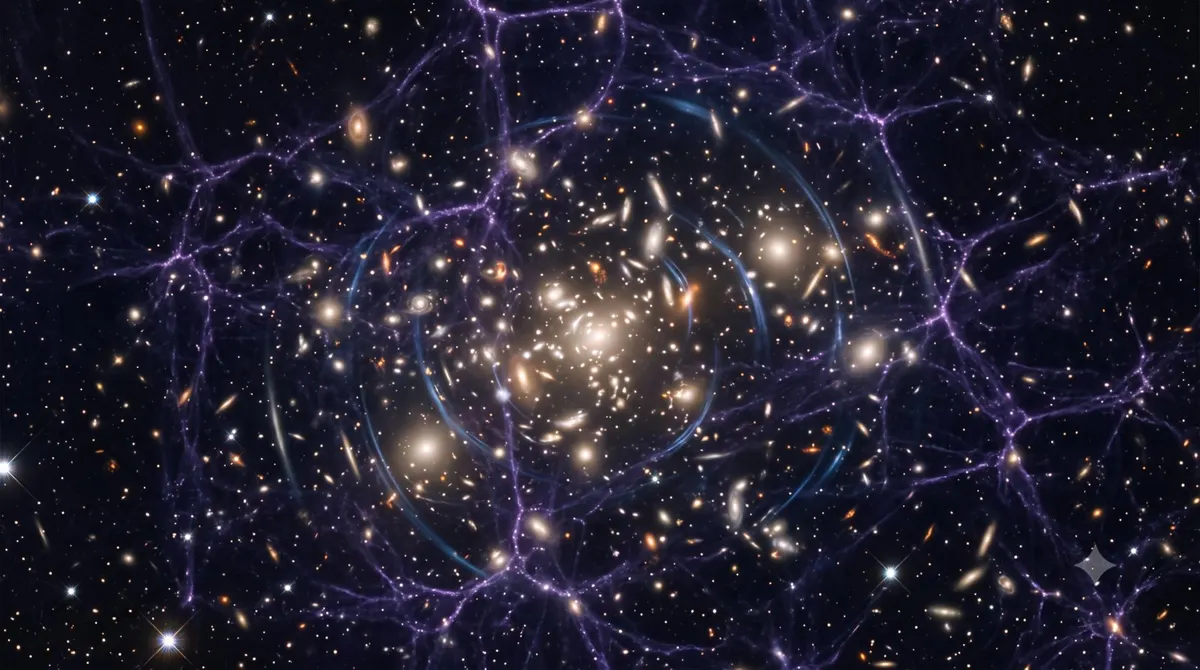
Here is a startling fact about the universe: most of it is missing. Not missing in the sense of being lost, but missing in the sense that we cannot see it, cannot touch it, and do not yet know what it is made of. When astronomers add up all the stars, planets, gas, and dust in the cosmos, they find it accounts for only a small fraction of the matter that must be there. The rest is something invisible, something we call dark matter. And its story is one of the great detective mysteries of modern science.
The First Clues
The trail began when astronomers started measuring how galaxies move. A galaxy is a vast, whirling collection of billions of stars, and the stars near its edge orbit around the center much like planets orbit the Sun. Based on the visible matter alone, the outer stars should move slowly, because there seems to be little mass out there to hold them in a fast orbit.
But when astronomers actually measured these speeds, they found something puzzling. The outer stars were racing around far too quickly. At those speeds, the galaxies should be flying apart, their stars flung out into space. Something unseen had to be providing the extra gravity to hold everything together. That something was the first strong hint of dark matter.
Weighing the Invisible
Once astronomers knew to look, evidence for the missing mass turned up everywhere. Galaxies gather into enormous clusters, and these clusters move in ways that also demand far more gravity than their visible contents can supply. Whatever provides that pull vastly outweighs everything we can see.
One of the most elegant pieces of evidence comes from the way gravity bends light. Einstein showed that mass warps space, and light traveling past a massive object gets deflected, almost as if passing through a lens. By studying how the light from distant galaxies is bent and distorted, astronomers can map where the mass lies, even when that mass gives off no light at all. Again and again, these maps reveal huge amounts of unseen material.
There is an especially striking case involving two galaxy clusters that collided long ago. When they crashed, the ordinary gas in each cluster slowed down and piled up in the middle, but the bulk of the mass, traced by the bending of light, sailed straight through and ended up on either side. In other words, most of the mass behaved as though it barely interacted with anything, exactly as we would expect if it were made of dark matter. Observations like this are hard to explain any other way.
What Dark Matter Is Not
It is tempting to think the missing mass might just be ordinary stuff that happens to be dark, like faint planets, cold gas, or dead stars. Scientists took this idea seriously and investigated carefully. The evidence points strongly against it. There is simply not enough ordinary matter in the universe to account for the missing mass, no matter how it might be hidden.
Dark matter appears to be something genuinely new, a form of matter that does not interact with light at all. It does not shine, does not absorb light, does not reflect it. As far as we can tell, it passes right through ordinary matter and even through itself, betraying its presence only through gravity. Right now, dark matter is likely streaming through you, through the Earth, through everything, unnoticed.
The Architect of the Cosmos
Dark matter is not just a curiosity to be explained away. It played a starring role in building the universe we live in. In the early cosmos, matter was spread out remarkably smoothly, but tiny variations in density existed here and there. Dark matter, feeling only gravity, began to clump together first, forming an invisible scaffolding across space.
Ordinary matter then flowed into these dark matter clumps, and within them, gas gathered and cooled and eventually ignited into the first stars and galaxies. In a very real sense, dark matter laid the foundations, and the visible universe of stars and galaxies grew up within its unseen framework. Without it, the cosmos might look nothing like the star-filled sky we know.
The Hunt Goes On
So what is dark matter actually made of? This is one of the biggest unanswered questions in all of science, and researchers around the world are chasing it with remarkable ingenuity. The leading idea is that dark matter consists of some kind of particle we have not yet discovered, one that barely interacts with normal matter. The search takes several forms:
- Building ultra-sensitive detectors deep underground, hoping to catch a rare dark matter particle nudging an ordinary atom
- Smashing particles together in powerful accelerators, watching for signs that dark matter is created
- Scanning the sky for faint signals that might come from dark matter particles interacting far away
So far, despite enormous effort and cleverness, dark matter has not been caught directly. Every experiment that comes up empty still teaches us something, narrowing down what dark matter can and cannot be. The mystery has proven remarkably stubborn, which only makes the eventual answer more tantalizing.
A Humbling Perspective
There is something profoundly humbling in all of this. We have built an impressive picture of the universe, mapped distant galaxies, and traced cosmic history back billions of years. And yet the majority of the matter around us remains a genuine mystery. The atoms that make up stars, planets, and people turn out to be the minority ingredient in the cosmos.
Dark matter reminds us how much remains to be discovered, even about the basic contents of reality. Far from being discouraging, this is exactly what makes science thrilling. Somewhere out there, or perhaps in a laboratory buried deep underground, lies the answer to what most of the universe is made of. When we finally solve this puzzle, it will reshape our understanding of everything, and the invisible scaffolding that holds the galaxies together will at last step into the light.