Talking Science Podcast
DNA – The Instruction Manual for Life
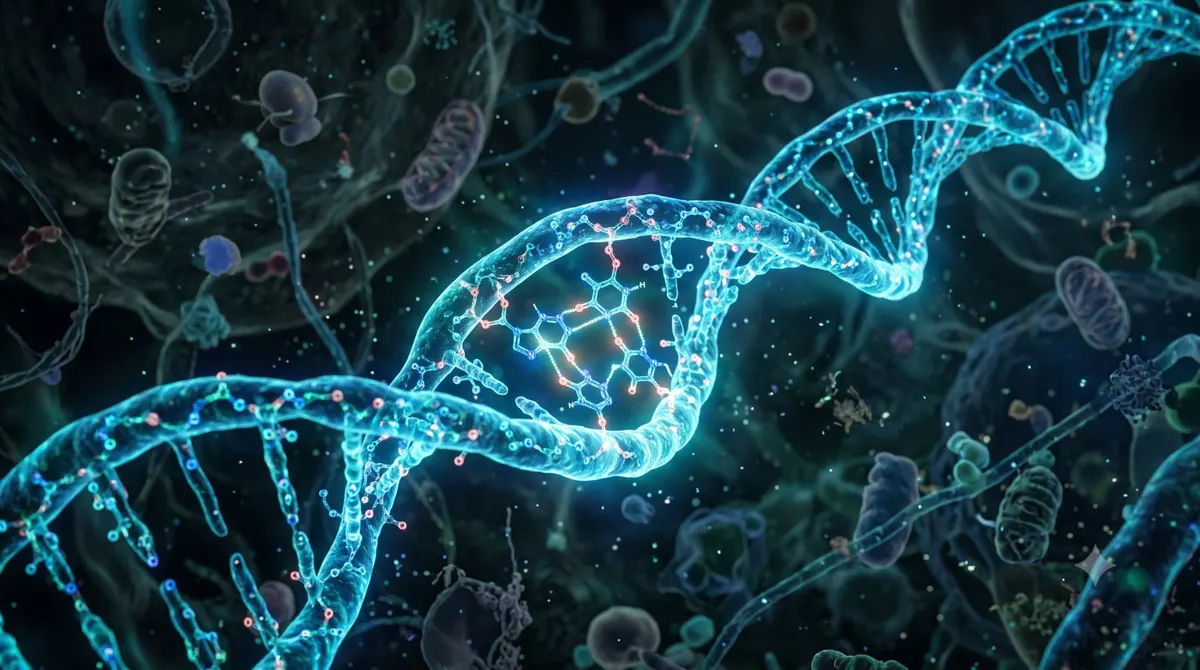
Inside almost every one of your cells sits a molecule so long, so densely coiled, and so quietly important that it is easy to forget it is there at all. It is called DNA, and it holds the complete set of instructions for building and running you. If you could unravel the DNA from a single cell and stretch it out, it would reach roughly two metres in length, yet it folds up small enough to fit inside a compartment you could never see without a microscope. This one molecule is the reason a fertilised egg becomes a person rather than a fish, and the reason you resemble your relatives. It is, in the truest sense, the instruction manual for life.
A Code Written in Four Letters
The remarkable thing about DNA is that all its information is spelled out with just four chemical building blocks, called bases. Their names are adenine, thymine, guanine, and cytosine, but you can simply think of them as four letters: A, T, G, and C. The order of these letters along the molecule is what carries meaning, in much the same way that rearranging the twenty-six letters of the alphabet lets you write anything from a shopping list to a novel.
A human being’s full set of instructions runs to about three billion of these letters. Written out in ordinary type, that sequence would fill hundreds of thick books. And yet the whole library is packed into a space far too small to see. The genius of the system is that a very simple alphabet, repeated in a specific order, can encode staggering complexity.
The Twisted Ladder
DNA takes the shape of a double helix, which is a fancy way of saying a ladder that has been gently twisted. The two long sides of the ladder are structural supports, and the rungs are where the information lives. Each rung is made of two bases that reach toward each other and clasp hands in the middle.
Crucially, these pairings are not random. A always joins with T, and G always joins with C. This strict rule is the quiet hero of biology. Because each base has only one permitted partner, one side of the ladder automatically dictates the other. If you know the sequence of one strand, you know the sequence of its twin. This built-in redundancy is what makes DNA so good at being copied faithfully, and it is the principle on which inheritance depends.
Copying the Manual
Every time a cell divides, it must hand a complete copy of the instruction manual to each of its two daughter cells. DNA achieves this with elegant simplicity. The twisted ladder unzips down the middle, splitting each rung into its two halves. Now each lonely strand acts as a template. Floating chemical letters drift into place along it, obeying the pairing rule, so that a T lines up opposite every A, and a G opposite every C.
When the process finishes, one original strand has become two complete ladders, each identical to the first. The copying is astonishingly accurate. Cells also carry proofreading machinery that catches and corrects most of the rare mistakes, which is a good thing, because errors that slip through can occasionally cause disease.
From Instructions to Action
Storing information is only useful if something can read it. The stretches of DNA that carry practical instructions are called genes, and most genes contain the recipe for building a protein. Proteins are the workhorses of the body, and they do almost everything that needs doing.
To read a gene, the cell makes a temporary working copy of that section using a closely related molecule called RNA. This messenger copy travels out of the DNA’s storage compartment to tiny cellular machines that read it three letters at a time. Each three-letter word specifies one building block of a protein, and as the machine reads along, it strings those blocks together into a chain that folds into a working molecule. A few of the things proteins build and run include:
- Enzymes that digest your food and power your chemistry
- Structural materials such as the keratin in hair and nails
- Antibodies that defend you against infection
The Same Language Everywhere
One of the most profound discoveries in all of biology is that this DNA code is essentially universal. The same four letters, the same pairing rules, and the same three-letter reading system are used by bacteria, mushrooms, oak trees, jellyfish, and human beings alike. A gene taken from one organism can often be read correctly by the cellular machinery of a completely different one.
This shared language is powerful evidence that every living thing on Earth is related, descended from common ancestors deep in the past. It also has enormous practical value. Because the code is universal, scientists can insert a human gene into bacteria and coax those bacteria to manufacture human insulin for people with diabetes, a technique that has saved countless lives.
Not Every Letter Is a Command
For a long time, scientists assumed that most of our DNA must be genes, busily coding for proteins. The reality turned out to be far stranger. Only a small fraction of human DNA actually spells out recipes for proteins. The rest was once dismissively called junk, but that name has proven far too hasty.
Much of this non-coding DNA is now known to play regulatory roles, acting like switches and dimmers that decide when a gene is turned on, how strongly, and in which cells. This is why a nerve cell and a skin cell can carry the exact same DNA yet look and behave completely differently: each reads a different selection of the instructions. The manual, it turns out, contains not just the recipes but also detailed notes on when and where to use each one.
A Manual That Writes Its Own Story
It is worth pausing on how strange and wonderful all this is. A single molecule, built from four repeating parts, stores enough information to grow a living creature, copies itself with near-perfect fidelity, and speaks a chemical language shared by every organism that has ever lived. DNA does not think or plan, yet the instructions it carries have been shaped over billions of years into the extraordinary diversity of life around us. Understanding it does not diminish the magic; if anything, learning that so much richness springs from something so simple only deepens the wonder.