 Talking Science Podcast
Earthquakes – Why the Ground Shakes
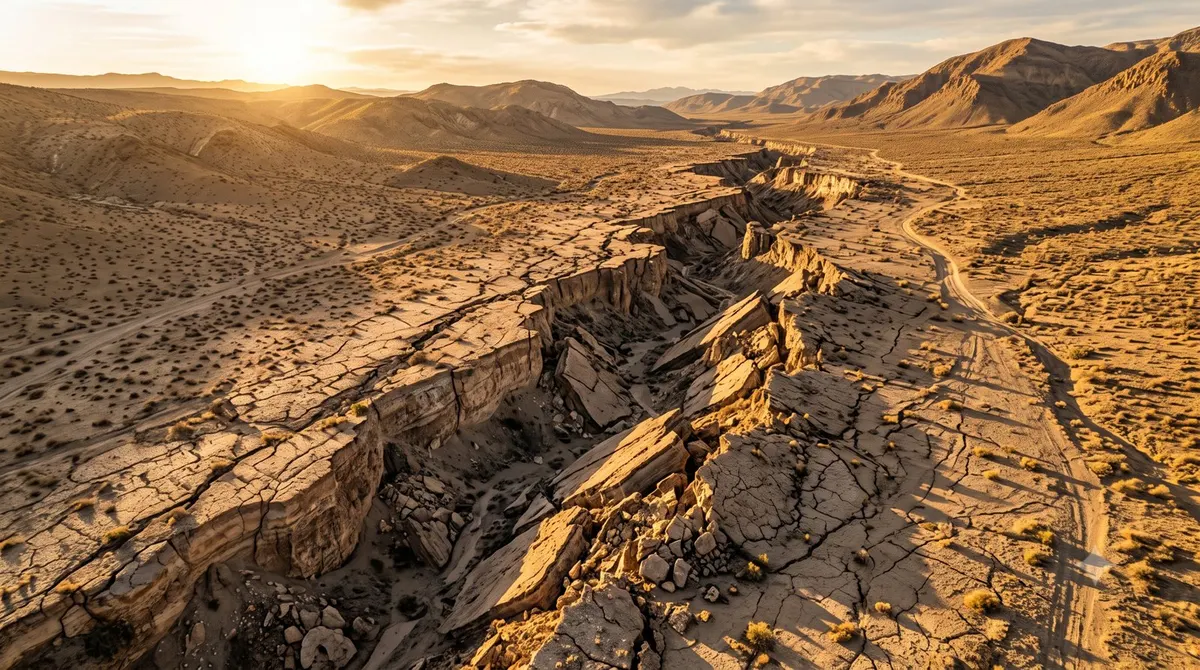
The ground beneath us feels like the very definition of stability. We say something is on solid ground, or built on firm foundations, trusting that the earth will hold still. So there are few experiences more unsettling than an earthquake, when that trust is broken and the floor itself begins to sway. Yet an earthquake is not the world going wrong. It is the natural release of forces that have been building quietly for years, a sudden lurch in the slow, ceaseless movement of the planet’s outer shell.
Rock Under Strain
To understand earthquakes, picture the Earth’s surface as a set of enormous rocky plates that are forever creeping past and against one another. Where two plates meet, they do not slide smoothly. Their rough edges catch and lock together, held fast by friction, while the vast forces driving the plates keep pushing. The rock along the boundary bends and strains, storing energy rather like a stick you slowly bend in your hands.
For a long time nothing dramatic happens. The strain simply accumulates, invisible and silent, sometimes for decades or centuries. But rock can only bend so far. Eventually the stress overcomes the friction holding the two sides together, the locked patch gives way, and the rock snaps into a new position in an instant. That sudden slip is an earthquake, and all the energy patiently stored over years is released in a matter of seconds.
Faults, the Scars of Movement
The cracks along which this slipping happens are called faults. A fault is essentially a fracture in the Earth’s crust where two blocks of rock can move relative to each other. Some faults are small, others stretch for hundreds of kilometres. The famous ones, like the San Andreas Fault in California, mark places where great plates grind past one another and have produced earthquakes many times over.
The exact spot underground where the rock first breaks is called the focus, and the point on the surface directly above it is the epicentre, the place you usually hear named in news reports. From that starting point the rupture races along the fault, sometimes tearing across a great length of rock before it finally stops. The larger the patch of fault that slips, and the farther it moves, the more energy is released and the stronger the earthquake.
Waves That Carry the Shock
When rock slips, the released energy spreads outward as waves, in much the same way that dropping a stone into a pond sends ripples across the water. These seismic waves travel through the body of the Earth and along its surface, and they are what we actually feel as shaking.
There are different kinds of waves, and they travel at different speeds. The fastest arrive first as a sharp jolt, followed by slower waves that often do the most violent shaking. This difference in speed is quietly useful. Because the fast waves outrun the destructive ones, sensitive instruments can detect the first tremor and send out an alert seconds before the strong shaking arrives. Those few seconds can be just enough to stop a train or take cover.
Measuring the Shaking
People often ask how earthquakes are measured, and the answer has two sides. One is magnitude, a number describing how much energy the earthquake released at its source. Modern magnitude scales are built so that each step up represents a large jump in energy, which is why an earthquake one number higher is dramatically more powerful than it might sound.
The other side is intensity, which describes how strongly the shaking was actually felt at a particular place and how much damage it caused. A single earthquake has just one magnitude but many intensities, strong near the epicentre and fading with distance. Intensity also depends heavily on the ground itself. Soft, loose soil can shake far more violently than solid bedrock, which is why two neighbouring towns can suffer very differently from the same quake.
Living With a Restless Earth
We cannot stop earthquakes, and despite great effort, scientists still cannot predict the exact day one will strike. What they can do is map where earthquakes are likely and roughly how strong they might be, based on the known faults and the history of past shaking. That knowledge is quietly powerful, because it guides how we build.
Most deaths in earthquakes come not from the shaking itself but from collapsing buildings. Engineers have learned to design structures that flex and absorb the motion rather than crack and fall. Simple preparation matters too, from securing heavy furniture to knowing where to shelter. In places that take these lessons seriously, earthquakes that would once have been catastrophes are survived with far less loss.
When the Sea Joins In
Some of the most devastating earthquakes strike not on land but beneath the ocean, and there they can unleash a second danger. When the seafloor suddenly lurches upward or drops down during a large undersea quake, it shoves the whole column of water above it. That displacement sends out a series of long, low waves that race across the open ocean, barely noticeable to a ship in deep water. This is a tsunami.
The danger reveals itself only as the waves reach shallow coastal water, where they slow, pile up and rise into towering walls of water that can surge far inland. Because the waves can travel across an entire ocean in hours, a quake on one shore can threaten coastlines thousands of kilometres away. This is why warning systems now watch for large undersea earthquakes, ready to alert distant coasts in time for people to move to higher ground.
The Price of a Living Planet
It can be tempting to wish earthquakes away, but they are inseparable from the very processes that make Earth the dynamic world it is. The same slow movements of the plates that shake the ground also build mountains, open oceans and recycle the planet’s surface over immense spans of time. Earthquakes are the sharp punctuation marks in that long, slow story. By understanding why the ground shakes, we trade fear for knowledge, and knowledge, translated into wise building and calm preparation, is our best defence on this beautifully restless planet.


