Talking Science Podcast
Exoplanets – Finding Worlds Around Other Stars
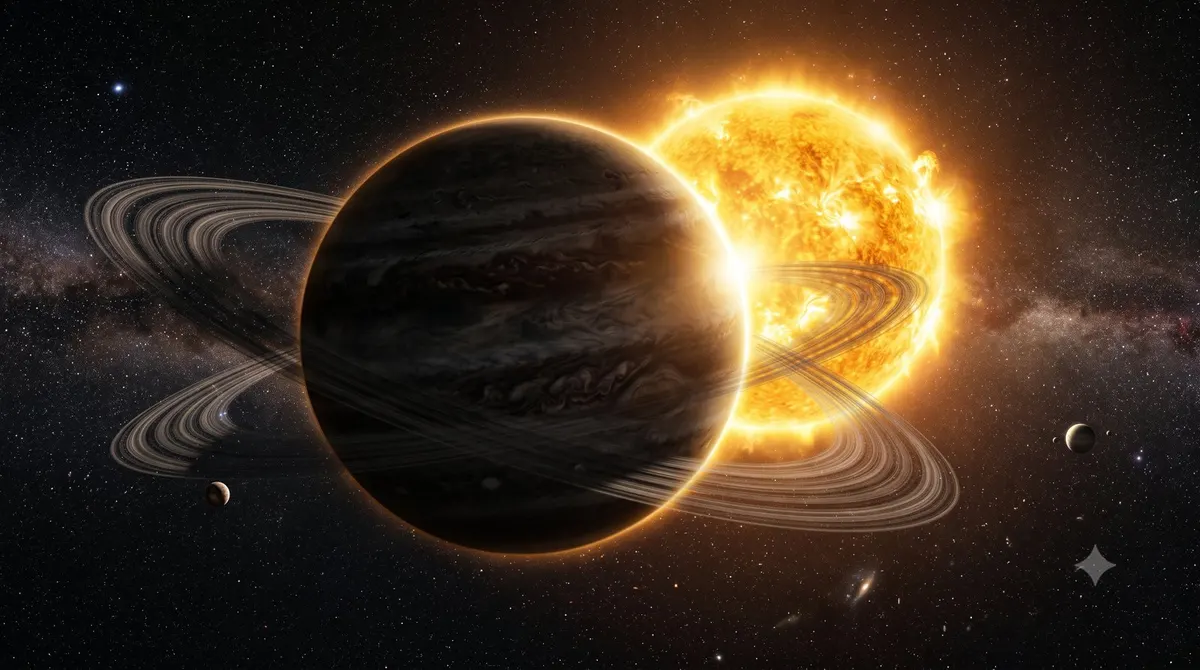
For almost all of human history, we knew of exactly one family of planets: our own. The Sun, its handful of worlds, and the Moon overhead were the whole catalogue. Anything beyond that was guesswork. Then, in the final years of the twentieth century, astronomers confirmed something that had been suspected for centuries but never proven – that other stars have planets too. Today the count runs into the thousands, and the strangeness of these distant worlds keeps rewriting what we thought a planet could be.
Why finding them is so hard
The basic problem is glare. A star is enormous and blindingly bright; a planet beside it is small, dark, and reflects only a sliver of borrowed light. Trying to see a planet next to its star is a bit like trying to spot a firefly hovering next to a lighthouse from many miles away. The star simply drowns everything out. For this reason, almost none of the planets we have found were seen directly. Instead, astronomers had to get clever and look for the effects a planet has on the star it orbits.
That shift in thinking – from trying to see the planet to noticing what the planet does – is what finally cracked the problem open. And it turned out there were several different fingerprints to look for.
The wobble method
The first successful trick relies on gravity being a two-way street. We usually say a planet orbits a star, but really both objects circle their shared centre of mass. The star is far heavier, so it barely moves – but it does move, tracing a tiny wobble in response to the planet tugging on it. As the star wobbles toward us and away from us, its light shifts very slightly in colour, stretching toward red as it recedes and squeezing toward blue as it approaches. This is the same Doppler effect that changes the pitch of a passing siren, only for light instead of sound.
By measuring these minuscule colour shifts over months and years, astronomers can work out that an unseen planet is present, roughly how heavy it is, and how long it takes to complete an orbit. The very first planet confirmed around an ordinary Sun-like star was found this way, and the discovery was a genuine shock: it was a giant world, comparable to Jupiter, whipping around its star in just a few days. Nothing in our own system behaves like that.
The transit method
The second great technique is even simpler in principle. If a planet’s orbit happens to be lined up so that it passes directly between us and its star, it blocks a tiny fraction of the starlight each time it crosses. The star dims by a small, precise amount, then brightens again. Watch long enough and the dip repeats on a regular schedule – the planet’s year, written in flickers of light.
This method, used by dedicated space telescopes staring at the same patch of sky for long stretches, has been responsible for the majority of exoplanet discoveries. It is powerful because the amount of dimming tells you the planet’s size, and the timing tells you its orbit. Combine a transit measurement of size with a wobble measurement of mass, and you can even estimate the planet’s density – a first clue to whether it is a ball of rock, a puffball of gas, or something in between.
Reading a planet’s air
Here is where things get genuinely remarkable. When a planet transits, a little starlight passes through the thin shell of atmosphere around its edge on its way to us. Different gases absorb different colours of light, so that filtered starlight carries a faint chemical signature. By splitting the light into a spectrum and looking for what is missing, astronomers can begin to identify what a planet’s atmosphere is made of – water vapour, carbon dioxide, and other molecules – across distances of many light-years.
This is an astonishing thing to be able to do. We are sampling the air of worlds we will never visit, worlds so far away their light left before some of us were born. The measurements are delicate and hard-won, but they are turning the study of exoplanets from a game of counting into a study of what these places are actually like.
A galaxy full of variety
What has emerged from all this is that our own Solar System is not the template we assumed it to be. Planets around other stars come in a bewildering range:
- Hot Jupiters – giant gas planets orbiting scorchingly close to their stars.
- Super-Earths and mini-Neptunes – worlds bigger than Earth but smaller than Neptune, a class we have none of at home.
- Planets orbiting two stars at once, with double sunsets.
Perhaps the most tantalising category is the potentially habitable one: rocky planets orbiting at just the right distance from their star for liquid water to be possible on the surface, in what astronomers call the habitable zone. Being in that zone does not guarantee life, or even water – it simply means the temperature might allow it. But finding such worlds tells us that the basic ingredients are common, not rare.
Where this is heading
The reasonable estimate now is that planets are the rule rather than the exception – most stars in our galaxy likely host at least one. That means the number of planets in the Milky Way alone runs into the hundreds of billions. A generation ago the question was whether other planetary systems existed at all. Now the questions are far richer: which of these worlds have atmospheres, which have the chemistry that could support life, and whether any of them ever have.
There is a quieter lesson in all of this too, one about how science actually moves forward. The people who first proposed hunting for planets by watching stars wobble were, for a long time, chasing a signal at the very edge of what their instruments could measure. Many searches turned up nothing. It took steadily better technology, and a willingness to keep looking, before the first clear detections arrived – and once they did, the floodgates opened. The story of exoplanets is a reminder that some of the most profound discoveries are not sudden flashes of insight but the reward for patient, careful measurement of things almost too faint to see.
We do not yet have the deepest answers we would like, but for the first time we have the tools to go looking – and the sky is very, very full.