Talking Science Podcast
Extinction – The Five Great Dyings
Extinction is the normal fate of species. Over the vast sweep of Earth’s history, the overwhelming majority of creatures that ever lived have vanished, giving way to new forms. Usually this happens gradually, one species at a time, in the ordinary churn of life. But five times, something far more violent has occurred. In geologically brief moments, catastrophe swept across the planet and erased huge fractions of all living things at once. Scientists call these the mass extinctions—and they have shaped the living world as profoundly as anything else in history.
Reading death in the rocks
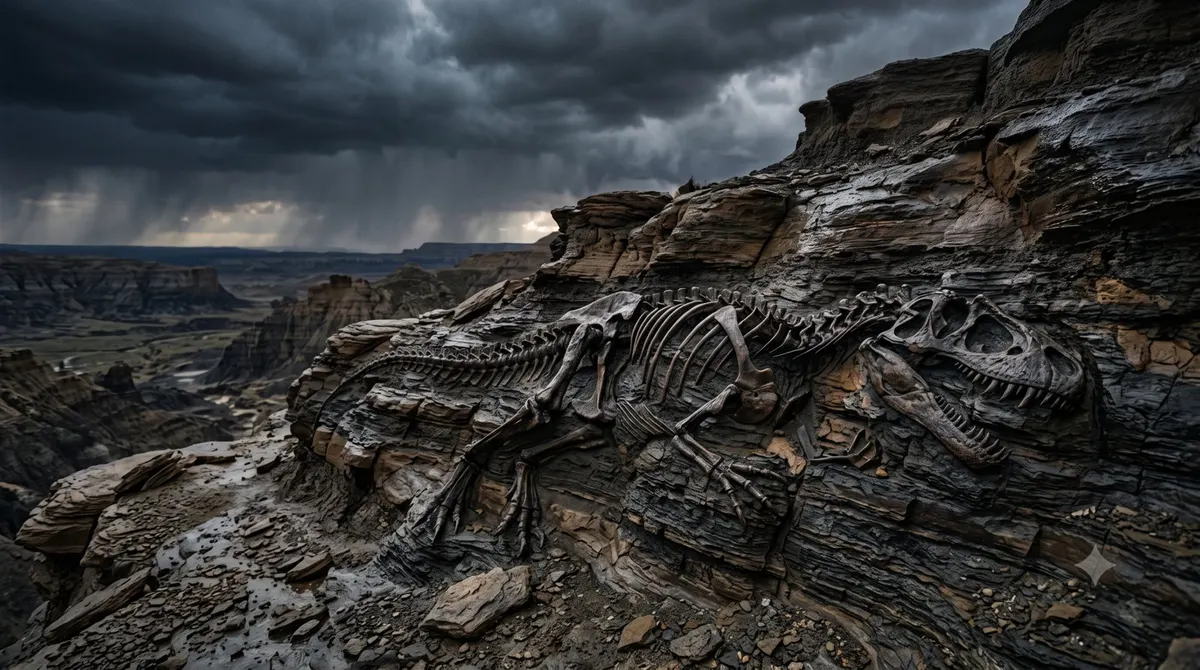
How can we possibly know about disasters that happened hundreds of millions of years ago? The answer is written in stone. As we dig down through layers of rock, we are reading backward through time, and the fossils entombed in those layers record which creatures were alive when each layer formed. At certain moments in the record, something dramatic happens: whole groups of fossils that were abundant in one layer simply disappear from the next.
These sudden gaps mark the mass extinctions. By studying the rocks around them—their chemistry, their structure, the traces of ancient climates locked within—scientists can piece together not only when these catastrophes struck but often what caused them. It is a kind of detective work spanning deep time, and it has revealed five great crises in the history of complex life.
The early catastrophes
The first great dying struck a very long time ago, when life was still confined mostly to the seas. A dramatic shift in climate, with ice spreading and sea levels falling, wiped out a large share of ocean species that had no way to cope with the changed conditions. Life recovered, diversified, and flourished—only to be struck again in the second mass extinction, another blow that fell hardest on marine life, its exact causes still debated.
What these early catastrophes share is a lesson that runs through the whole story of extinction: life is resilient over the long run but vulnerable in the moment. Ecosystems that took millions of years to assemble can unravel with startling speed when conditions change faster than species can adapt. And each time, the survivors inherited a transformed world.
These crises also reveal a strange creativity hidden inside catastrophe. Each mass extinction did not merely destroy; it reset the board. By clearing away dominant groups, it opened room for others to rise and diversify into the empty spaces left behind. The living world we know today, ourselves included, is in large part the product of who happened to survive these disasters and what they became afterward. Extinction, for all its horror, has been one of the great sculptors of life.
The greatest dying of all
The third mass extinction stands apart as the most devastating of them all—so severe that scientists sometimes call it simply the Great Dying. It came close to ending complex life on Earth entirely. By most estimates, the overwhelming majority of species in the ocean disappeared, along with a huge share of life on land. Life had never come so close to being extinguished, and it would take an exceptionally long time to recover.
The leading explanation points to an episode of colossal volcanic activity, when vast outpourings of lava and gas poured into the atmosphere over an extended period. The consequences cascaded: a warming climate, oceans starved of oxygen and turned hostile to life, and a chemistry thrown violently out of balance. It is a sobering reminder that the Earth’s own internal forces can be as deadly as anything from space.
What makes the Great Dying especially instructive is how the damage spread. No single blow killed everything at once; instead, one disruption triggered another in a chain reaction that rippled through the whole planet. Warming released more warming, dying seas poisoned the waters further, and ecosystems collapsed as the species that held them together vanished. It is a pattern worth remembering, because it shows how a living world can come undone not through one catastrophe alone but through many, feeding on one another.
The famous one
The fourth mass extinction cleared the way for the dinosaurs to rise to dominance. But it is the fifth that everyone knows, because it ended their long reign. Around sixty-six million years ago, the great dinosaurs—rulers of the land for well over a hundred million years—vanished, along with many other groups on land and in the sea.
The prime suspect is dramatic: a massive asteroid slammed into the Earth, and evidence of the impact site and its telltale chemical signature can still be found today. The collision would have thrown enormous quantities of debris into the sky, darkening the sun, chilling the climate, and disrupting the food chains that life depended on. Massive volcanic activity around the same time may have added to the strain. Out of that ruin, though, came opportunity: with the dinosaurs gone, small furry creatures called mammals—our own ancestors—rose to fill the empty world.
Are we the sixth?
This brings us to the most unsettling question of all. Many scientists warn that we may be living through the beginning of a sixth mass extinction—and that this time, the cause is us. Species are currently disappearing at a rate far above the natural background level, driven not by asteroids or volcanoes but by human activity. The main pressures are familiar:
- Destruction of habitats as forests, wetlands, and reefs are cleared or degraded.
- A warming climate that shifts conditions faster than many species can adapt.
- Overexploitation, pollution, and the spread of invasive species.
Unlike the catastrophes of the past, this one is unfolding with a witness that understands what is happening and could choose to act.
That is the crucial difference. The five great dyings were blind forces of nature, indifferent to their victims. The crisis we now face is one we can see, measure, and—at least in part—prevent. The fossil record makes clear that life always eventually recovers, given enough time, but recovery unfolds over millions of years, far beyond any human horizon. The species alive today, including our own, do not get to wait that long. Understanding the great extinctions of the past is not just a matter of curiosity; it is a warning, and perhaps an invitation to write a different kind of ending.