 Talking Science Podcast
Pressure – From the Deep Sea to Diamond Anvils
A sealed packet of chips on a plane at cruising altitude puffs up like a pillow. Your ears pop on the way back down. At home, a pressure cooker turns a tough cut of beef tender in a fraction of the usual time. All three are the same idea at work: pressure.
Follow that idea far enough and it leads to the deepest ocean trench, and to laboratories where specks of matter are squeezed between diamonds to recreate conditions deep inside planets.
Force Spread Over an Area
Pressure is simply how much force pushes on a given area. The same force concentrated on a small area produces a high pressure; spread over a large area, it produces a low one. That's why a sharp knife cuts while a blunt one squashes, why a stiletto heel can dent a timber floor that an elephant's broad foot might not, and why snowshoes stop you sinking.
Scientists measure pressure in pascals, one newton of force per square metre, which is a very small pressure. Bureau of Meteorology weather maps use hectopascals, and average sea-level air pressure is about 1013 hectopascals, or roughly 101,000 pascals.
The Ocean of Air Above Us
We live at the bottom of an ocean of air many kilometres deep. At sea level, air pressure is equivalent to about ten tonnes resting on every square metre, or roughly a kilogram on every square centimetre. In the 1640s, Evangelista Torricelli showed this weight could hold up a column of mercury about 76 centimetres tall in a glass tube, inventing the barometer. In the following decade, Otto von Guericke showed that teams of horses couldn't pull apart two metal hemispheres once the air between them was pumped out.
So why aren't we crushed? Pressure in a fluid pushes equally in all directions, and our fluid-filled bodies, mostly water that hardly compresses, push outward just as hard as the air pushes in. Trouble arises only where a pocket of gas can't equalise, such as the middle ear. As a plane descends and the cabin pressure rises, the eardrum is pushed inward until a small passage called the Eustachian tube opens and lets air through with a pop. Cabins are typically pressurised only to the equivalent of a couple of thousand metres altitude, so air sealed in a chip packet at ground level expands. Our piece on the atmosphere explains how air thins with height.
Pressure and the Boiling Point
Water boils when its molecules have enough energy to form bubbles of vapour that can push back against the surrounding pressure. At sea level, that happens at 100°C. Lower the pressure and bubbles form more easily, so water boils at a lower temperature. On the summit of Mount Kosciuszko, water boils at around 93°C, and near the top of Mount Everest at roughly 70°C, which makes cooking frustratingly slow.
A pressure cooker does the reverse. By trapping steam, it raises the pressure inside to around twice atmospheric pressure, and water's boiling point climbs to about 120°C. Food cooks faster because the water really is hotter. Hospital autoclaves use the same trick to sterilise equipment with pressurised steam.
Into the Deep
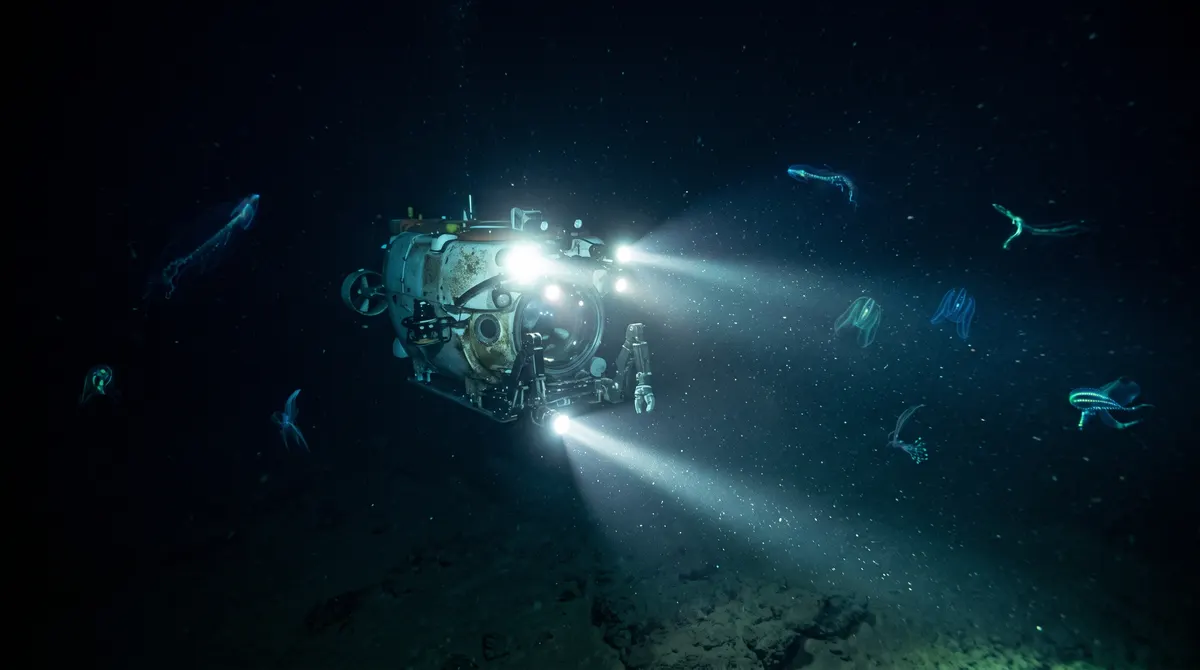
Water is far denser than air, so pressure rises much faster with depth. Every ten metres of seawater adds roughly one more atmosphere. A diver at 10 metres feels twice the surface pressure, and at the bottom of the Challenger Deep in the Mariana Trench, nearly 11 kilometres down, the pressure is more than a thousand times that at the surface.
For human divers, the main danger isn't the water pressing on the body but the gas inside it. A volume of gas shrinks as the pressure on it rises, a relationship known as Boyle's law, so the air in a breath-hold diver's lungs is squeezed to half its volume at ten metres. Scuba divers breathe air delivered at the surrounding pressure, which keeps their lungs inflated but creates a different problem.
Why Divers Ascend Slowly
Gases dissolve more readily in liquids under higher pressure. That's why a bottle of soft drink fizzes when you open it: the pressure drops and dissolved carbon dioxide comes out as bubbles. The same thing happens to nitrogen in a diver's body. The deeper and longer the dive, the more nitrogen dissolves into the tissues.
If a diver comes up slowly, that extra nitrogen has time to travel back to the lungs and be breathed out. Come up too quickly and it can form bubbles in the blood and tissues, causing decompression sickness, often called the bends. Effects range from joint pain and skin rashes to serious harm to the nervous system. It was first widely recognised in nineteenth-century workers building bridge foundations in pressurised chambers called caissons. Today divers follow dive computers or tables with planned stops on the way up, and serious cases are treated in a recompression chamber, where raised pressure and pure oxygen help shrink the bubbles.
How Deep-Sea Life Copes
Many animals thrive at depths that would be fatal to an unprotected human, without any armour. Most have no air spaces to crush, and their watery bodies match the pressure outside. The deep ocean is home to fish, crustaceans and other creatures living at extraordinary depths, and snailfish have been filmed more than eight kilometres down.
Pressure still matters at the molecular level, because it can distort proteins and stiffen cell membranes. Deep-sea animals counter this with membranes built from more flexible fats and by accumulating small protective molecules, such as trimethylamine N-oxide, that help keep proteins in working shape. The amount of this molecule in fish rises with depth, and some researchers think the limits of this strategy may help explain why no fish has been found much deeper than about eight kilometres. It is also why the infamous blobfish only looks like a sagging lump after being hauled to the surface.
Squeezing Matter with Diamonds
To study the pressures inside planets, scientists use a remarkably simple device, the diamond anvil cell. Two gem-quality diamonds, their tips cut to tiny flat faces smaller than a pinhead, are pressed towards each other with a minute sample held between them in a thin metal gasket. Because the force is concentrated on such a small area, the pressure can match and even exceed the roughly 3.6 million atmospheres estimated at the centre of the Earth.
Diamonds are used because they are extremely hard and also transparent, so researchers can shine lasers through them to heat the sample to thousands of degrees, and probe it with X-rays to see how its atoms rearrange. Pressure is often gauged using a tiny chip of ruby beside the sample, whose glow under laser light shifts in colour as it is squeezed. These experiments have revealed new forms of iron relevant to Earth's core, a mineral structure thought to exist at the base of the mantle, and hydrogen-rich compounds becoming superconductors at unusually high temperatures, though some claims in that field have proved controversial.
An Invisible Everyday Force
Pressure is a simple idea, force spread over an area, but it shapes everything from the weather and the boiling point of soup to the safety of a scuba dive and the inner structure of planets. We spend our lives under a weight of air we never feel, and the same physics that makes a chip packet bulge lets scientists recreate a planet's heart in a speck smaller than a grain of sand.


