Talking Science Podcast
Galaxies – How the Milky Way Was Built
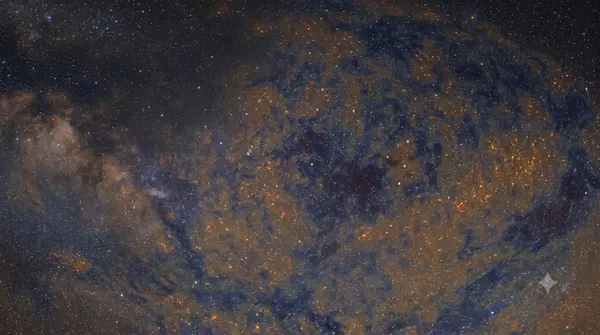
On a truly dark night, far from city lights, you can see a faint band of misty light arching across the sky. Ancient peoples told many stories about it, but we now know what it is: the combined glow of countless stars, so distant and so numerous that they blur together into a soft river of light. That band is our own galaxy, the Milky Way, seen from the inside. We live within a vast city of stars, and understanding how that city was built is one of the great achievements of modern astronomy.
What a galaxy is
A galaxy is an enormous collection of stars, gas, dust, and other material, all bound together by gravity and orbiting a common centre. The numbers involved are almost impossible to picture. Our galaxy contains something on the order of hundreds of billions of stars, and the Sun is just one ordinary star among them, tucked away in the suburbs rather than the bright centre. And the Milky Way is just one galaxy among a vast multitude – the observable universe holds a staggering number of them, each with its own population of stars.
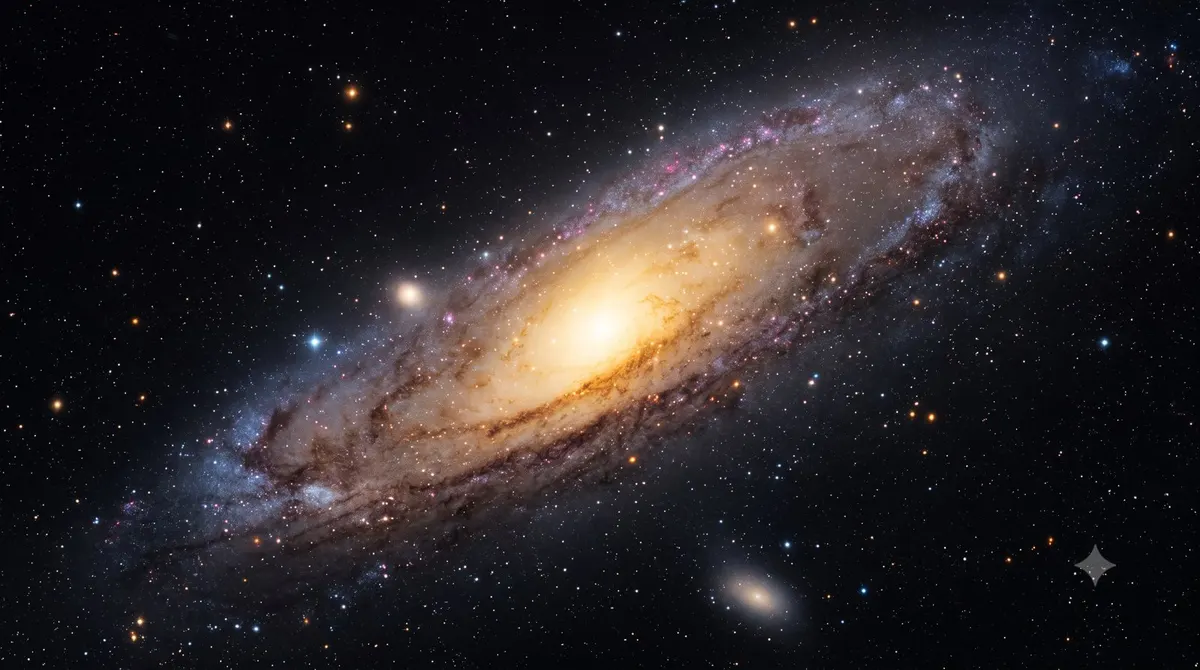
Galaxies come in different shapes. Some, like ours, are graceful spirals, with bright arms winding outward from a central bulge, the whole thing turning slowly like a colossal pinwheel. Others are smooth, featureless balls of stars, and some have no clear shape at all. Our own Milky Way is a barred spiral, meaning it has a straight bar of stars across its middle from which the spiral arms extend.
Not built in a day
It is tempting to imagine that a galaxy simply formed all at once, spinning into shape early on and staying that way. The reality is more interesting and more gradual. Galaxies were assembled over enormous spans of time – billions of years – and the Milky Way we see today is the end result of a long, ongoing process of construction that is still not finished.
In the early universe, matter was spread out fairly smoothly, but not perfectly. Regions that were slightly denser than average had slightly stronger gravity, so they pulled in more material, which made them denser still. Over time, gravity gathered gas into ever-larger clumps, and within those clumps the first stars ignited. Small collections of stars formed first, and then these came together to build larger structures. Galaxies, in this picture, grew from the bottom up, assembling out of smaller pieces.
Growth by collision
One of the most striking discoveries about galaxies is that they grow partly by merging with and devouring one another. This sounds violent, and in a sense it is, though it unfolds over such vast timescales that no explosion or crash is ever visible in a human lifetime. When a large galaxy and a smaller one drift close together, gravity draws them into a slow, sweeping dance. The smaller galaxy is stretched, torn apart, and eventually absorbed, its stars scattered and mixed into the larger one.
The Milky Way has done this many times over its history. It grew, in part, by swallowing smaller galaxies that strayed too near, adding their stars to its own. Astronomers can still find the evidence of these ancient meals: streams of stars moving together through the galaxy in ways that betray their origin in some smaller galaxy long since consumed. In a real sense, our galaxy is built from the remains of others.
The invisible scaffolding
There is a deeper layer to this story, and it involves something we cannot see. When astronomers measure how fast stars orbit within galaxies, they find them moving too quickly. The visible stars and gas simply do not have enough gravity to hold everything together at those speeds; a galaxy spinning that fast ought to fly apart. Yet galaxies hold together. Something unseen must be providing the extra gravity.
That something has been named dark matter. We do not know exactly what it is, and no one has ever seen it directly, but its gravitational effects are everywhere in the way galaxies move. The current understanding is that every galaxy sits within a vast, invisible halo of this material, far larger and heavier than the visible galaxy inside it. Dark matter is thought to have been the scaffolding on which galaxies were built – its gravity gathered the ordinary matter that went on to form stars. It is a humbling idea: the bright part of a galaxy that we can actually see may be only a small fraction of what is truly there.
The heart of the galaxy
At the very centre of the Milky Way lies another remarkable object: a supermassive black hole, millions of times heavier than the Sun, compressed into a region from which not even light can escape. Most large galaxies appear to harbour one of these at their core. Its gravity dominates the innermost part of the galaxy, and astronomers have tracked stars whipping around this invisible centre at tremendous speeds, betraying the presence of something enormously massive and unseeable.
Our own place in all this is worth picturing. The Sun and its planets sit well out toward the edge of the galaxy, roughly halfway between the crowded centre and the sparse outskirts, riding along one of the spiral arms. From here we take a very long time to complete a single lap of the galactic centre – a journey measured not in years but in hundreds of millions of years. Every star you can see with the naked eye is a near neighbour by galactic standards, part of our little local corner of a structure so vast that its far side is hidden from us behind clouds of stars and dust. When we map the Milky Way, we are in the curious position of trying to draw a picture of a city while standing in one of its suburbs, unable to step outside for a proper look.
A galaxy with a future
The story is not over. Our galaxy continues to form new stars from its reserves of gas, and it is still on the move. In the distant future, far beyond any human timescale, the Milky Way is expected to draw close to and eventually merge with our large neighbouring galaxy, the Andromeda galaxy. When that happens, the two great spirals will dance together and gradually combine into a single, larger galaxy. It will be one more chapter in the long process by which galaxies are built – the same process that assembled our own home in the cosmos, star by star and merger by merger, over billions of years.