Talking Science Podcast
Gravitational Waves – Ripples in Spacetime
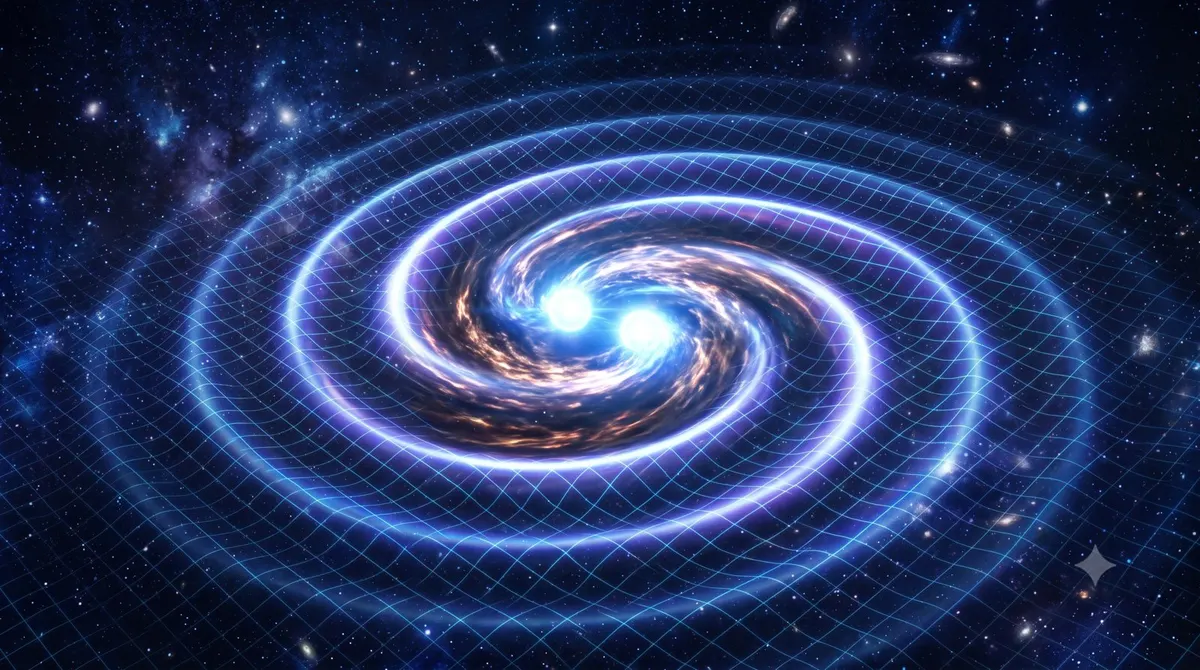
Imagine the fabric of space and time as a vast, invisible sheet stretched across the universe. Now imagine two enormous objects, like a pair of black holes, spiraling around each other and finally crashing together. That collision sends ripples racing outward through the sheet, gentle waves in the very structure of reality itself. These are gravitational waves, and a century after they were first predicted, humanity finally built machines sensitive enough to feel them. It opened an entirely new way of experiencing the cosmos.
Einstein’s Bold Prediction
The story begins with a revolutionary idea about gravity. For a long time, people thought of gravity as a simple force pulling objects together. Then Einstein offered a deeper picture. He proposed that space and time are woven together into a single flexible fabric, often called spacetime, and that massive objects bend and curve this fabric around themselves. What we feel as gravity is really the effect of moving through curved spacetime.
From this insight came a striking prediction. If massive objects can bend spacetime, then objects that move and accelerate should create ripples in it, disturbances that travel outward at the speed of light. Einstein worked out that these gravitational waves should exist, but he doubted we would ever detect them. The effect seemed impossibly tiny, far too small to measure with any instrument imaginable at the time.
Why They Are So Hard to Catch
Einstein’s pessimism was understandable. Gravitational waves are astonishingly faint by the time they reach us. As a wave passes through, it stretches space in one direction and squeezes it in another, but only by a fantastically small amount. The change is far smaller than the width of an atom, even smaller than the tiny particles inside an atom. Detecting such a whisper of a signal seemed hopeless for generations.
Part of the difficulty is that gravity is by far the weakest of nature’s fundamental forces. It may not feel weak when you drop a plate, but consider that a small magnet can lift a paperclip against the pull of the entire Earth. Because gravity is so weak, its waves are extraordinarily gentle, and only the most violent cosmic events produce waves strong enough for us to have any hope of noticing.
Listening With Lasers
To catch these faint ripples, scientists built some of the most sensitive instruments ever created. The basic idea is elegant. Split a beam of laser light and send the two halves down long tunnels arranged at right angles, bouncing them off mirrors at the far ends and back again. Normally the two beams recombine in a predictable way. But if a gravitational wave passes through, it slightly stretches one tunnel and squeezes the other, changing the distance the light travels by an almost inconceivably small amount.
By comparing the returning beams with extreme precision, the instrument can detect this minuscule change. The engineering challenge was immense. The detectors had to be shielded from every possible disturbance, from passing trucks to distant earthquakes to the tiny random jiggling of their own atoms. It took decades of patient effort and ingenuity to reach the required sensitivity.
To be confident a signal is real and not local noise, scientists built more than one detector, separated by great distances. A genuine gravitational wave sweeping through the Earth reaches each detector at slightly different moments, and comparing those arrival times even helps reveal roughly which direction the wave came from. When two far-apart instruments record the same faint pattern within a fraction of a second, coincidence becomes an extraordinarily unlikely explanation, and the case for a true cosmic signal becomes compelling.
The First Detection
The breakthrough finally arrived when a gravitational wave observatory registered a signal unlike anything before. Two black holes, each many times the mass of our Sun, had spiraled together and merged in a distant galaxy far across the universe. The collision released a staggering amount of energy in the form of gravitational waves, and after traveling for over a billion years, those ripples washed over the Earth and gently stretched the detectors.
The signal matched the predictions of Einstein’s theory beautifully. Scientists could even work out the story it told: two black holes, their masses, and the moment they became one. It was the first time anyone had directly detected gravitational waves, and it confirmed a prediction made a full century earlier. The achievement was celebrated around the world and recognized with a Nobel Prize.
A New Way to Observe the Universe
Why does this matter so much? For all of history, we studied the cosmos almost entirely through light, from visible starlight to radio waves, X-rays, and beyond. Gravitational waves are something completely different. They are not light at all, but ripples in spacetime, and they carry information that light cannot provide. It is a bit like gaining a new sense, as if we had spent our whole lives seeing the universe and suddenly learned to hear it too.
This new sense reveals events that are otherwise invisible. Colliding black holes give off no light, so without gravitational waves we would never know about many of them at all. The waves open a window onto some of the most extreme and dramatic events in nature:
- Black holes merging in the darkness of distant space
- Neutron stars colliding and forging heavy elements
- Echoes that may reach back toward the earliest universe
The Dawn of a New Astronomy
Since that first detection, scientists have observed many more gravitational wave events, and the field has blossomed into a thriving new branch of astronomy. Detectors around the world now work together, and researchers are designing even more sensitive instruments, including ambitious plans for detectors in space that could sense waves far too subtle for ground-based observatories.
Each detection teaches us more about black holes, neutron stars, and the workings of gravity itself. Sometimes a gravitational wave signal is accompanied by a burst of light, letting astronomers study a single cosmic event through two completely different channels at once, a powerful combination that reveals far more than either alone. We are only at the very beginning of this adventure. A century after Einstein imagined ripples in spacetime and doubted we would ever feel them, we have learned to listen to the universe in an entirely new way, and it is singing back to us with stories we are only starting to understand.