 Talking Science Podcast
How 3D Printing Quietly Became a Lab Essential
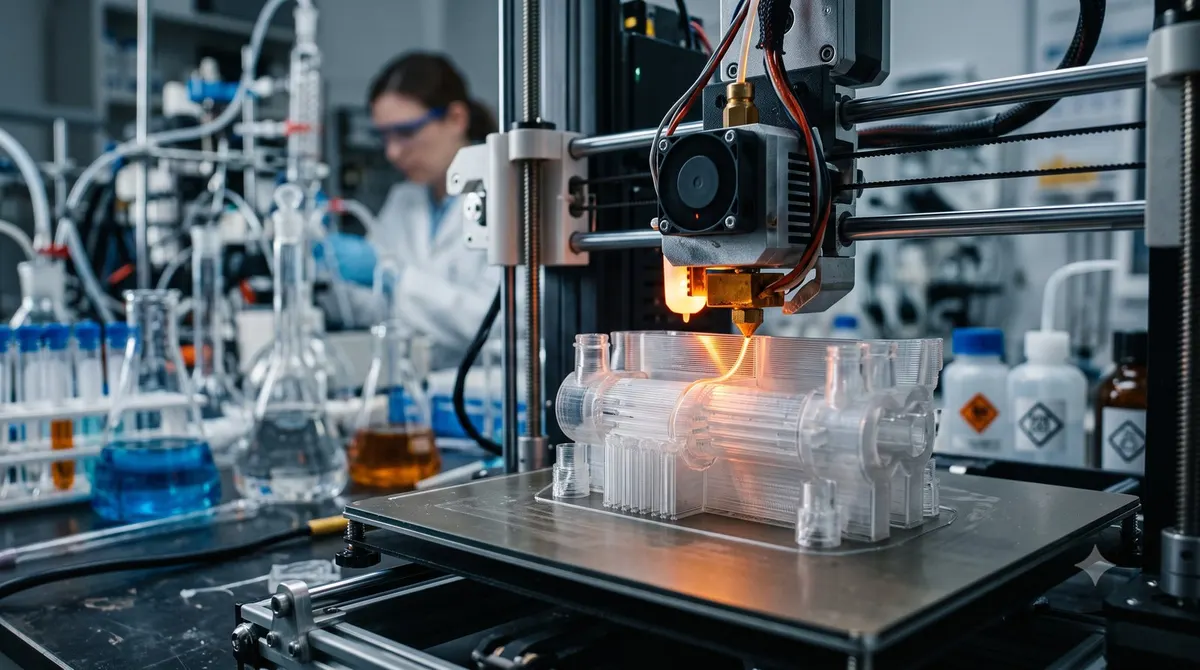
When 3D printing first caught the public imagination, it was sold as a machine that would sit in every home, churning out toys and spare parts on demand. That future never quite arrived on the kitchen bench. Somewhere far less glamorous, though, the technology has become genuinely indispensable: the research laboratory. Across biology, chemistry, medicine and physics, printing objects layer by layer has quietly changed how experiments get done.
The end of “we cannot buy that part”
Science runs on custom equipment. An experiment often needs a bracket, a holder, a fluid channel or an adaptor that no catalogue sells, because no one has ever needed exactly that shape before. Traditionally a researcher would either compromise the experiment around what was available or wait weeks for a machine shop to fabricate a one-off part at considerable cost. A 3D printer collapses that loop to an afternoon. A scientist can design a piece of apparatus in the morning, print it over lunch, test it, adjust the design and print again — iterating at the speed of thought rather than the speed of procurement.
Printing the body’s spare parts
Medicine has embraced the technology with particular enthusiasm. Surgeons now routinely print exact replicas of a patient’s anatomy from their scans, so a complex operation can be rehearsed on a physical model before the first incision. Custom prosthetics and dental work, once slow and expensive to make by hand, can be produced to fit an individual precisely. Most striking of all is bioprinting, where living cells are deposited layer by layer in the hope of building functional tissue — skin, cartilage, and one day perhaps whole organs — grown to match the person who needs them.
From one-off to on-demand production
What began as rapid prototyping has increasingly become a way to make finished, usable objects, not just mock-ups. Lightweight components for satellites, patient-specific surgical guides and small production runs of specialised parts are now printed to final quality. This is why 3D printing has grown from a novelty into a genuine 3D printing service that businesses and laboratories use to turn a digital design into a real object without tooling up a factory. The economics are unusual: printing one item costs almost the same per unit as printing a thousand, which makes it perfect for the bespoke, low-volume work that defines research.
Why layers change everything
The deeper reason 3D printing suits science is geometric freedom. Traditional manufacturing removes material — drilling, cutting, milling — and so struggles with hollow chambers, internal channels or intricate lattices. Building up in layers imposes no such limits, so a researcher can create shapes that are simply impossible to machine, such as a single block threaded with a network of tiny cooling channels, or a scaffold with the delicate internal structure that cells need to grow on.
The unshowy workhorse
The home 3D-printing revolution may have been oversold, but the laboratory version quietly delivered. It did not replace the machine shop or the factory; it gave scientists a way to make the strange, specific, one-of-a-kind objects that discovery so often demands — and to make them today rather than next month.


