Talking Science Podcast
Allergies and Autoimmunity – When Defence Misfires
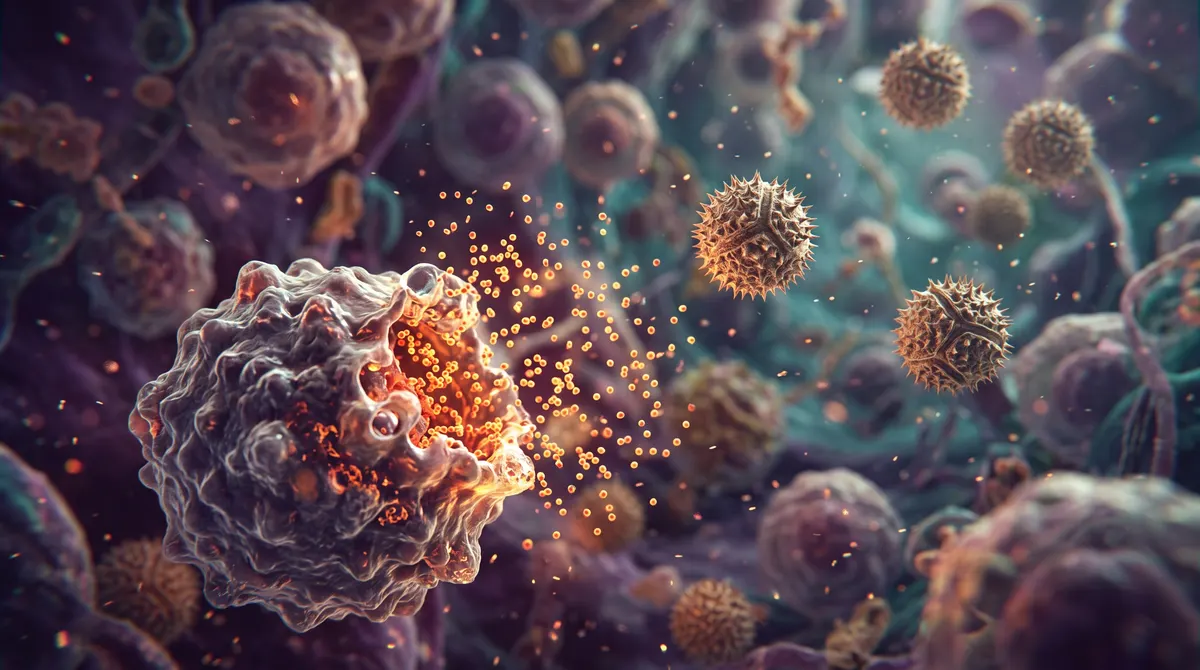
Two people are stung by the same bee on the same afternoon. One rubs the spot, swears a little and forgets about it by dinner. The other's throat begins to tighten within minutes. Elsewhere, a child's pancreas quietly stops making insulin, and an adult finds that a slice of ordinary bread leaves their gut inflamed and damaged.
These look like very different problems, but they share a common thread. In each case, the immune system, a finely tuned defence force, has misjudged its target. Allergies and autoimmune diseases are what happens when protection turns into harm. What follows is a general science explainer, not medical advice, and anyone with symptoms should see a doctor.
How the Immune System Tells Friend From Foe
Your immune system has an extraordinarily difficult job. It must recognise and attack an almost endless variety of viruses, bacteria and parasites, while leaving your own tissues, your food and harmless pollen alone. Our guide to the immune system introduces the main players.
Much of the precision comes from white blood cells called lymphocytes, particularly T cells and B cells. Each one carries receptors shaped to recognise a particular molecular target. Because those receptors are generated by shuffling genes semi-randomly, some inevitably end up recognising the body's own proteins.
To prevent disaster, the body runs a kind of training school. Young T cells mature in the thymus, a small organ behind the breastbone, where they are shown samples of the body's own proteins. Most of those that react too strongly are destroyed. This process, called central tolerance, is backed up by a second layer known as peripheral tolerance, in which specialised regulatory T cells patrol the body and calm down immune responses that should not be happening. When enough of these overlapping checks fail, trouble follows.
What Happens in an Allergic Reaction
An allergy is an immune overreaction to something that is not actually dangerous, such as pollen, dust mites, peanuts or bee venom. It usually happens in two stages.
The first is sensitisation. On first meeting the substance, the immune system wrongly flags it as a threat and produces a type of antibody called immunoglobulin E, or IgE. These antibodies attach themselves to mast cells, which sit in the skin, the airways and the lining of the gut, packed with chemical signals. Nothing obvious happens yet.
The second stage comes on the next exposure. The allergen binds to the IgE on the mast cells, which then burst open and release histamine and other chemicals. Blood vessels widen and leak, smooth muscle in the airways tightens, and nerves start to itch. Depending on where it happens, the result can be sneezing, hives, swelling or wheezing.
Because mast cells are spread throughout the body, the reaction can sometimes become widespread within minutes. This is anaphylaxis: airways can narrow, blood pressure can fall sharply and several body systems can be affected at once. It is a medical emergency, and it is treated with adrenaline, which rapidly reverses many of these effects.
Why Allergies Are on the Rise
Allergic conditions have become markedly more common over recent decades, especially in wealthy countries, and Australia is among the most affected. A large Melbourne study found that roughly one in ten one-year-olds had a food allergy confirmed by testing. Australia also has high rates of hay fever and asthma.
Genes cannot change this fast, so researchers look to the environment. Leading but debated ideas include:
- The hygiene hypothesis and its modern update, the "old friends" idea: immune systems that meet fewer microbes early in life, especially the diverse microbes of soil, animals and other people, may not learn to stay calm. Our article on the microbiome explores this further.
- The timing and route of exposure. Research suggests that meeting food proteins through broken or inflamed skin may promote allergy, while eating them early may encourage tolerance. A major trial published in 2015 found that introducing peanut to high-risk infants greatly reduced their chance of developing peanut allergy, and Australian infant feeding advice now recommends introducing common allergenic foods in the first year.
- Other factors, such as diet, time spent indoors and sun exposure, are being investigated, but none explains the trend on its own.
When the Body Attacks Itself
Autoimmune disease is a different kind of mistake. Rather than overreacting to something harmless from outside, the immune system targets the body's own tissues. Three examples show the range.
In type 1 diabetes, T cells attack and destroy the beta cells in the pancreas that produce insulin. Once enough are lost, the body can no longer control its blood sugar, and people need insulin for life.
In coeliac disease, the trigger comes from outside but the damage is to the body itself. In genetically susceptible people, proteins in gluten, found in wheat, barley and rye, provoke an immune response that damages the lining of the small intestine, flattening the tiny finger-like projections that absorb nutrients.
In multiple sclerosis, the immune system attacks myelin, the fatty insulation that wraps nerve fibres in the brain and spinal cord. Damaged insulation slows or blocks nerve signals, producing very varied symptoms.
In most autoimmune diseases, genes load the dice but do not decide the outcome. Environmental triggers, possibly including some infections, appear to tip the balance.
Why Women Are Affected More
One of the most striking patterns in autoimmunity is that it affects women far more often than men. Across autoimmune conditions as a whole, women make up a large majority of patients, though the imbalance varies between diseases.
The reasons are still being untangled. Women generally mount stronger immune responses than men, which helps them fight some infections but may also raise the risk of attacking themselves. Sex hormones such as oestrogen influence immune cells. The X chromosome carries many immune-related genes, and since women have two X chromosomes, some of those genes may be more active.
Retraining Rather Than Suppressing
For many years, the main tools for these conditions were to avoid the trigger, relieve the symptoms or broadly suppress the immune system, which can leave people more vulnerable to infection. Newer approaches aim to retrain the immune system instead.
Allergen immunotherapy, sometimes called desensitisation, has been used for decades for conditions such as hay fever and insect venom allergy. Patients receive gradually increasing doses of the allergen, by injection or as drops or tablets under the tongue, over months or years. The immune system slowly shifts towards tolerance, with more regulatory T cells and different antibodies that help block the allergic reaction. Similar oral approaches are being used for some food allergies under close medical supervision.
Autoimmune research is chasing the same goal: switching off only the faulty response while leaving the rest of the immune system intact. In 2022, a drug that can delay the onset of type 1 diabetes in some people at high risk was approved in the United States, a sign that targeted approaches are beginning to reach patients.
A Defence System Learning Balance
Allergies and autoimmune diseases are not signs of a weak immune system but of a powerful one aiming at the wrong target. Healthy immunity depends on a constant balance between attack and restraint, shaped by genes, early life and environment. The hope is to treat these conditions not by silencing the body's defences but by teaching them to tell friend from foe again.