Talking Science Podcast
How Rockets Actually Work
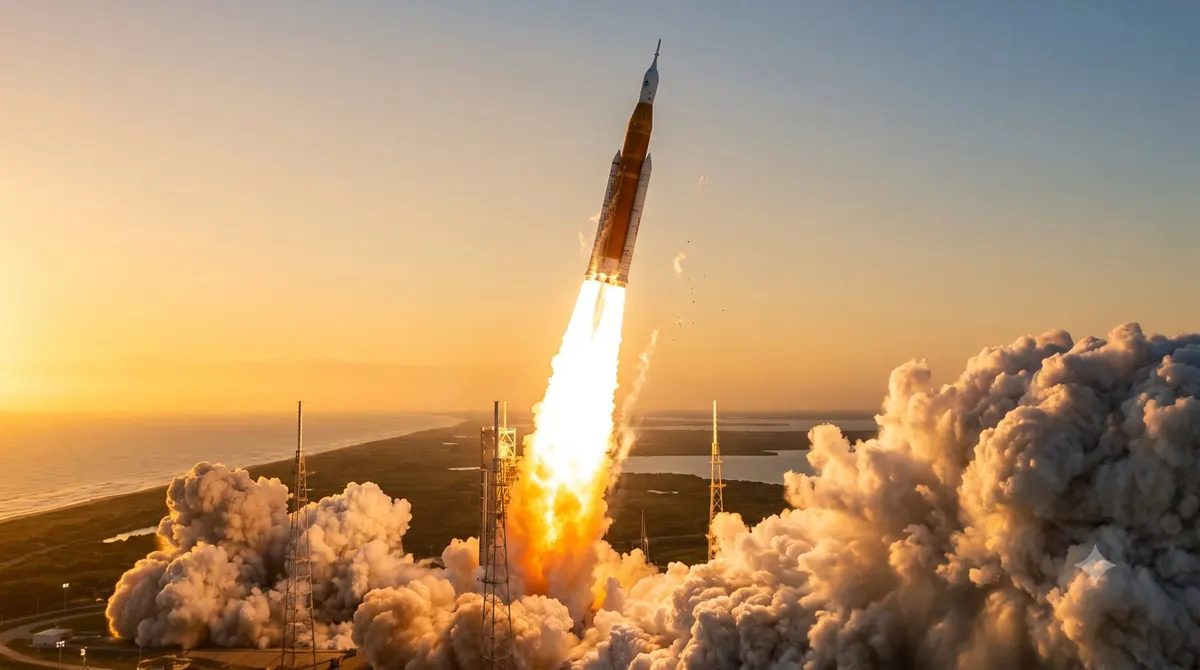
There are few sights more thrilling than a rocket launch. The ground trembles, a column of flame erupts, and a machine heavier than a hundred cars climbs slowly, then swiftly, into the sky and beyond. It looks like magic, or like brute force overwhelming gravity. But a rocket is not magic, and it is not really pushing against the ground or the air. The principle that lifts it is beautifully simple, and once you grasp it, the whole business of spaceflight starts to make sense.
The Law That Makes It Work
Every rocket runs on a single rule of physics, often summed up as: for every action, there is an equal and opposite reaction. It sounds abstract, so picture something ordinary. Blow up a balloon and let it go without tying the neck. It zips wildly around the room. Why? The air rushes out of the back, and as it does, the balloon is pushed forward. The air goes one way; the balloon goes the other.
Or imagine standing on a skateboard and throwing a heavy ball. As the ball flies forward, you roll backward. You pushed the ball, and the ball, in effect, pushed you. This is the whole secret of rocketry. A rocket throws something backward at tremendous speed, and in return it is shoved forward. There is nothing more mysterious to it than a balloon flying across a room, just scaled up enormously.
Throwing Fire Out the Back
What a rocket throws backward is hot gas. Inside the rocket, fuel is burned in a controlled, continuous explosion, producing a vast quantity of scorching gas at high pressure. This gas is funnelled out through a nozzle at the bottom, blasting downward at incredible speed. Just as the balloon shot forward when its air escaped, the rocket is driven upward as its exhaust roars out beneath it.
The force pushing the rocket up is called thrust, and it depends on throwing as much gas as possible, as fast as possible, out the back. That is why a rocket engine burns fuel at such a furious rate; the flames pouring from its base are the visible sign of all that mass being flung downward. The rocket is not resting on the flame like a stilt. It is being pushed up by the act of hurling that flame away.
Why Rockets Carry Their Own Air
Here is something many people find surprising. A rocket carries not only its fuel but also its own supply of oxygen. On Earth, when we burn anything, the burning uses oxygen from the surrounding air. A candle flame, a car engine, a campfire – all of them pull oxygen from the atmosphere without our noticing.
But a rocket is heading for space, where there is no air and therefore no oxygen to draw on. So it must bring its own. Rockets carry tanks of fuel and separate tanks of oxygen, mixing the two to keep the fire burning even in the vacuum of space. This is also why a rocket works in space at all. Some people assume a rocket needs air to push against, like a swimmer pushing off a wall. It does not. The rocket pushes against its own exhaust, so it flies just as well – in fact better – in the emptiness beyond the atmosphere.
The Tyranny of Weight
Getting to space is spectacularly hard, and the reason is weight. To lift a rocket you need fuel, but fuel is heavy, and that extra weight needs still more fuel to lift it, which adds yet more weight. This vicious circle means a rocket must be mostly fuel. On a typical launch, the overwhelming majority of what stands on the pad is propellant, with only a tiny fraction at the very top being the actual cargo bound for space.
Engineers fight this problem with a clever trick called staging. Instead of building one giant rocket, they stack several smaller ones on top of each other. The bottom stage burns its fuel to get the whole stack moving, then, when empty, it drops away entirely. Why haul an empty fuel tank any higher? Freed of that dead weight, the next stage ignites and carries on, lighter and more efficient. A rocket sheds pieces of itself as it climbs, arriving in space as just a small remnant of the towering machine that left the ground.
Reaching Orbit, Not Just Height
There is one more idea worth clearing up. Reaching space is not really about going straight up. A rocket that simply rose high and stopped would fall right back down. To stay in space – to orbit the Earth – a spacecraft must travel sideways at astonishing speed, fast enough that as it falls toward the Earth, the ground curves away beneath it just as quickly.
In a sense, an orbiting spacecraft is perpetually falling, but moving forward so fast that it keeps missing the planet. That is what an orbit is: a permanent, graceful fall around the world. This is why rockets tip over and fly nearly sideways not long after launch. Gaining height is only the first half of the job; gaining tremendous sideways speed is the harder, more important half.
This also explains the odd weightlessness astronauts feel in orbit. People often assume there is no gravity up there, but gravity is still very much at work; it is what holds the spacecraft in its curving path. The astronauts float because they and their ship are falling together, at exactly the same rate, around the Earth. It is the same sensation you feel for a split second at the top of a roller coaster drop, stretched out into hours and days. Far from escaping gravity, an orbiting crew is riding it, endlessly falling around the world without ever hitting the ground.
So the flaming spectacle of a launch comes down to something you could demonstrate with a balloon and a skateboard. Throw mass backward, get pushed forward. Everything else – the self-supplied oxygen, the dropped stages, the sideways sprint into orbit – is engineering built on that one clean idea. The next time you see a rocket rise on its pillar of fire, remember that it is not fighting the air or leaning on the flame. It is simply hurling hot gas downward with such fury that the whole magnificent machine is flung toward the stars.