Talking Science Podcast
Jupiter and Its Ocean Moons
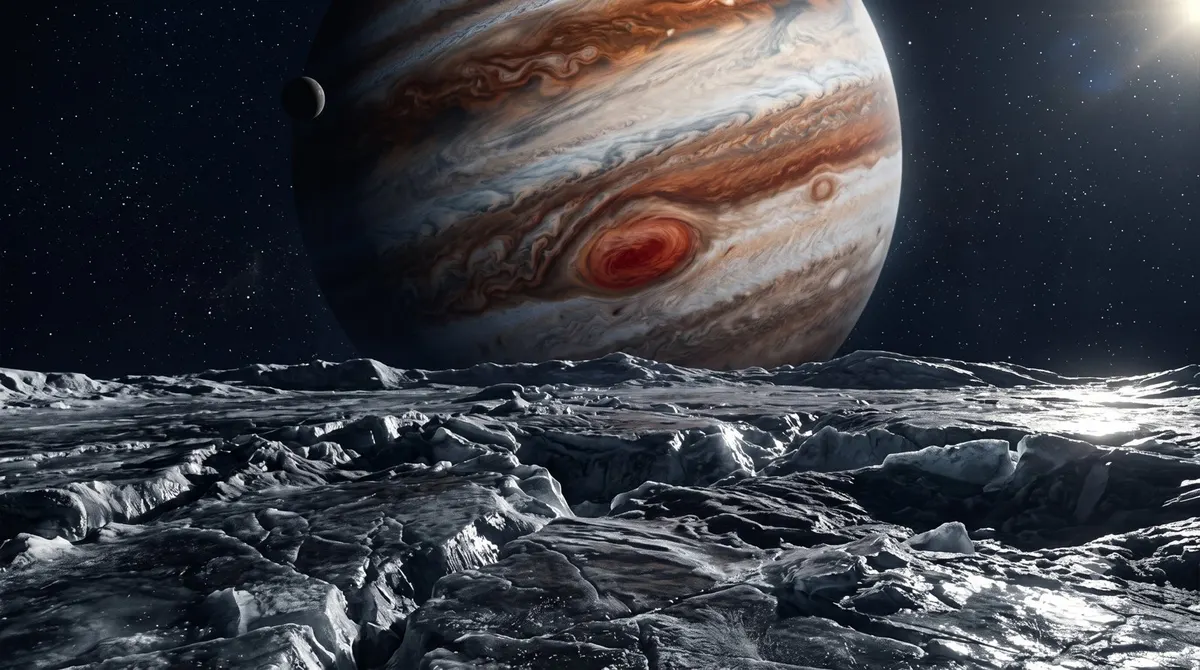
Jupiter is the giant of our Solar System, a planet so massive that all the others could fit inside it with room to spare. It is a world of ferocious storms and crushing gravity, a place utterly unlike Earth. Yet for all its own grandeur, some of the most exciting discoveries about Jupiter are not about the planet at all. They are about its moons – and the possibility that beneath their frozen surfaces lie hidden oceans of liquid water, warm and dark and possibly not entirely dead.
A planet made of gas
Jupiter is what astronomers call a gas giant. Unlike Earth, it has no solid surface you could stand on. It is composed mostly of hydrogen and helium – the same lightweight elements that make up the Sun – and as you descend into it the gas simply grows thicker and hotter and denser until it behaves in ways no gas on Earth ever does. There is no clear boundary where atmosphere ends and planet begins. If you tried to land on Jupiter, there would be nothing to land on; you would just sink deeper into an ever more hostile abyss.
The planet’s most famous feature is the Great Red Spot, a colossal storm larger than the entire Earth that has been churning for centuries. Jupiter spins remarkably fast for its size, completing a day in about ten hours, and that rapid rotation smears its clouds into the striking bands of cream, orange, and brown that give the planet its distinctive striped appearance.
The moon that started a revolution
Jupiter is orbited by a large family of moons, dozens upon dozens of them. Four are large enough and bright enough to be seen with a simple telescope, and their discovery centuries ago carried a profound message. Here were objects plainly circling something other than the Earth – direct evidence that our world was not the fixed centre of everything. Those four large moons remain the stars of the show today, and two of them in particular have become prime targets in the search for life beyond Earth.
Oceans under ice
The great surprise of Jupiter’s moons is water. One of them, an ice-covered world roughly the size of our own Moon, has a surface of cracked and refrozen ice that looks like a frozen sea heaved and split apart. Beneath that shell, the evidence strongly suggests, lies a global ocean of liquid salt water – possibly containing more water than all of Earth’s oceans combined. Another large moon, the biggest in the entire Solar System, appears to hide a similar buried ocean, sandwiched between layers of ice deep below its surface.
This raises an obvious puzzle. These moons sit far from the Sun, where sunlight is faint and temperatures are brutally cold. Their surfaces are frozen solid. So how can there be liquid water underneath? The answer lies not in sunlight but in squeezing.
Warmth from a gravitational tug-of-war
The source of heat is Jupiter itself. The giant planet’s gravity is immense, and as these moons orbit, they are pulled and stretched by it – and by the gravity of the neighbouring moons too. Because their orbits are not perfectly circular, the strength of that pull rises and falls as they travel around, so each moon is constantly being flexed, squeezed and released. This flexing generates heat inside the moon through friction, in the same way that bending a paperclip back and forth quickly makes it warm. Scientists call this tidal heating.
The effect is powerful. On one of Jupiter’s inner moons, tidal heating is so extreme that the surface is covered in erupting volcanoes, making it the most volcanically active body known. On the icy moons, the same heating is gentler, but it is apparently enough to keep an ocean liquid beneath the frozen crust, warmed from within rather than from the distant Sun.
What makes this arrangement so elegant is that it does not depend on the Sun at all. For a long time, the region around a star where liquid water could exist was thought of as a narrow band at just the right distance – close enough to be warm, far enough not to boil away. Jupiter’s moons quietly broke that rule. Here are worlds far outside any comfortable zone, kept liquid inside by nothing more than the relentless gravitational kneading of their giant neighbour. It suggests that liquid water in the universe may be far more common than we once assumed, tucked away inside frozen moons in the cold outer reaches of countless planetary systems.
Why oceans mean the search for life
An ocean of liquid water, kept warm by internal heat, is exactly the kind of environment that makes biologists sit up. On Earth, some of the most surprising life is found in the deep ocean, clustered around volcanic vents on the seafloor where hot, mineral-rich water pours out into the cold dark. No sunlight reaches these places, yet whole ecosystems thrive there, drawing their energy from chemistry instead of light.
If life can flourish in the black depths of Earth’s oceans without sunlight, then a warm, salty, mineral-rich ocean beneath the ice of a Jovian moon is at least worth taking seriously. To be clear, no life has been found there, and none may exist. But the ingredients that life seems to need – liquid water, energy, and the right chemistry – may all be present. That combination is rare and precious, and it is why missions are being sent to study these moons up close, peering through the ice for clues about the seas below.
A giant worth revisiting
Jupiter, then, is a world of contradictions. The planet itself is a place of unimaginable violence, a swirling ball of gas where nothing could survive. Yet circling it are quiet, frozen moons that may hold some of the most promising real estate for life anywhere beyond our own planet. It is a reminder that in space, the headline act is not always the most interesting part of the show. Sometimes the real story is hiding in the supporting cast – in this case, beneath a shell of ancient ice, in oceans no one has ever seen.